Chris Ashton once ran a business from a bathroom. The bathtub held the files. It is a useful detail to keep in mind when looking at the later photographs: the airy offices, the corporate awards, the dogs apparently enjoying better workplace privileges than most humans. Before all that, there was a small Philadelphia apartment and a married couple trying to make the sums work.
After graduating from Wharton in 2003, Chris and Natasha Ashton set about building the company that became Petplan in North America, now known as Fetch Pet Insurance. Their first financing was personal enough to come with a monthly statement. Chris later joked that Visa and MasterCard were their first investors. The joke works because it leaves the inconvenience intact. Credit cards are admirably prompt about reminding you that enthusiasm has a due date.
The bathroom makes a neat opening image, but the more interesting story concerns what happened when the company no longer fitted inside it. Ashton had to learn how to introduce an unfamiliar purchase, how to build an organization around animals without making it frivolous, and how to give other people room to do the work.
“Our first ‘investors’ were our Visa and our MasterCard.”
Chris Ashton, 2013
A green beret before the business cards
Ashton arrived at entrepreneurship by a route that included Oxford and the Royal Marines. He read geography at St Edmund Hall, then completed Royal Marines Young Officer training, earning his green beret in 1995. His service included work as a troop commander and unit training officer. In 2001, he and Natasha moved to the United States to study at Wharton. Both completed their MBAs in 2003.
Those are substantial changes of setting: university, military service, another country, business school. They also discourage the tidy idea that founders must spend their entire lives rehearsing for one company. A geography degree did not dictate pet insurance. A green beret did not dictate a Philadelphia bathroom. The sequence left room for a business that emerged after the couple moved.
It would be tempting to credit every later management decision to military training. The chronology alone cannot establish that. His public comments about running Petplan are more practical: watch costs, prepare the operation before advertising, and let employees contribute ideas. Those habits deserve attention on their own terms. They show what he chose to emphasize when explaining his business to other people.
America needed the explanation first
Petplan faced a sales problem with an extra step. Many American customers needed an explanation of the category before they could compare companies within it. In Britain, the Ashtons knew a more established market. In the United States, the opportunity came attached to a considerable amount of teaching.
Chris used the example of opening a coffee shop. Customers already understand coffee; a new café can move straight to explaining its particular appeal. Pet insurance required a longer conversation about the product itself. That observation helps explain why the couple launched a print magazine, Fetch!, alongside the insurance business. They were finding ways to have a conversation before asking for a purchase.
A magazine is an intriguing accessory for an insurance company. It has room for curiosity, recurring characters and a reason to return. It also costs money and takes work. The choice suggests how much attention the founders gave to reaching people in a form they would voluntarily spend time with. The business needed customers to learn something new without feeling they had been assigned homework.
The launch that left fifty things undone
Ashton was equally candid about the company’s website. In a 2011 guide to building a digital presence, he recalled going live while already knowing dozens of things the team wanted to change. Waiting until every desired feature was included, he said, would have prevented the launch altogether. The site and the online magazine had also developed unevenly, leaving the team with improvements to make.
This is a less polished founding memory than the usual account of a perfectly timed debut. It is also easier to recognize. A useful website acquires new demands as people use it. An idea that looks complete in a meeting can become incomplete the moment a customer arrives. Ashton’s account allows for that uncomfortable interval between putting something into the world and making it better.
The same guide recorded a 2,100 percent increase in company revenue over the three years after the website launched in 2006. The number describes the business during that period; it does not establish that the website alone caused the growth. The revealing detail is the willingness to launch while the next list of jobs was already waiting.
Lunch survived. Waste did not.
In 2009, Ashton described a company that watched small expenses while providing free lunches for employees. Paper and printer cartridges were places to save; feeding the team was a place to spend. Frugality, in his telling, involved choosing where the money went. The distinction matters in an office, where an indiscriminate saving can be felt much more sharply than it appears on a spreadsheet.
He had attended business school after the dot-com crash and paid attention to the stories of money spent without a viable business underneath it. Petplan was preparing to try national television advertising, but he emphasized the need for enough people and processes to handle the response. Buying attention before being able to answer it would waste the opportunity.
There is a modest pleasure in this account of management. Printer cartridges seldom make the commemorative photograph. Yet a founder discussing them is revealing how he expects the company to behave when nobody is handing out an award. The lunch table and the supply cupboard belong to the same budget. Someone has to decide which one should feel the squeeze.
A bigger office, with four-legged conditions
By September 2013, Petplan was preparing to move with 90 employees from premises near Philadelphia International Airport to Newtown Square. The existing building lacked space for further expansion. Ashton also welcomed the grounds at the new location, where the founders’ dogs could run around. A relocation decision had acquired a constituency unlikely to attend the property meeting.
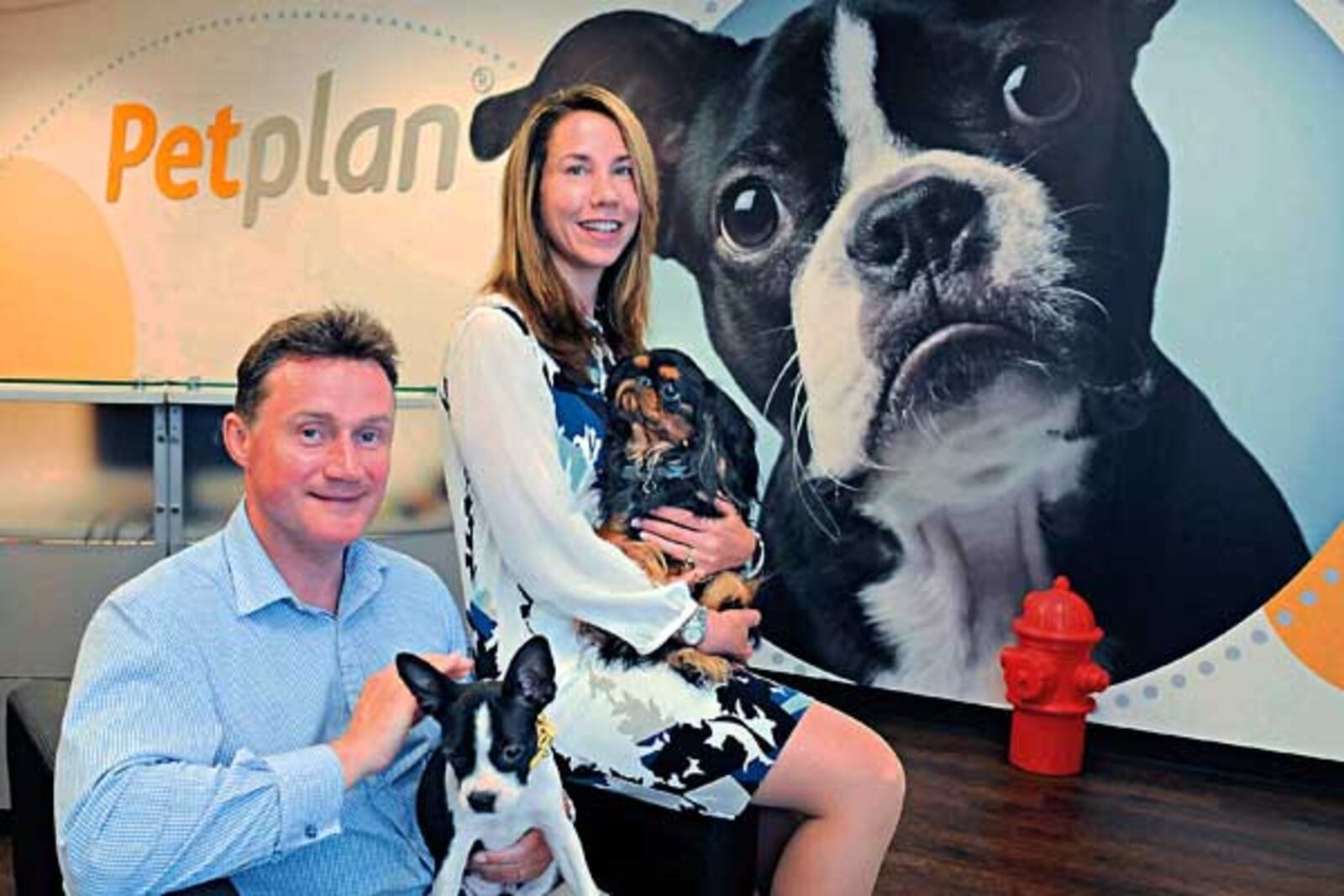
A 2014 office photograph captures Chris holding Reggie and Natasha holding Montgomery. A much larger dog looks out from the wall behind them. The image is cheerfully literal: the people running the company have brought the subject of the company into the frame. It is an office photograph with enough ears for a small committee.
The arrangement required more than a fondness for dogs. Ashton said finding suitable premises had been difficult because many properties would not allow them. Petplan secured permission at its new headquarters. An office policy becomes more convincing when it affects the choice of office itself. Here, bringing pets to work was a condition the founders carried into the move.
When everyone can no longer fit in the room
Growth brought a problem less photogenic than dogs at desks. The business reached $18.7 million in revenue in 2010 and entered the Inc. 500 at number 123 in 2011. A larger organization could no longer depend on the founders being involved in every corner of it.
Ashton described hiring for both experience and temperament, encouraging employees to offer ideas, and using internal discussion boards to keep conversations moving across the business. He also wanted a sense of fun. “We want people who believe that pets are fun,” he said. It was a hiring criterion with rather more personality than proficiency in a spreadsheet.
The underlying question is familiar to anyone who has watched a small team grow. How do you preserve the ease of a conversation when there are too many people for one conversation? Ashton’s answer involved channels for participation and public recognition of useful ideas. The founders could keep paying attention while allowing more of the answers to come from elsewhere.
The company gets a chapter of its own
Recognition followed the expansion. In 2013, Chris and Natasha received an Ernst & Young Entrepreneur of the Year award in the Greater Philadelphia region. Petplan appeared on Forbes’ America’s Most Promising Companies list in consecutive years. The enterprise that had occupied their bathroom was now being considered alongside other growing businesses.
In October 2019, Warburg Pincus announced its acquisition of Petplan. The announcement described a company serving more than 200,000 customers across the United States and Canada, with Paul Guyardo as CEO. It did not disclose the financial terms. The scale is clear without translating a corporate transaction into a guess about a founder’s personal fortune.
The company subsequently adopted the Fetch name, launching as Fetch by The Dodo in 2022. That change belongs to its later chapter. Chris’s place in the story is as co-founder and former co-CEO. Keeping the titles in their proper time makes the achievement more intelligible: he helped build a business that continued under other leadership, rather than remaining permanently dependent on his name.
Back to Oxford, onward to other questions
Ashton’s more recent public record brings him back to institutions and ideas beyond Petplan. His LinkedIn profile lists a Wharton certificate in Leading an AI-Powered Future, issued in February 2025, and election as a St Edmund Fellow in October that year. Natasha was also elected a Fellow. The return to Oxford was something the couple could share.
St Edmund Hall’s biography records travel with their two sons since selling Fetch and identifies Chris as a board member of Bobi, a venture working on car purchasing and finance with AI. A March 2026 Venture Lab listing also placed the Ashtons together in virtual sessions for entrepreneurs. These are separate activities, with a connection to the work of advising and exploring new businesses.
The bathroom is now a long way behind him. Still, its files offer a better closing image than a trophy cabinet. They belong to the stretch of the story when an idea had become work but had yet to become an institution. Ashton’s brief piece of business advice remains apt: “Hope is not a plan.” A plan, it seems, may initially require somewhere unexpected to put the paperwork.