Drive far enough up a two-lane road in Ashe or Watauga County and the coverage bars on most phones start to flicker out. For 35 years, one carrier bet its business on the parts of the map where that happened. Carolina West Wireless, run out of Wilkesboro, North Carolina, built cell sites on ridgelines that the national carriers looked at and decided were not worth the concrete. That bet is what made it useful. It is also, in the end, what made it hard to keep running.
In June 2026 the company said it had agreed to transition its wireless network to Verizon and would shut off its own service on September 30, 2026 - roughly 35 years after two rural telephone cooperatives started it. The deal terms were not disclosed. What the ending makes clear is the thing the company spent decades quietly proving: covering a mountain is expensive, and the money that made it possible does not stay put.
01 / What it actually didThe only signal on the ridge
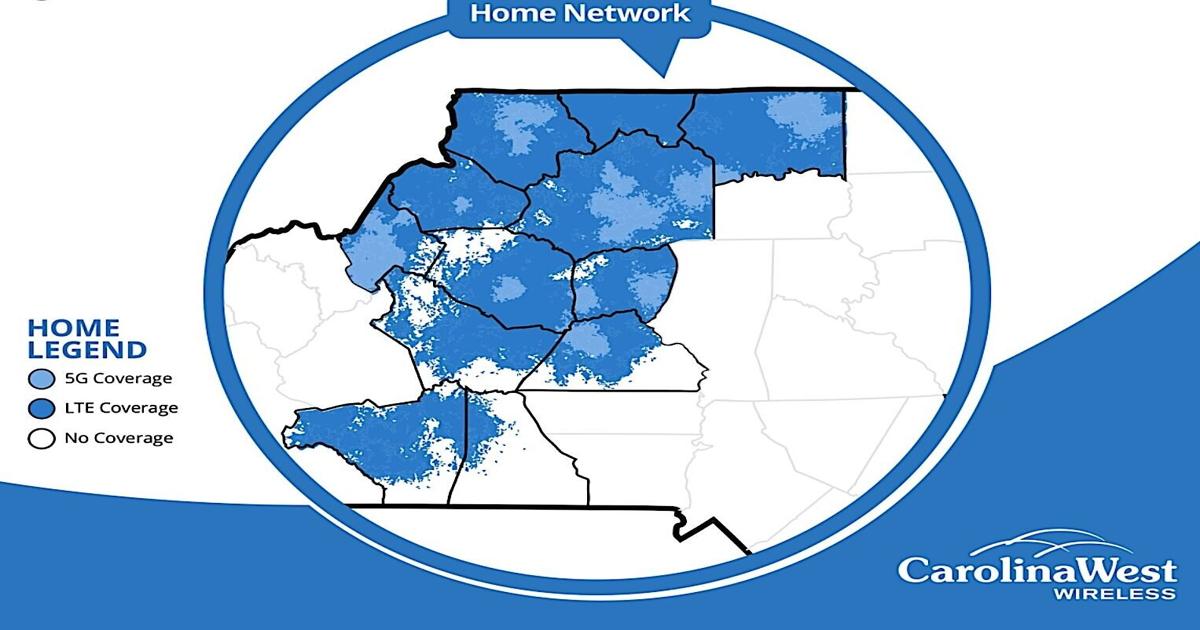
Carolina West Wireless was a regional wireless carrier - the same broad category as Verizon, AT&T and T-Mobile, at roughly one ten-thousandth of the size. Its footprint covered about 0.02% of the United States by area. Nationally that is a rounding error. Locally it was the difference between a call connecting and not, because across parts of its territory it was the sole mobile provider. The network carried thousands of 911 calls a year and backstopped telehealth appointments in places where the nearest hospital is a long drive of switchbacks away.
The company frames its own history simply: it went "from bag phones to iPhones." It started in 1991 as a joint venture between two rural telephone membership cooperatives, Skyline Telephone and Surry Telephone - a phone-co-op side project that grew into a carrier serving the North Carolina High Country: Watauga, Ashe, Wilkes, Surry and the counties around them.
"Carolina West Wireless has been a trusted staple in western North Carolina for decades."
- Jerome Cheatham, East Area President, Verizon02 / Who bought itCustomers, and their businesses
On the consumer side, the pitch was ordinary and that was the point: 5G and 4G LTE plans, unlimited data, national roaming so a mountain customer was not stranded when they drove to Charlotte, the latest phones, trade-in deals and hotspots. It sold the same things a national carrier sells, staffed by people who lived in the same counties as the buyers. The company recently leaned into niches too - a dual-branded store model with kid-safe carrier Bark Mobile, and a collaboration to bring the Xplora children's smartwatch to customers.
The more interesting half of the catalog was business connectivity - the unglamorous services a rural carrier can sell precisely because it owns the local network:
None of it is flashy. All of it is sticky. A hardware store owner in Sparta who runs cameras, a pipe sensor and a truck tracker on one local carrier does not switch on a whim. That is the quiet moat a regional carrier builds when it stops thinking of itself as only a phone company.
03 / How it was differentLocal as a strategy, not a slogan
Carolina West never tried to beat the national carriers on price or on nationwide scale - it could not. It competed on two things the big three struggle to fake: coverage in specific hollows and ridgelines the nationals underbuilt, and a retail-and-support presence run by locals. Over 35 years it poured money into event sponsorships, nonprofit fundraisers and public schools through a program it called Communication4Education. The Boone Area Chamber called it "a shining example of how businesses can positively impact the community." Banners at the local ballgame are not charity when your product is trust; they are distribution.
"The communications marketplace is losing rural and regional competitors at too rapid a pace."
- Tim Donovan, Competitive Carriers Association04 / What it costThe subsidy that walked away
Here is the part a reader can actually learn from. Building towers on mountains is a capital sink, and the business case only ever worked with help. In 2012 Carolina West won roughly $20.8 million in FCC Mobility Fund Phase I support to extend rural coverage. Many of its towers exist because of that money. But federal Universal Service Fund support for its high-cost network then slid year after year - from about $3.1 million in 2014 to roughly $690,000. A promised Mobility Fund Phase II never materialized. By 2024 the company was warning the FCC that towers could be decommissioned without more support.
Federal support for the network, per year
A roughly 78% drop in the money that made high-cost rural towers viable. When the subsidy shrinks but the mountain does not, something has to give.
That is the mind-changer. A carrier can love its communities and still run the numbers. When the support that underwrote the towers fell by roughly three-quarters, while national carriers kept expanding and the cost of running ~300 sites did not, independent operation stopped penciling out. The company said the decision "was made with the future of our customers and communities at the forefront." Read plainly: the economics of covering a mountain caught up with it.
05 / The handoffSpectrum, towers, and a $150 goodbye
Under the June 2026 agreement, Verizon takes over Carolina West's network - a substantial stack of spectrum across low, mid and high bands and the roughly 300 towers behind it. Because a spectrum transfer of this kind needs FCC review under the public-interest standard, the deal put a small mountain carrier in front of the federal regulator one last time. For customers, the mechanics were blunt: number port-outs opened July 1, 2026, service ends September 30, and Verizon dangled a switch-early incentive - a $150 Mastercard gift card per line and no activation fee for customers who moved before July 30. The company pledged severance and career-transition help for employees.
"This decision was made with the future of our customers and communities at the forefront."
- Slayton Stewart, CEO, Carolina West Wireless (as reported)06 / Where it fitsA casualty list that keeps growing
Carolina West's exit is not an isolated event. Regional and rural carriers have been folding into national networks for years, and trade groups have warned that competition in rural wireless is eroding. The lesson for anyone building in a capital-heavy market the giants ignore is double-edged: being the only provider in a geography is a real moat, and it is also a real dependency. If your unit economics lean on a subsidy or a single funding program, your business plan is partly written by whoever controls that program. When the check shrinks, the moat can turn into a liability faster than customer loyalty can offset it.
Would the playbook work somewhere else? Sometimes. In a rural market with stable high-cost support, dense local retail and a sticky B2B layer - internet backup, sensors, cameras, fleet tracking - a regional carrier can hold ground the nationals do not fight hard for. Where it breaks is exactly where Carolina West broke: when the subsidy that justified the infrastructure is withdrawn faster than the customer base can grow, and a national buyer can absorb the spectrum more cheaply than you can keep the lights on.
07 / The arcThirty-five years, in six beats
For 35 years, a small company in Wilkesboro answered a question the industry mostly avoids: who pays to put bars on a ridge that a spreadsheet says to skip? Its answer was a mix of local loyalty, sticky business services, and federal support - and when one of those legs gave way, the whole stool tipped toward a buyer big enough to carry it. The signal stays on. The name comes down. And the map it drew of who gets covered, and why, is worth keeping.