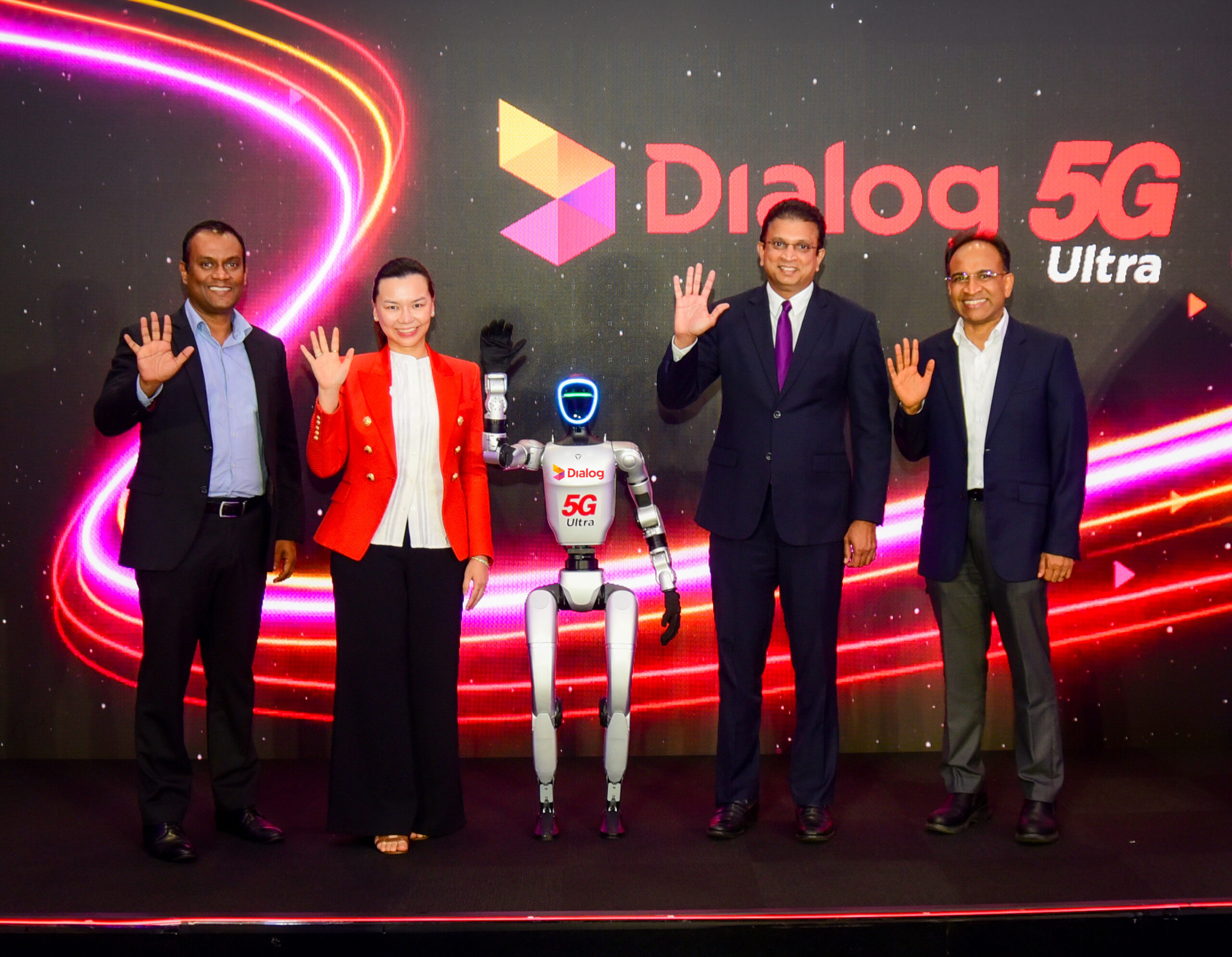
At Dialog’s commercial 5G launch, the executives had company: NOVA, a humanoid robot, stood in the lineup, one mechanical hand raised for the photograph. It was a cheerful piece of theatre for a business whose everyday work is considerably less theatrical. Customers want the video call to hold, the television to work and the data balance to survive until payday.
Dialog Axiata has built its proposition around more of those everyday needs. The Sri Lankan group sells mobile service, home broadband and pay television, then follows the connection into business software, cloud services and payments. A phone number can be the beginning of a much longer commercial relationship. The interesting question is how much of that relationship an operator can usefully serve.
Its answer now includes an acquired rival and a new generation of radio equipment. Dialog absorbed Airtel Lanka in 2024 and launched commercial 5G in December 2025. The logic is straightforward: combine infrastructure where possible, expand what the network can do, and give existing customers more reasons to spend. Executing that logic requires rather more than a good launch photograph.
01The fourth arrival bought another seat at the table
Dialog began as MTN Networks, incorporated in 1993 with Telekom Malaysia and Capital Maharaja as its original corporate backers. Commercial operations followed in 1995 under the Dialog GSM brand. It entered a market with three mobile operators already established. Hans Wijayasuriya, who joined the founding management team in 1994, became chief executive in 1997 and served through 2016.
That history matters because today’s broad operator was once the challenger. Its subsequent growth produced a company listed on the Colombo Stock Exchange, with the regional Axiata group as controlling shareholder. The consumer name survived changes in corporate identity and an expanding collection of services. A familiar brand became useful shelf space for the next product.
The Airtel transaction made the strategy tangible. Dialog acquired all of Airtel Lanka through a share swap in June 2024. Bharti Airtel received 10.355% of the enlarged Dialog equity; Axiata’s holding became 73.75%. Dialog welcomed three million Airtel subscribers. This was an exchange of ownership, with dilution for existing shareholders, rather than a disclosed all-cash purchase price.
Legal amalgamation followed on August 30. Dialog said both brands would continue serving their customers as the networks consolidated. The distinction is useful: a customer-facing brand can remain while the expensive machinery underneath is combined. Axiata’s 2025 reporting subsequently described completion of the Airtel core-network merger and a reduction in Dialog’s data centres from nine to four.
02The household is the market
The product menu starts with familiar decisions: prepaid or postpaid mobile, a broadband connection for home, a television package. MyDialog gives customers a place to manage their connections. For households, the practical attraction is having several routine services within reach of a provider they already know. For Dialog, each additional service creates another recurring source of revenue.
Prepaid recharges turn small purchases into continuing demand. Postpaid and television subscriptions bring monthly bills. Add-ons let customers buy extra capacity or access tailored to particular applications. Devices and roaming broaden the menu again. The business depends on repeated use, which is why the quality of an ordinary evening online matters as much as an impressive demonstration.
The details deserve reading. One published home-broadband add-on offers 40GB for selected social platforms over 30 days at Rs 590 including taxes. Its terms say content subscriptions are separate. Dialog’s Fun Blaster mobile page also specifies a 1Mbps video limit and 360p quality for certain plans. “Unlimited” describes one part of a package; it does not erase the rest of the terms.
That is a useful buying habit to copy: compare the applications covered, the expiry period, speed restrictions and ordinary data allowance together. Someone watching approved social video has a different requirement from someone uploading work files. A cheap-looking bundle can be the wrong purchase without anything being wrong with the network itself. The same exercise helps a business buyer: specify the work to be done first, then ask which service and allowance support it. Starting with the advertised package name reverses that order.
035G has to get past the front door
Dialog’s December 2025 launch announcement described more than 220 live 5G sites and a commitment to invest US$100 million over the following two years. It had secured spectrum in the 3500MHz and 27GHz bands. By March 2026, it reported more than 800 live sites across 24 districts; its first-half results subsequently put the footprint above 1,000.
Air Fibre, introduced in the second quarter of 2026, gives that expansion a household job. Despite the name, it uses 5G to deliver Wi-Fi without a fixed line. A plug-and-play connection offers another route into a home where a wired installation is inconvenient or unavailable. The service turns mobile-network investment into a competitor for fixed broadband spending.
The commercial comparison is local. SLT-Mobitel offers wired fibre as well as mobile connectivity, while Hutch is another mobile alternative. Dialog’s breadth and combined infrastructure give it multiple ways to serve a customer, but they do not settle which connection works best at a particular address. Equipment compatibility, signal conditions and the actual package still decide the experience.
Dialog demonstrated 6.2Gbps on a Samsung Galaxy S25 Ultra with Huawei in April 2025. That was a technology demonstration, not a household speed guarantee. Buyers should treat a trial result as evidence of capability and assess the service they can actually order. A family purchasing Wi-Fi needs dependable performance where the router sits, not a record achieved somewhere else.
04The less glamorous customer: a cold room
Businesses give Dialog another route beyond selling gigabytes. Its enterprise catalogue includes cloud and colocation, communications, cybersecurity and connected-device services. The IoT list is pleasingly specific: vehicle tracking, generator monitoring, server-room monitoring and cold-room temperature monitoring. These products connect a telecom contract to a task a business already needs to perform.
A fleet manager wants to know where vehicles are. A cold-store operator wants temperature visibility. A business hosting applications needs connectivity and computing resources that fit together. Dialog can offer several pieces of that arrangement, drawing on its network operations and partnerships. Its cloud business received VMware sovereign-cloud recognition in 2023, adding a local-hosting proposition to the sales conversation.
For smaller companies, Dialog Enterprise Marketplace advertises more than 100 digital solutions, most using pay-as-you-use pricing. Offerings include HR tools and a mobile-based call-centre service. The distribution idea is the interesting part: give firms self-service access and use an operator’s billing capability to make buying software less cumbersome. The buyer still needs a useful tool, manageable recurring costs and a clear implementation plan.
05The rupee wrote its own business plan
Network expansion has a cost before the next customer pays. Sri Lanka’s 2022 crisis exposed that imbalance sharply. Dialog’s accounts recorded roughly Rs 30.3 billion in net foreign-exchange losses and a group loss after tax of about Rs 33.4 billion. Revenue growth could not insulate the business from the financial consequences of a weakening currency.
The pressure reached operations too. The company’s interim reporting described power cuts, fuel shortages, inflation and higher interest rates. A telecom operator needs imported equipment and reliable energy while many customers pay in local currency. That mismatch helps explain why financial management belongs in the same conversation as radio coverage. More traffic does not automatically solve a dollar liability.
In July 2022, IFC announced a loan package of up to US$150 million. Its project disclosure covered refinancing and capital expenditure, including 4G equipment, fibre and core-network upgrades. Access to long-term institutional financing helped support the investment programme during an unusually difficult period. It was debt with obligations attached, not a venture round or evidence that infrastructure had become inexpensive.
The more recent figures show a different operating position. In the first half of 2026, Dialog reported Rs 95.5 billion in revenue, Rs 19.3 billion in net profit and Rs 18.5 billion in capital expenditure. Its profit explanation included stronger operating earnings, lower financing costs and currency gains, with forward contracts playing a role. The financial weather still matters.
Infrastructure gets paid for before the next subscriber signs up.
06The next transaction starts with a phone number
Payments extend the same customer relationship in another direction. Dialog Pay brings payments and financial services into MyDialog. In September 2026, Dialog announced a Ria Money Transfer partnership allowing overseas senders to transfer money directly into eligible eZ Cash wallets associated with Dialog or Airtel numbers. A connection used for communication becomes a destination for money from abroad.
International connectivity is expanding too. On September 7, Dialog reported 5G roaming across 100 destinations through 200 partner networks. Chief operating officer Lim Li San framed the expansion around continuity for travelling customers. That fits the broader business: keep finding places where an existing customer relationship can solve another practical problem.
That ambition also puts demands on the organisation. Dialog describes performance-based career development and an emphasis on values and ethics. A more concrete example is its joint Enabler programme with MAS Holdings: in 2024, fourteen participants with disabilities gained workplace exposure across the two employers. Inclusion here involved time inside offices and operating sites, followed by participants’ recommendations.
The transferable lesson is to build adjacent services around capabilities already earned: distribution, billing, customer support and operating infrastructure. It requires capital, permission to operate and products customers actually need. Without adequate coverage, affordable equipment or dependable service, adding another bundle will accomplish little. Dialog’s next sale ultimately depends on whether the last connection did its job.
“As our customers travel, we want their digital experience to move with them.”
Lim Li San · Group Chief Operating Officer
7 September 2026
Keep the connection going
Explore the products, follow the company or watch the network launch.