A new telecom name fits on a shop sign. A mobile network takes years to build. Yas Madagascar’s most revealing number is therefore older than Yas itself: $100 million, the investment Telma announced for a network expansion covering 2019 to 2023. The yellow-and-blue branding arrived later. By then, customers in two Malagasy cities had already been offered commercial 5G.
That sequence helps explain the company. Yas sells mobile calls, data, household internet and business connectivity in Madagascar, where its own About page reports 10 million subscribers. Behind the retail offers sits an infrastructure business with a much longer memory. Behind that sits AXIAN Telecom, whose regional ambitions turned the familiar Telma name into Yas in November 2024.
The interesting question is what all this machinery buys the person holding the phone. A video call that stays connected? A payment made without a bank visit? A household subscription that fits the budget? Those are more demanding tests than whether the new name looks good on a router.
The $100 million came first
AXIAN’s corporate history places its acquisition of Telma in 2004. The business it developed subsequently linked mobile service with fixed networks and international infrastructure. By its 2015-2016 corporate review, Telma was describing more than $400 million invested across mobile, national fibre and the EASSy submarine cable. That was the company’s historical account of spending across several assets, not the price of a single launch.
The next big commitment was more specific. Telma’s 2019 review set out $100 million of investment for 2019-2023, with an Ericsson agreement intended to add more than 700 mobile sites. The plan connected 4G expansion with preparation for 5G. Treat that figure as an announced investment programme, rather than a final audited bill or a funding round. Its significance is the decision to expand capacity before the later branding exercise.
Announced network investment.
More than 700 new mobile sites planned.
On June 26, 2020, Telma’s commercial 5G network went live in Antananarivo and Toamasina. Ericsson identified two immediate uses: faster mobile broadband and fixed wireless access, which brings an internet connection to premises over a radio link. The launch therefore had a household and business application beyond a faster handset. It also put Madagascar among Africa’s early commercial 5G markets.
The work continued after the announcement. In January 2024, Ericsson described modernization of the radio network, microwave transport and core systems. Those components handle different parts of a connection’s journey. Updating them together is a reminder that an impressive radio at the edge cannot compensate for every bottleneck further inside the network.
One island, several ways to get online
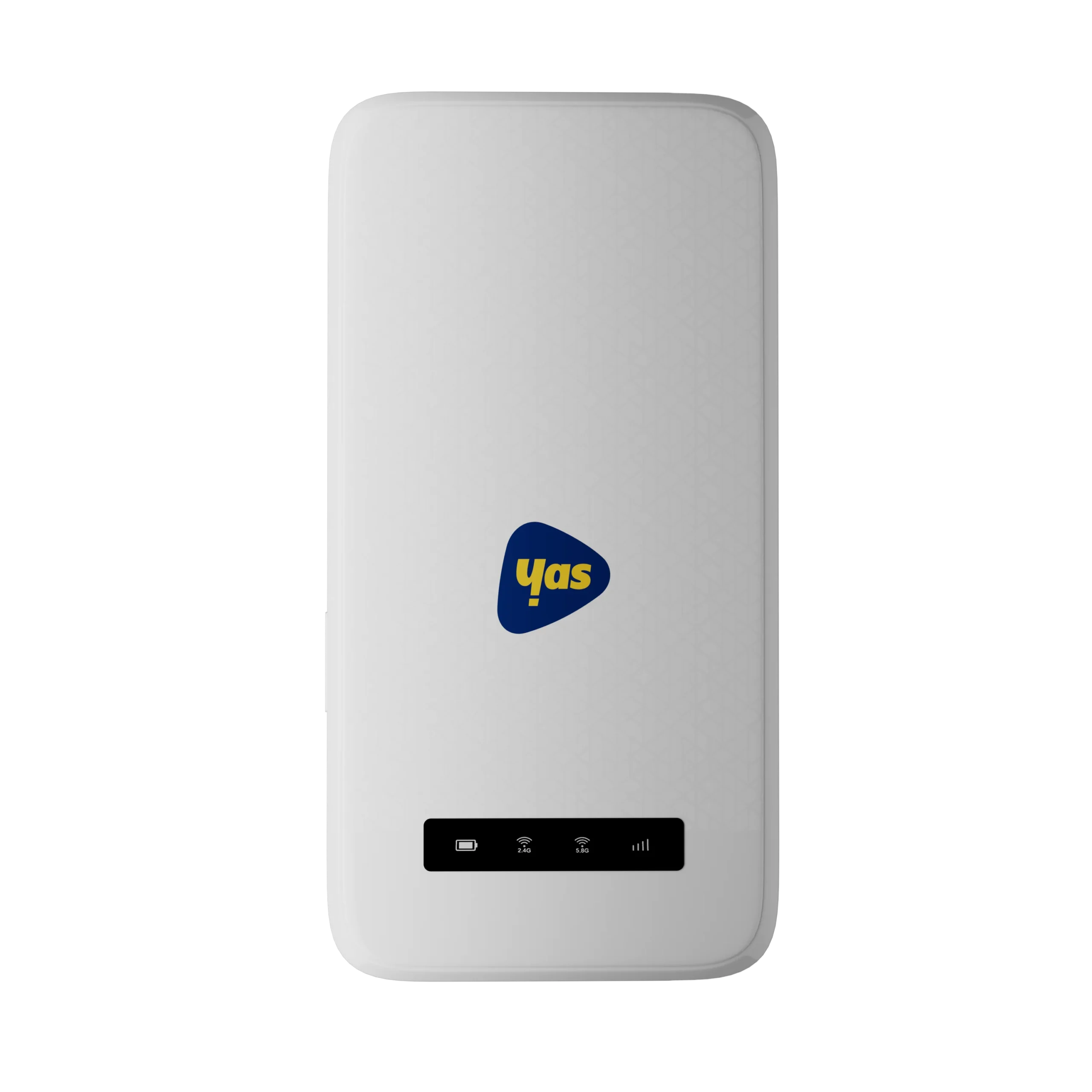
Yas’s catalogue runs from prepaid mobile bundles to home fibre, smartphones and portable internet devices. A person who mainly messages on a phone needs a different purchase from a family streaming at home. A business connecting staff and offices has another set of requirements. Yas’s breadth lets it pursue all three, although the right choice still depends on the location and the job.

The business catalogue separates smaller firms, large enterprises, government and NGOs, and wholesale customers. That is a useful clue to its commercial model: recurring connectivity sold at different scales, supplemented by devices and service contracts. Consumer subscriptions bring repeat purchases; organizations buy connectivity around operational needs. A public agency, an office and a short-term mobile user need different support as well as different allowances.
Yas’s technical expertise lies in operating those connected layers. Its market position should not be reduced to a slogan about speed. Orange Madagascar offers mobile bundles and Airtel publishes competing data packages. The defensible comparison is more local: signal at the customer’s address, usable data for the price, support when something goes wrong, and the terms attached to the connection.
The price of staying connected
Start with an actual offer. Yas’s published Fibre IN subscription costs 49,000 ariary a month, carries a 100 GB fair-use threshold and specifies a 24-month contract. Installation is advertised as free. The monthly charge multiplied by the stated term is 1,176,000 ariary, assuming the tariff stays unchanged and excluding other charges. That arithmetic is more useful to a household than the word “fast.”
Monthly prices · 24-month contracts
Published offers checked September 9, 2026.
The next two fibre tiers list 69,000 and 99,000 ariary monthly, with fair-use thresholds of 250 GB and 400 GB respectively. Address eligibility comes first. So does understanding what happens after the threshold: it is a condition to clarify before signing, not a reason to assume endless full-speed use. Choosing a larger allowance makes sense only if the household needs it.
Mobile purchasing follows a different clock. The Net Week 10000 offer lists 3 GB for 10,000 ariary, valid for seven days; Net Month 15000 lists 2.5 GB for 15,000 ariary, valid for 30 days. The cheaper weekly package has more data but a shorter life. Someone comparing only gigabytes could buy the wrong thing. Validity is part of what the customer pays for.
That is the practical way to approach Yas: check the place, then the device, then consumption and commitment. A mobile router can suit someone who needs a movable connection. Fibre can suit a fixed household with an eligible address. Neither label settles whether the offer fits a particular working day or monthly budget.
The phone is also a payment counter
Connectivity has another everyday companion in MVola. Launched in 2010, MVola obtained bank status in 2021 and offers transfers alongside savings, advances and insurance services. Its own website reports more than 10 million customers. That figure belongs to MVola, with its own definition and reporting context; it should not be added to Yas’s subscriber claim as though every account represents a different person.
The distinction between the brands matters. MVola S.A. is a separately regulated bank. Yas’s website sends customers to it, but a telecom subscription and a financial account remain different services. For the customer, their proximity makes the phone useful for more than conversation. For the wider business, payments and connectivity give people additional reasons to return.
It is a commercial relationship worth understanding without turning it into magic. A payment service must work at the moment money is needed. An internet bundle must last until its next purchase. Combining them in a customer’s daily routine creates convenience, while also making clear instructions and dependable support more consequential.
When the ocean interrupts
In May 2024, the vulnerable part of the experience was far from the handset. Failures affecting the EASSy and SEACOM submarine cable systems disrupted internet access across the region, including Madagascar. Local reporting described Telma reconfiguring traffic to make use of available capacity. On May 24, a follow-up reported service approaching normal after repairs, while stabilization continued.
The episode shows why mobile signal and working internet are different things. The link from a phone to a tower is only part of the route. International traffic must travel onward, and damaged cables can force it onto constrained alternatives. For a customer waiting on a file, that distant failure becomes a very local problem.
- 01Phone or router
- 02Local access network
- 03National transport
- 04International route
Simplified path for traffic to an overseas service. Each stage can constrain the experience.
For organizations, the lesson is to ask which dependencies a backup connection actually avoids. Two services that encounter the same upstream problem may offer less protection than their separate invoices suggest. The question belongs in a business connectivity conversation before an outage, alongside restoration arrangements and the cost of downtime.
A network that speaks Malagasy
Yas’s 2025 sustainability report describes RESAO, a Malagasy-language voice interface introduced that year for accessing digital services. The company says it is designed to accommodate accents and linguistic variation, including for customers with limited literacy or visual impairments. This is a different kind of network improvement: helping a person complete a purchase after the connection already exists.
There is continuity with Telma’s older ambition. Its 2019 corporate review stated the mission in French: “Faire de chaque Malagasy un citoyen du monde digital.” The aspiration was to make every Malagasy a citizen of the digital world. A spoken interface puts a specific product decision behind that broad language.
“Faire de chaque Malagasy un citoyen du monde digital.”
Telma’s stated mission, corporate review 2019
The same review described a move to the Telma campus, with employee wellbeing among its stated purposes. Together with today’s declared values of audacity, passion, innovation and commitment, that tells readers how the employer presents itself. The more revealing customer test is whether these intentions appear in usable products and helpful service.
Five markets, one name, local homework
AXIAN’s November 2024 announcement brought mobile operations in five countries under Yas: Madagascar, Comoros, Senegal, Togo and Tanzania. It described shared practices, cost optimization and a smoother customer experience as reasons for the change, while saying existing business structures would remain. The decision was about operating as a regional group, rather than starting the Malagasy network over again.
The transferable lesson is the sequence: invest in the underlying service, give customers practical ways to buy and use it, then make a shared brand carry those promises. The conditions are demanding. Capital, local delivery, affordable purchases and support all have to meet. Yas Madagascar’s story makes those conditions visible, from a cable beneath the ocean to a menu spoken aloud. The new name has plenty of work to do.