The easiest way to understand Carmen Stewart's business is to imagine a machine that has stopped. Somewhere in an Ontario plant, a line is idle because one electrical component has failed. The component may fit in a hand. The problem around it does not. Someone has to identify the right replacement, confirm that it is available, get it across the province and help a customer trust the answer. On a production floor, every hour turns uncertainty into cost.
Stewart built a career inside that gap between a part and a promise. Publicly identified as Chief Marketing Officer and Executive Vice President of Sales at Gerrie Electric Wholesale, Stewart worked in a trade that is almost invisible when it works. Electrical distributors sit between manufacturers and the contractors, factories, institutions and utilities that need their products. They translate catalogs into applications, shelves into uptime and vendor relationships into answers.
It is practical work. It is also strategic work. A distributor can advertise speed, but inventory makes the claim true. It can promise expertise, but a counter person or account manager has to recognize the application. It can build a web portal, but the stock count, invoice and delivery date behind the screen have to be right. Stewart's title joined marketing and sales, two functions that depend on the rest of the operation behaving as advertised.
01 / The long middleA career inside the company customers rarely see
Gerrie began in September 1957, when Ken Gerrie opened an electrical supply counter on Florence Drive in Oakville. The early assortment was opportunistic: farm-wiring material, house-wiring supplies, sump pumps, water heaters, light bulbs and small appliances during the holidays. The company describes those beginnings with a vivid object, the "Panic Wagon," a service vehicle attached to its one-employee era.
The counter became a network. Georgetown received the first branch in 1977, followed by Milton in 1978. Gerrie moved its head office to a 20,000-square-foot Burlington facility in 1981. A systems group arrived in 1982 to serve growing automation requirements. In 1988, a centralized computer system began standardizing procedures across the business. That chronology is also a compact history of distribution: local knowledge first, then branches, specialization and shared data.
Stewart's LinkedIn record connects Stewart to Gerrie and lists Niagara College from 1967 through 1971. The public trail becomes sharper through industry moments. In 2009, Stewart was identified as vice president of sales and marketing when Gerrie received Affiliated Distributors' Canadian Affiliate of the Year award for its electrical supply division. The criteria emphasized participation, communication and leadership within the affiliate network. Stewart stood at the left of the award photograph beside the Gerrie leadership team and an AD representative.
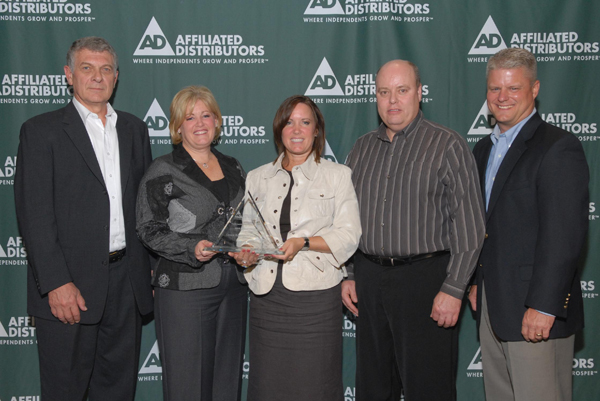
A team photograph is an unusually accurate portrait of this kind of executive work. Sales may have a visible leader, but no distributor wins as a solo act. Purchasing has to cultivate manufacturers. Warehouse teams have to find the item. Drivers have to move it. Branch staff have to understand the customer. Finance has to make the terms workable. The award put five people in the frame because the promise to a customer passes through many hands.
02 / Scale without spectacleWhat changed while Stewart stayed in the room
By 2016, Stewart's title had grown to Chief Marketing Officer and Executive Vice President of Sales. Trade coverage that year pictured Stewart with Gerrie's executive group as the company requalified for Canada's Best Managed Companies program. Gerrie reported annual sales above $150 million and a presence in roughly 20 southern Ontario cities and towns. Its business had spread beyond electrical supply into process, automation, lighting, project services, supply chain and IP networks.
Each added division complicated the selling job. A spool of cable is a product. An automation system is a conversation across controls, software, engineering and production. Supply-chain services change the question from "Do you have this?" to "How should we keep your operation supplied?" Project services introduce schedules and coordination. The distributor moves from taking orders to helping design the conditions under which orders become predictable.
The physical network kept changing too. In 2022, Gerrie described an automated 76,000-square-foot distribution centre built to improve efficiency and compete with global fulfillment operations. Its e-commerce investments gave customers ways to check inventory, delivery dates and order status, and to retrieve invoices and proof of delivery. That is digital transformation in work boots: less waiting for an answer, fewer opportunities for error and more of the transaction visible to the buyer.
The tempting story is that software replaced the relationship. In technical distribution, software reorganized it. A customer can self-serve the routine questions, leaving people to handle exceptions, specifications and judgment. The database knows a quantity. A seasoned sales organization knows why the quantity matters, what an acceptable substitute looks like and which delay cannot be tolerated.
Gerrie also widened its footprint through the 2022 acquisition of FM Supply, whose Waterloo and Stratford locations kept operating under their existing name while gaining access to Gerrie's inventory and broader services. The arrangement captured a familiar independent-distributor problem: how to gain the advantages of a network without discarding the local habits that earned customer trust.
03 / The handoffSuccession as an operating system
In April 2023, Gerrie announced three appointments to its executive team. Joanna Kwant became Executive Vice President of Sales. Jonathan Kwant took responsibility for e-commerce, marketing and vendor strategy. Taylor Gerrie became Executive Vice President of Operations, leading distribution-centre and logistics work. The company explicitly described the appointments as building blocks for succession ahead of the anticipated future retirements of Stewart and Richard Solonenko, then CFO and EVP Operations.
Read the allocation closely and an old job becomes visible in its component parts. Sales strategy sits with one leader. Marketing, e-commerce and vendor alignment sit with another. Distribution and logistics sit with a third. The chart recognizes what a title can conceal: customer growth, supplier strategy and fulfillment are separate disciplines, but they produce one experience.
Vice President, Sales and Marketing when Gerrie received AD's Canadian affiliate award.
Chief Marketing Officer and Executive Vice President of Sales during Gerrie's Best Managed requalification.
Named in the announcement that set out Gerrie's next executive structure and anticipated succession.
Succession in a family business can look like genealogy from the outside. Inside, it is information architecture. Who knows why a customer orders early? Who remembers which vendor solved the last shortage? Which branch needs latitude, and which process needs consistency? Those answers live in people until an organization gives them somewhere else to live: shared systems, trained leaders, documented routines and repeated decisions.
Gerrie's appointees had each spent years moving through different parts of the company before taking executive responsibility. Their histories included counter sales, account management, marketing, automation, distribution-centre operations and strategic transformation. The design of the handoff treated operational range as preparation. It also separated Stewart's broad commercial remit into roles that matched the company's newer scale.
04 / The quiet recordThe biography written in systems
Stewart has not built a conspicuous public persona. There is a LinkedIn profile, a handful of trade photographs and the corporate record. No archive of speeches is required to see the shape of the work. In 2009, Stewart stood with the team behind an affiliate award. In 2016, Stewart appeared with the executives of a distributor operating across several technical divisions. In 2023, the company named the people who would take those functions forward.
That sequence offers a more useful measure than personal visibility. The business around Stewart became broader, more automated and easier for customers to access. Gerrie now describes 24 Ontario locations, more than 400 team members and annual sales above $200 million. It serves residential, commercial and industrial work with electrical, lighting, automation and connected-network solutions. These are company achievements, built by a company-sized cast. Stewart's place in that cast was the commercial seam where capability became a customer relationship.
There is something fitting about a career in distribution leaving this kind of footprint. The whole category is designed to make other people's work possible. The distributor is not the factory, the contractor or the finished building. It is the connective tissue among them. Its success appears as an avoided delay, a correct specification, a delivered box and a crew that can keep moving.
Return to the stopped machine. The customer does not need a slogan. The customer needs a credible answer, backed by stock, technical knowledge and a route from warehouse to floor. For years, Carmen Stewart's job sat at the point where that answer was made. The breaker may be the object in the hand. The business is everything required to put it there.