The clock in a television control room is not interested in excuses. A program ends, a commercial rolls, the next tape must be ready, and dead air waits like a trapdoor. In the late 1980s, Tim Bigoness worked master control at TV20 in San Francisco. He ran shows, commercials, and cues in a role he recalled was handled by one person there, even when other stations might divide it among three. He also floor-directed, worked cameras, and learned live production. It was frantic, physical, and exact. It may also have been the perfect first office for a future software executive.
Bigoness is now chief marketing officer at D-Tools, the business-software company for low-voltage system integrators. The distance between a local TV control room and a platform that tracks proposals, product specifications, drawings, labor, installation, and service looks enormous. Listen for the beat, though, and the route makes sense. Both jobs ask where the work is now, who needs it next, and what happens if a cue arrives late.
“It feels like work, but it's joyful and challenging work.”Tim Bigoness, on a long tenure that still felt alive
The drummer picks a day job
Television was the responsible choice of a musician who did not fancy becoming a 30-year-old unemployed drummer. Music had arrived first. Bigoness grew up around San Francisco, heard the Beatles through his older sisters' records, and watched their Saturday-morning cartoon. He began guitar lessons at eight and promptly migrated to drums. Keith Moon, Mitch Mitchell, Ginger Baker, John Bonham, and Ringo Starr followed. His grandfather, a standup bassist in big bands, supplied a family precedent.
He played in bands from his teens onward. As his style matured, he came to prefer the pocket over the spectacular fill. Bigoness has called himself a groove drummer, the player whose job is to make the song cohere. It is an unfashionably useful description of management too. The groove is felt most clearly when it disappears.
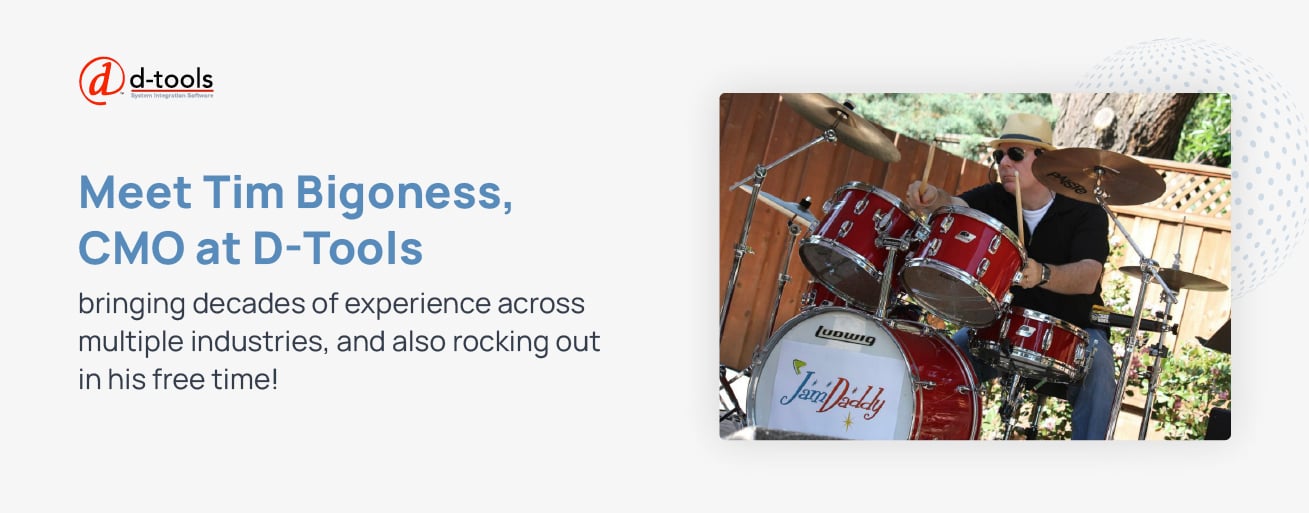
His band JamDaddy brought together fellow career professionals for classic rock and blues gigs around the Bay Area. They rehearsed a few times a month, charted songs, kept what worked, and played country clubs, wineries, and private parties. In 2019, Bigoness also performed at CEDIA Expo with the CE Pro All-Star Band. It is difficult to invent a cleaner collision of his two worlds: the software executive, at his industry's largest gathering, seated exactly where he likes to be - behind everyone else, making the room move.
A post office box full of consequences
Television led to public relations, where Bigoness learned to position technical ideas quickly enough for an editor to care. Then, in the mid-1990s, he joined editors from other publications to co-found Morph's Outpost, a trade magazine for multimedia developers. The publication belonged to the brief, unruly era when interactive media felt like a new continent and its mapmakers needed a magazine.
The romance came with bookkeeping. Bigoness remembered visiting a post office box beside the bank, hoping for an advertising check, a subscription check, anything that could be deposited before deciding what got paid. Small business ceased to be an abstraction. Cash flow was no longer a slide in a presentation. It was the short walk from the mailbox to the teller.
That experience made him, in his telling, a better employee when he returned to a software company. He understood there was no magic pile of money behind a smaller operation. Every person had to help keep it alive. Decades later, that memory gave him an unusual point of connection with integration-company owners. Many are technicians and enthusiasts first, entrepreneurs by necessity, and managers because someone must schedule the work and send the invoice.
Publishing, software, and the art of translation
Before D-Tools, Bigoness moved through the companies that shaped early digital media. At Macromedia he managed the Worldwide Developers Program and Made with Macromedia branding initiatives, and helped drive the creation of Macromedia Press. Later came senior marketing work at Equilibrium and Scene7, two companies associated with the emerging dynamic-imaging market. Across television, publishing, public relations, and software, the recurring task was translation: make complex machinery understandable without sanding away what makes it valuable.
He joined D-Tools in 2005, around the era of System Integrator 4. Apart from a nine-month excursion into another industry, he has remained through successive desktop releases, the launch of D-Tools Cloud, the addition of payments and analytics, and a widening customer base across residential and commercial AV, security, HVAC controls, IT services, higher education, and government.
Around 2011, direct sales became a larger part of his remit. The move closed a useful circuit. Marketing could no longer imagine the customer from a distance because Bigoness was sitting in the conversation, hearing what software did well, where it stumbled, and whether the buyer might someday become an honest case study. Selling became another form of product research.
The operating rhythm
Do not bring a wrecking ball
Bigoness's public philosophy of software is unusually restrained. Start with one question: what problem does this company need to solve? An integration firm may already have a customer database it likes, accounting habits it trusts, and a team allergic to another migration. D-Tools can provide proposals, engineered drawings, product data, project management, and field service, but Bigoness argues that the customer remains the judge of its best process.
“We're not here to blow up your infrastructure. We're here to enhance it.”Tim Bigoness, on integrating with what already works
The position is both practical and personal. Bigoness has lived through enough production systems to know that replacing everything at once is a fine way to discover why the old quirks existed. His preference is to preserve good workflows, repair weak handoffs, and let detailed product data travel from the first proposal through design, procurement, installation, and service.
This is where the drummer's vocabulary returns. A company has a tempo. Sales hands a job to engineering; engineering hands it to the field; the field hands it to service. A bad transition creates the corporate equivalent of a dropped beat: rework, a missed cost, a confused customer, a technician with the wrong information. Bigoness sells software, but his subject is coordination.
The long gig keeps changing
Longevity can sound like stasis until the product timeline is laid out. In late 2023, D-Tools made its Cloud Solo plan free. Bigoness said the idea was to reach thousands of integrators still building proposals in Word and Excel. Within nine months, the number of companies on D-Tools Cloud rose from roughly 1,200 to more than 3,300. By early 2025, he said more than 8,000 entities used D-Tools software across more than 90 countries.
The company released System Integrator version 23 in 2025 while shipping monthly Cloud updates. That August, D-Tools secured a $12 million Series C investment led by StellarIQ, with backing from Greybull Stewardship, to accelerate product development, analytics, and AI capabilities. Bigoness has described AI and machine learning as foundational to what comes next, with an important qualification: useful capabilities should work with users, not simply act for them.
In May 2026 he appeared ahead of InfoComm to discuss “smarter, scalable” project management. Three months later, D-Tools and Portal.io announced they had become one company, joining two long-standing partners while keeping D-Tools SI, D-Tools Cloud, and Portal.io available. Another transition arrived; another handoff needed a clean count-in.
Bigoness has used the Japanese idea of kaizen to describe a culture of constant improvement, then punctured any corporate neatness by admitting the team does not always succeed. That matters. Improvement without failed attempts is a slogan. Improvement with missed notes is practice.
Hold the groove
There is a temptation to turn a long career into a straight line after the fact. Bigoness's route is better left crooked: drums, television, PR, a precarious magazine, multimedia software, dynamic imaging, system integration. The thread is not an industry. It is an appetite for complicated ensembles and the backstage systems that keep them from collapsing.
He has said he wants to be a better person today than he was yesterday. The phrase is modest enough to survive contact with an actual workday. It asks for a small correction, not a reinvention. Listen harder. Fix the handoff. Count the labor. Leave space for the other player. Return tomorrow and do it again.
Onstage, the audience rarely leaves humming the drum part. At a well-run integration business, customers rarely marvel at the procurement schedule either. They notice that the room works, the crew arrives prepared, and the promise survives the project. Bigoness has built a career around those invisible measures. The work is joyful. The work is challenging. The next cue is already coming.