The first office had two folding chairs, a Google spreadsheet, and very little room for executive distance. In 2012, Caleb Gilbertson and Travis Veit sat back-to-back in Gilbertson’s small Uptown Minneapolis apartment and started Imprint Engine. A company that would eventually coordinate branded merchandise across continents began with a seating arrangement better suited to a particularly awkward game of musical chairs.
The spreadsheet held the orders. The founders held the rest. Gilbertson brought a background in websites, software, and digital marketing. Veit brought creative production and supply-chain experience. They were entering a business full of physical things: printed shirts, packaging, gifts, boxes that needed to arrive somewhere. Gilbertson’s interest kept extending to the machinery behind them.
Fourteen years later, that interest remains recognizable. The scale has changed. So has his job. The question running through his career is how much friction he can remove before the next problem appears.
A graphics job with a website problem
His route into technology started inside the promotional-products trade. Straight out of high school, Gilbertson persuaded the owner of a supply company to hire him in its graphics department despite his lack of direct experience. Roughly six months later, he noticed the company’s website needed work. He proposed spending half his time learning how to improve it.
Within a few months, the business had a new site. Gilbertson continued building websites and teaching himself digital marketing and software development, while designing marketing materials and brokering print and promotional products for extra income. The job had given him a place to start; the poor website had given him another occupation.
He later joined Renters Warehouse and became its chief technology officer, helping the business expand from three locations to more than 30. When his friend Veit approached him in 2012 about starting a promotional-products company, Gilbertson was returning to familiar territory with a different set of tools. He could see the merchandise and the workflow that surrounded it.
One customer can change the room
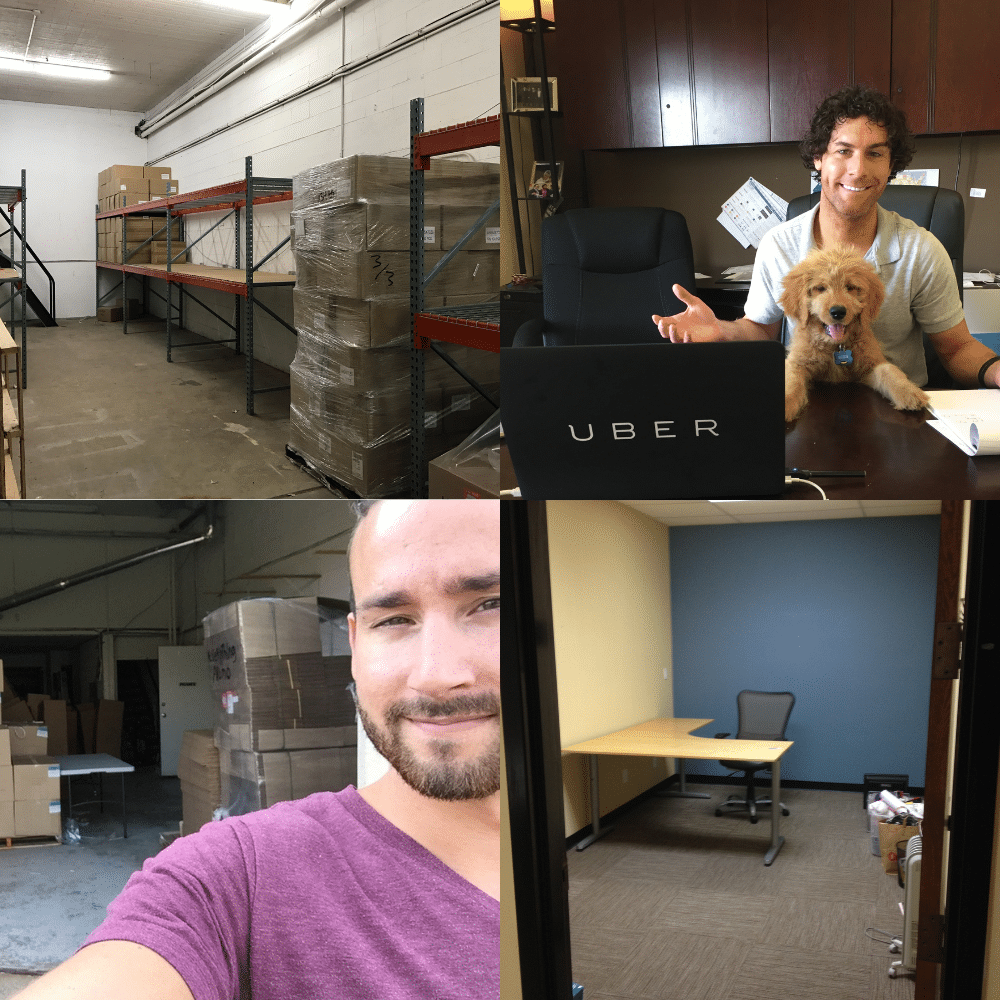
Uber became an early customer with consequences far beyond an ordinary account win. By 2019, Imprint Engine was handling merchandise for an Uber employee store offering 500 products. It also supplied welcome kits to restaurants joining Uber Eats, with Gilbertson describing roughly 40,000 kits shipped over the preceding two years.
That gives the word “swag” a rather demanding job description. Each restaurant kit represented a destination, a set of materials, and an expectation that the contents would be right. Multiply that by thousands, and the creative assignment becomes inseparable from the operational one. A nice design still has to survive the address label.
For a young business, the account was both an opening and an exposure. Gilbertson’s April 2026 conversation with Jeremy Parker looked back on a period when Uber accounted for 90 percent of revenue. Dependence of that size gives a single customer considerable influence over the future. Diversifying meant building a business with more than one answer to the question of who would place the next order.
The relationships also traveled. As people left Uber for other employers, some took Imprint Engine with them. Cold email helped the company reach further customers, including GitHub and GoPro. The work could move through a professional network as well as a warehouse.
A big account brings volume. A broader client base gives the company more places to go next.
The work between the objects
The founders had experienced the nuisance they were trying to solve. Marketing work could turn into a succession of calls between printers, suppliers, online stores, and warehouses. Every separate vendor added another conversation to manage. Imprint Engine brought those services together, using the founders’ savings to help build the operation.
It is easy to understand the attraction from the buyer’s side. The person ordering a merchandise program may also be organizing an event, welcoming employees, or coordinating a campaign. Chasing several vendors becomes another project inside the project. Gilbertson’s company set out to take responsibility for more of that sequence.
By early 2022, the company was reporting $13 million in 2021 revenue and discussing a projected $20 million for 2022. Those discussions included the growing role of HR buyers and online stores. A merchandise order increasingly belonged to an ongoing employee program, with repeat needs and more coordination than a one-time purchase.
That helps explain Gilbertson’s recurring attention to systems. The product at the end might be simple. The chain of decisions that gets it there can be surprisingly crowded.
Dublin is more than a shipping destination
International work made the chain longer. In April 2022, Imprint Engine announced its European headquarters in Dublin. The local team would support enterprise clients including Uber, GitHub, Gopuff, and Klarna, with responsibilities covering sourcing, account support, tariffs, and shipping.
Gilbertson described the point as putting people on the ground to serve international customers. The detail matters. Sending a package abroad and operating a local business involve different commitments. A regional team can deal with production and service where the customer needs them, rather than treating every overseas order as an exception routed through Minnesota.
The company’s expansion continued into India in 2024 and subsequently Sydney. Its current account of the business describes more than 150 people and a 40,000-square-foot US headquarters supporting decoration, kitting, and fulfillment. Its IEX software brings ordering, inventory, reporting, and distribution into a shared system.
There is something pleasingly literal about the distance from a small living room to a warehouse. More space solves the storage problem. A shared system addresses a less visible problem: keeping the people using all that space working from the same information.
in February 2026
in February 2026
announced November 2025
An annual result, a cumulative total, and a future target. Each number measures a different thing.
The CEO with the janitor title
Gilbertson’s Slack title, discussed in his 2026 interview with Parker, is “Janitor.” The joke is a useful counterweight to the corporate title. Running the company includes clearing obstacles, and growth requires giving other people room to do work the founder once controlled.
Delegation has become a practical part of that transition. The apartment arrangement gave two founders direct visibility into nearly everything. An international organization needs leaders who can take responsibility without waiting for the person who started it to inspect every decision.
In November 2025, Imprint Engine appointed Colin Loughran as global chief revenue officer, based in Dublin. Loughran would bring sales, marketing, and operations into closer alignment. Gilbertson would spend more of his attention on product innovation and work with engineering teams on AI in the company’s gifting platform. The $100 million revenue ambition came with a change in who would be doing which work.

A forecast with work attached
Gilbertson put his thinking about AI into a September 2025 essay, Swag 2035. He considered how the technology might change the promotional-products industry over the following decade. His recommendations included examining workflows, improving the organization of data, trying small experiments, and preparing employees for more strategic work.
Those are fairly unglamorous instructions for a subject that often arrives wearing a silver spacesuit. They also fit his earlier experience. A website needed rebuilding. A set of vendors needed coordinating. An international program needed shared information. New tools create possibilities, but someone still has to decide where they belong in the work.
The essay is a forecast, with all the uncertainty that entails. Its practical value lies in the preparation it asks for now. Clean information and a team able to judge results are useful whether a particular prediction arrives on schedule or takes a detour.
By his 2026 Montréal skucamp appearance, Gilbertson was framing the distributor’s changing role around responsibility for the eventual result.
“Yesterday, we sold products, and today, we manage projects. Tomorrow, we design outcomes.”
Caleb Gilbertson · skucamp Montréal, 2026
The progression sets a harder assignment. Selling an object ends with a transaction. Designing an outcome asks what the customer wanted that object to accomplish, and whether the whole program delivered it.
Still learning, fourteen years in
Recognition has followed the expansion. Commonsku named Gilbertson its 2026 Distributor Entrepreneur of the Year. Imprint Engine ranked 28th on the 2025 PPAI 100 distributor list and appeared at number 2,530 on the 2025 Inc. 5000. The company’s Inc. profile also lists Best Workplaces recognition for three consecutive years, from 2023 through 2025.
There is a less ceremonial version of the culture, too. Gilbertson has posted about a company music video made around its values, including some self-deprecating commentary about the dancing. An office can have principles and still risk embarrassing itself on camera. Perhaps a company in the business of making brands tangible ought to be willing to participate.
Marking Imprint Engine’s fourteenth anniversary on LinkedIn, Gilbertson reflected that the hours worked might make the tenure feel twice as long. He described it as his longest-running project, said he was still learning, and thanked the people who had contributed along the way.
That word, “project,” feels at home in his story. It leaves room for another revision. The chairs have moved, the orders have multiplied, and the founder who once asked for half his day to improve a website is making time to build again.