The useful way to understand Imprint Engine is to ignore the mug. Look past the embroidered cap, the neat tissue paper and the custom mailer that made it to an employee's kitchen table. Behind that cheerful object sits a chain of less photogenic decisions: Who approved the art? Which factory made it? How many size-large hoodies are left in Dublin? Can an employee in Delhi choose something different? Who pays the duty? And why is the brand team tracking addresses in a spreadsheet?
Imprint Engine has built a company around those questions. Founded by Caleb Gilbertson and Travis Veit in Minneapolis in 2012, the privately held business presents itself as a global brand-experience partner. In practical terms, it combines a creative agency, product developer, decorator, e-commerce builder, warehouse network and logistics operator. Its proprietary IEX platform sits in the middle, giving clients one place to run stores, gifting campaigns, inventory, budgets, orders and reports.
This is a more interesting proposition than “we make swag.” The object is what recipients remember. The system is what enterprise buyers pay to stop thinking about.
The product is fewer handoffs
A conventional merchandise program can scatter responsibility across a designer, a promotional-products distributor, a printer, a web-store vendor and a third-party warehouse. Each handoff creates a small chance for a large headache: a color changes, inventory goes stale, an overseas order gets routed from the wrong region, or a local team improvises around standards set at headquarters.
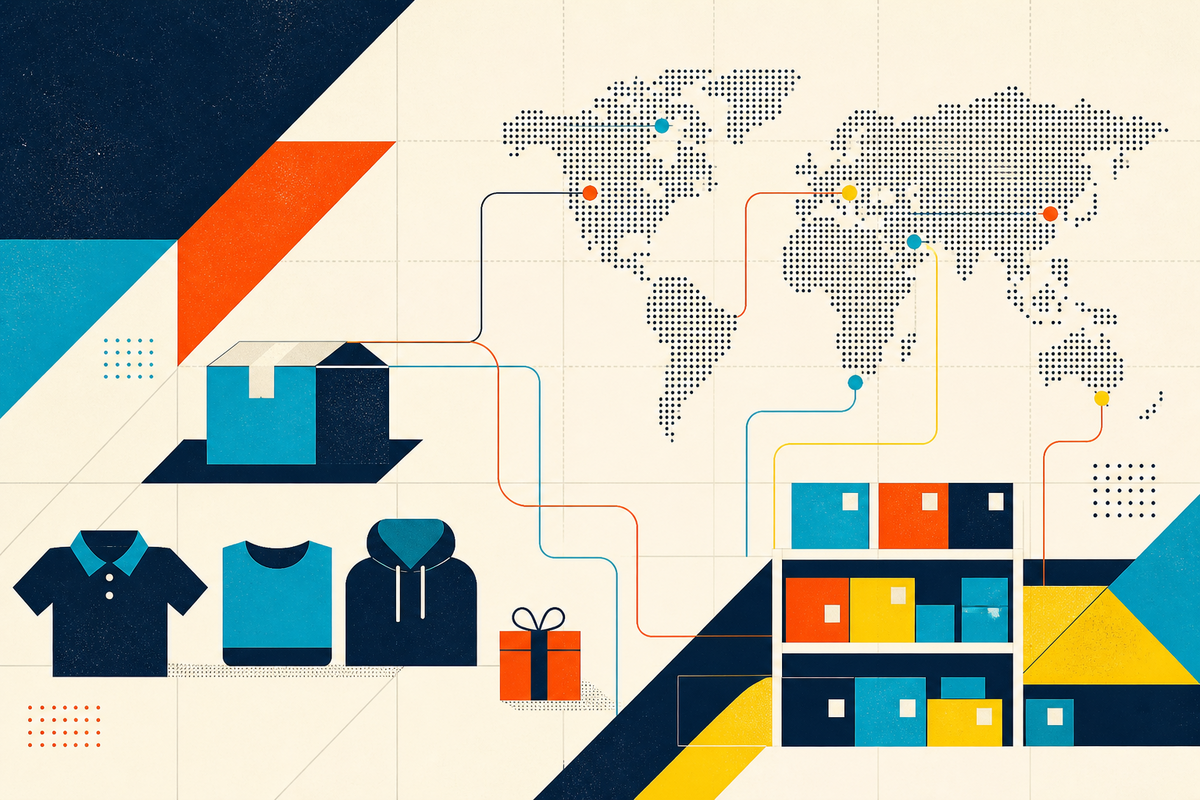
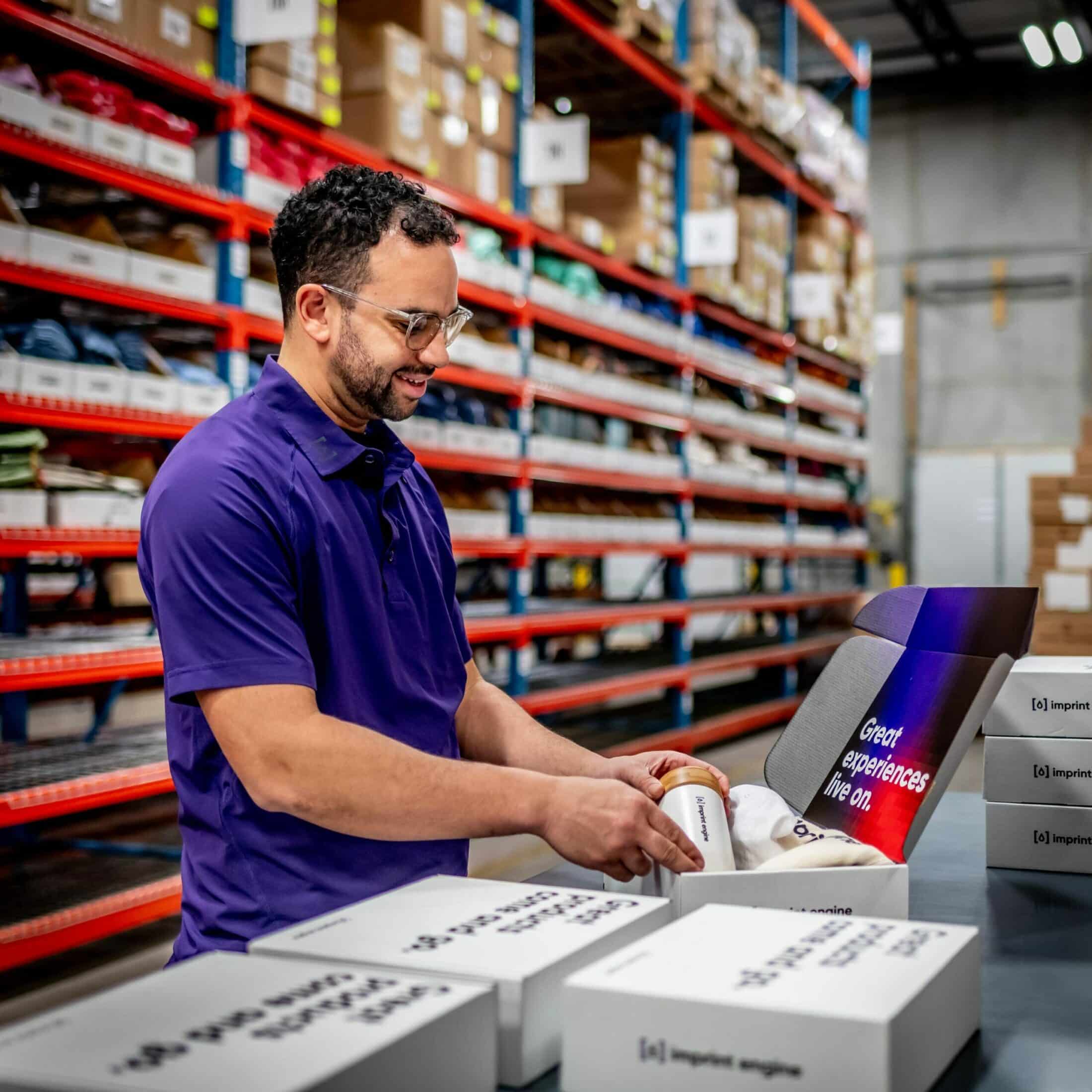
Imprint Engine's answer is vertical integration. Its creative team develops concepts and custom products. Production teams decorate and assemble them. Warehouses hold stock. Regional operations source closer to recipients. IEX records what is available and who can order it. The company says this model protects consistency while reducing the number of vendors a client has to manage.
One physical brand loop
The pitch lands best with organizations that have outgrown the one-off order. Public customer stories and testimonials name Walmart, Uber, DocuSign, Postman, Gopuff, Miro, LegalZoom and Metropolis, among others. Their users are the people caught between brand ambition and operational reality: marketing leaders, event teams, procurement managers, people-operations groups and retail buyers.
“Great products come and go. Great experiences live on.”Imprint Engine's stated belief
A 5,000-person test
DocuSign's 20th anniversary offers a clean view of the machinery. The company wanted to recognize nearly 5,000 employees around the world. That meant more than choosing a nice present. The program needed secure address collection, recipient choice, regional sourcing, brand approval and reliable international delivery - all without dumping the work on DocuSign's internal team.
Imprint Engine built an IEX gifting campaign with a secure selection site, customizable kits and a donation option for people who did not want an object. It coordinated with DocuSign's IT and brand teams, then sourced across regions. The published result was a 30 percent saving on product spend and one reported delivery issue, attributed to a recipient's size selection. It is the kind of outcome that makes the “platform plus operations” thesis tangible.
Other case studies show the range. Walmart turned to Imprint Engine for more than 250 unique products across three fast-moving events. Another Walmart project, with Crush Brands and Roblox creator Rush Bogin, translated a virtual backpack into a real one with matching accessories. Uber used the company to coordinate international gifting and maintain brand integrity across stakeholders. Postman used it to streamline global distribution. The pattern is consistent: the product is important, but orchestration wins the assignment.
Software in a screen-print shop
IEX is the differentiating layer. It supports branded stores, limited campaigns and “claim” experiences where recipients enter their own addresses and select an item. Administrators can see inventory, set budgets, manage users and download reports. Procurement integrations can connect the experience to systems a large company already uses.
The public release log reads less like agency news and more like a modest SaaS changelog. Recent entries cover Canadian province validation, bulk-address uploads, webhook settings, campaign reports, password-protected claim links and separate courier fields. None makes a good billboard. Together they reveal where the work lives: in the edge cases that turn a pretty storefront into dependable enterprise infrastructure.
The custom-product ladder
Subtle adapts a familiar form. Signature builds the branding into construction. Showcase starts from a blank sheet and develops something new.
The software also helps Imprint Engine behave less like a catalog. A catalog wins on breadth and price. An operating system wins by staying embedded: the store remains live, inventory keeps moving, campaigns recur and reporting becomes part of the customer's routine. That changes a lumpy promotional order into a longer relationship with revenue spread across merchandise, creative work, storage, technology and fulfillment.
This business model borrows a little from several industries without fitting neatly inside any one of them. The merchandise carries a distributor's margin. Design and program strategy resemble agency work. Storage, pick-and-pack, kitting and postage look like third-party logistics. The storefront and campaign tools introduce a software component. A client may encounter all four on the same invoice, even if the experience feels like one service.
That blend matters because each layer reinforces the next. A designer who knows the warehouse constraints can specify packaging that will actually ship. A sourcing team with inventory data can recommend a reorder before an event runs the store dry. A regional operator can choose a locally available equivalent instead of sending an ordinary bottle across an ocean. And a campaign report can tell the brand team whether recipients claimed the item at all. The feedback loop is the advantage. Imprint Engine is not merely placing itself between buyer and factory; it is trying to learn from the whole trip.
Global, but deliberately local
The company's geographic expansion follows the same logic. In 2021 it moved into a 40,000-square-foot headquarters in Brooklyn Center, Minnesota, built for in-house decoration, kitting and fulfillment. That year it also established a European office in Dublin. Operations later expanded to Delhi and Sydney, with team members in additional countries.
Local presence can shorten routes, simplify currencies and tariffs, and reduce the absurdity of shipping a common item halfway around the planet. It also makes brand control harder: the same kit needs to feel intentional whether it is opened in Minneapolis, Munich or Mumbai. Imprint Engine's “global engine” idea is essentially a promise that regional execution will not turn into regional improvisation.
That expansion earned outside recognition. Imprint Engine received the 2024 Minnesota Governor's International Trade Award, one of four honorees chosen from more than 2,000 applicants. It ranked No. 28 among distributors in the 2025 PPAI 100, then No. 36 in 2026. PPAI also cited high marks for growth, professional development and employee happiness.
Where it sits - and what can go wrong
Imprint Engine occupies an awkward, useful intersection. It competes with promotional distributors such as 4imprint, HALO, BDA and Staples Promotional Products; with gifting platforms such as Sendoso, Stadium and Snappy; and with the do-it-yourself bundle of a creative agency, Shopify-like storefront, sourcing partner and third-party logistics provider.
Its differentiation is consolidation, not a magical new object. Owned infrastructure can mean tighter quality control and fewer excuses between vendors. Proprietary software can expose stock and automate the repetitive parts. Regional teams can source and ship locally. Dedicated account groups can translate a brief into a program instead of an order form.
The tradeoff is the same one found in any full-service relationship: consolidation creates dependence. A customer has to trust one partner across creative taste, software reliability, inventory accuracy and physical delivery. Global operations add complexity even when they are designed to remove it for the client. And sustainability remains a structural challenge. Better products, regional sourcing, recyclable packaging and recipient choice can reduce waste, but the category still exists to manufacture and move more things.
Imprint Engine's answer is to make those things more considered and the system around them more visible. Its public culture stresses teamwork, curiosity, integrity, adaptability and individuality. The phrase it uses is “Creatively Reliable” - two words that neatly describe the balancing act. Creative gets the hoodie worn. Reliable gets 5,000 of them through the right doors.
The object carries the logo. The operation carries the promise.
The company began with two founders in a closet-sized living room. Fourteen years later, it has software releases, warehouse capacity, international hubs and a chief revenue officer charged with global growth. That evolution says something about the market. Physical brand experiences never disappeared when marketing went digital. They simply inherited digital expectations: personalization, visibility, automation and measurable control.
So yes, Imprint Engine sells apparel, drinkware, kits, gifts and objects that may eventually appear on an office shelf. But the sharper description is less glamorous and more valuable. It sells the relief of knowing where the boxes are, who is allowed to order them, and whether the brand inside still looks like itself when it arrives.