Promotional merchandise has a vocabulary problem. Call it swag and it sounds disposable. Call it a global programme and the machinery comes into view: designers, factories, compliance checks, web stores, warehouses, customs paperwork, local fulfilment, invoices and the quiet terror of putting the wrong shade of blue beside a famous logo. The Pebble Group plc lives in that machinery. From Manchester, it runs two businesses that approach the same sprawling trade from opposite directions.
Brand Addition is the larger, older half. It acts as an outsourced merchandise department for companies with scale, designing and sourcing products, operating client-branded ecommerce sites and moving goods across Europe, North America and Asia. Facilisgroup is the systems half. It gives independent promotional-product distributors in the United States and Canada a specialist operating platform, preferred-supplier economics and a room full of peers who understand why a missing decoration approval can wreck a month-end close.
Two doors into one untidy market
The structure is more coherent than it first appears. The global promotional-products market is worth roughly $50 billion, but it is fragmented and operationally stubborn. A multinational wants one creative and accountable partner across countries. A regional distributor wants the purchasing leverage and software discipline of a much larger company without surrendering its independence. Pebble sells each customer what the other side of the market lacks.
Brand Addition
Customer: large global brands.
Offer: design, sourcing, ecommerce and fulfilment.
2025 revenue: £107.5m.
How it gets paid: margin on products and services.
Facilisgroup
Customer: North American distributors.
Offer: Syncore, buying power, playbooks and community.
2025 revenue: about $23m.
How it gets paid: subscriptions and supplier-network fees.
Brand Addition says most of its sales come through roughly 70 contracts. Its public client gallery includes Google, Intel, HSBC, Nespresso, Indeed, Accenture and Edward Jones. These are not buyers hunting for the lowest-price pen on Tuesday. They need brand consistency, product safety, sustainability evidence and delivery across borders. Contracts can be worth millions of pounds, and the relationship becomes hard to dislodge once the agency operates the store, holds the stock and knows the procurement rules.
“I genuinely don’t know how I would function without Brand Addition by my side.”Procurement manager, Indeed
The quote is flattering, but its mechanics matter more. A provider that manages event kits, warehousing, websites and global shipping is not selling a novelty object. It is absorbing complexity. That explains why Pebble's most persuasive number is not a creativity award but 97 percent retention among Brand Addition's top 30 clients in 2025.
The operating system starts with the invoice
Facilisgroup addresses the same complexity lower down the chain. Its ideal partner is a promotional-products distributor doing more than $1 million in annual revenue and beginning to buckle under its own improvised processes. Syncore follows an order from first pitch to paid invoice. CRM, proposals, product search, artwork, production, order tracking, receivables, payables, commissions and supplier rebates sit in one system.
That last word is important. Facilisgroup is not merely a software vendor. Its preferred-supplier network counted 88 companies at the end of 2025. Partner distributors pool purchasing strength, see negotiated pricing inside the platform and automatically track early-payment discounts and rebates. Suppliers pay fees to reach the network. Distributors also receive operating playbooks, training and access to a community willing to compare notes. The bundle makes a plain software comparison incomplete.
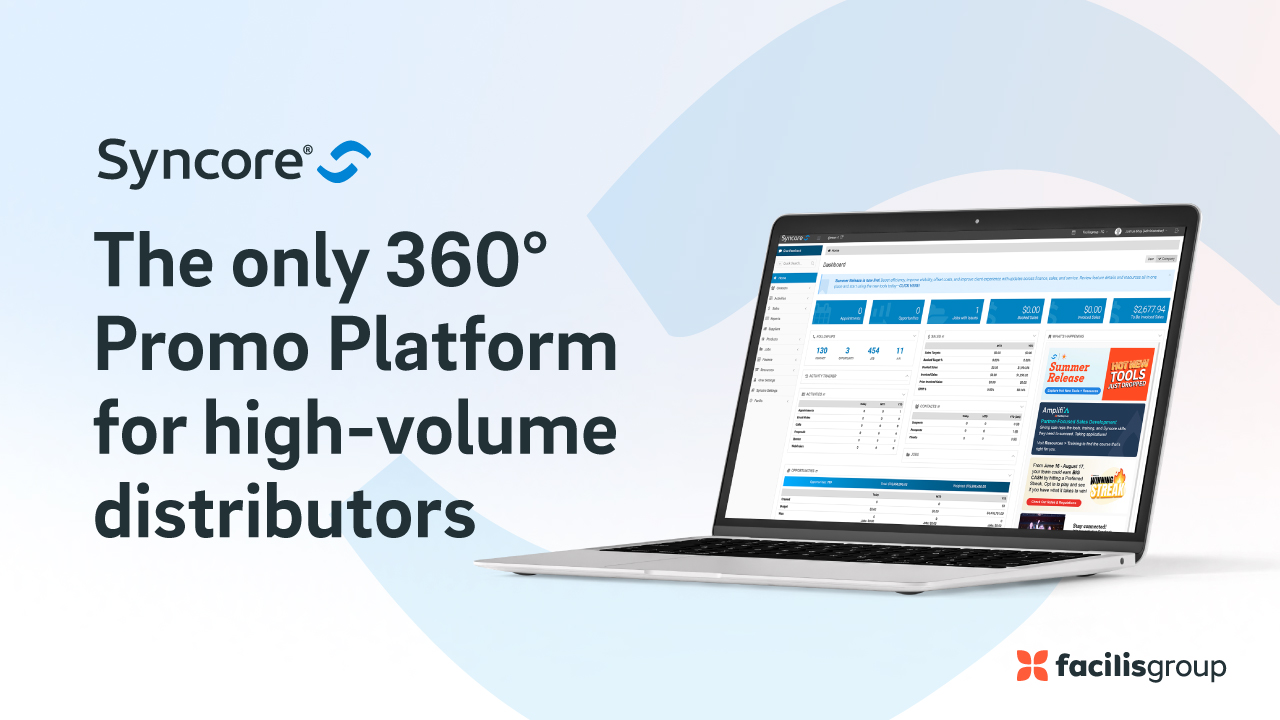
The platform is sticky by design and by inconvenience. Facilisgroup says distributors average more than eight years on Syncore. Moving an ERP is painful anywhere; moving one that also carries supplier pricing, finance history and community membership is especially unappealing. New partners reportedly average 14 percent growth two years after joining, though that is the company's own cohort statistic, not a promise to every buyer.
What £27 million bought
Pebble's shape was assembled, not dreamed up on a startup whiteboard. Brand Addition emerged in 2010 from three 4imprint businesses. Chris Lee's management team bought it with private-equity backing in 2012, opened a full-service Shanghai office in 2014 and acquired US-based Gateway CDI in 2016. A second buyout followed in 2017.
Then came the decision that changed the category of the company. In December 2018, the group bought Facilisgroup. Total payments were eventually reported at £26.965 million, including deferred amounts settled around the flotation. The acquisition added subscription revenue, a North American distributor network and a reason to build proprietary ecommerce tools. The Pebble Group name arrived with it.
The December 2019 AIM flotation raised £135 million gross at 105 pence a share and valued Pebble at about £176 million. Yet only roughly £79 million was new money for the company. It primarily repaid debt, redeemed preference shares and settled the remaining Facilisgroup obligations. IPO and transaction-related costs were £3.9 million. In other words, the listing first repaired the balance sheet; it did not drop £135 million into a product laboratory.
The first stumble was physical
Barely three months later, Covid-19 attacked the part of the model dependent on events, offices and face-to-face campaigns. Brand Addition cut headcount to match expected sales volumes and recorded £0.4 million of restructuring costs in 2020. Group revenue fell sharply that year. The response was not a wholesale pivot. Pebble kept the two-engine thesis and accelerated the digital half, buying ecommerce software assets from CoreXpand for $5.3 million in December 2020. Commercio, the resulting store platform, launched in 2022.
Subsequent disruptions kept testing the physical engine: Brexit, freight congestion and, most recently, uncertainty over US tariffs. In 2025, Brand Addition revenue was broadly flat, but its gross margin rose from 35.2 to 37 percent as the company sold more valuable services and managed costs. This is the sober version of resilience: fewer slogans, more margin mix.
Sustainability has become part of that service rather than a separate brochure. Brand Addition evaluates product provenance, materials and factories, then gives procurement teams evidence they can use inside their own policies. The group reports through EcoVadis and describes supplier standards covering labour, ethics and environmental practice. This does not make every promotional object necessary or harmless. It does make the agency responsible for answering harder questions than “Can you print the logo?” For a global buyer, avoiding an unsafe factory or an unverifiable materials claim is brand protection. The expertise earns its keep when the cheap quote carries an expensive reputational risk.
A million-dollar recruitment experiment
The latest growth choice is unusually legible. Facilisgroup added roughly $1 million of incremental spending in 2025 to recruit more distributor partners, mainly through people. Adjusted EBITDA at the division fell as planned. Thirty partners signed contracts, nearly twice the 16 won in 2024, and the year ended with 253 partners after acquisitions and departures. Pebble estimates a new partner's average lifetime value at about $500,000. If the cohort activates and stays, the arithmetic is attractive. If onboarding slows or partner merchandise volume stalls, the expense arrives before the revenue.
This is also what readers can copy. Pick a narrow market whose workflows general software handles badly. Put the customer's operating data, purchasing advantage and professional network in one proposition. Charge recurring fees where the benefit recurs. Measure retention before celebrating acquisition. Then invest behind a channel only when lifetime value and onboarding capacity are visible.
The conditions matter. The pattern works best where customers share suppliers, repeat orders and specialised compliance requirements. It is weaker in a tiny market, a low-retention category or one where a horizontal platform already solves the workflow cheaply. It also depends on trust: preferred economics stop being special if suppliers leave, while community becomes theatre if members will not share.
The moat is the unglamorous bit
Brand Addition faces international agencies and distributors with their own creative teams and fulfilment networks. Facilisgroup faces promo-specific software such as commonsku and SAGE, ecommerce platforms and the eternal alternative of stitching together a CRM, accounting package and spreadsheets. Pebble's answer is depth rather than novelty: global service on one side; software, buying leverage and shared practice on the other.
In 2026, Facilisgroup added custom proposal design, online approvals and Outlook integration, announced plans for stronger AI-assisted search and connected Syncore to S&S Activewear's FAST PLATFORM for low-minimum print-on-demand work. Each feature removes a handoff. None needs to sound revolutionary to be useful.
The group remains exposed to concentrated clients, discretionary marketing budgets, cyber risk, warehouses and international supply chains. Brand Addition still produces most of the revenue, so Pebble cannot software its way around a downturn in physical merchandise. But the pairing gives it two ways to earn from the same complicated ecosystem. One makes global brands feel consistent. The other helps local operators behave like larger businesses. The product in the middle may be a water bottle. The business is everything required to get the right one to the right person without drama.
Go further
Explore the businesses, see the product in motion or hear management explain the 2025 numbers.