Consider the person ordering tote bags for a conference. The bags are ordinary. The predicament is not: a deadline, a budget, a logo that must look right, and several colleagues who will notice if it does not. Buying merchandise means accepting responsibility for a small public performance. 4imprint has spent decades making that responsibility feel manageable.
- A direct-order business built around samples, artwork help and guarantees.
- Suppliers usually hold and ship the goods; 4imprint manages the purchase.
- Existing customers generated nearly four in five orders in 2025.
The company sells pens, mugs, shirts, bags, notebooks and other objects carrying somebody else’s name. Customers range from family businesses to large corporations, churches, universities and hospitals. A team can outfit volunteers, thank employees or stock a trade-show table. The objects differ. The recurring assignment is to turn a logo file into something useful, on time.
Twelve pages, one useful shortcut
The operating business traces its roots to Dick Nelson’s Nelson Marketing in Indiana in 1985. Its defining experiment followed in 1987: a twelve-page catalog mailed to 250,000 businesses. Buyers could use a toll-free number instead of waiting for a commissioned salesperson’s visit. Fewer steps, less expense. Long before the shopping cart, this was an argument for convenience.
Bemrose bought the business in 1996; the 4imprint name followed in 2000. But the catalog could become a habit as easily as an advantage. Growth slowed. After a change in control, Kevin Lyons-Tarr took charge of the operating business in 2004 and pushed harder online. The useful insight was that a delivery channel should not define the company.
“We needed to stop being a catalog company.”
Kevin Lyons-Tarr, speaking to PPAI in 2023
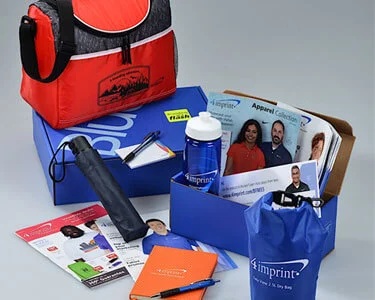
Today, brand advertising and search carry more of the marketing load than direct mail. Catalogs remain. So do Blue Box sample mailings. The test is practical: which approach helps a buyer choose, order and return? A box on a desk and a search result can serve the same commercial purpose.
The product is also a promise
4imprint’s ordering service supplies some unglamorous necessities: free samples, complimentary artwork assistance and an imprint proof. A sample lets colleagues argue about the actual bottle. A proof lets them approve the actual placement. Each removes a different reason to hesitate.
Its 360° Guarantee adds financial commitments. If an event is missed because the company failed to ship on time, the order is free. An eligible lower-price comparison within thirty days brings double the difference back. An unsatisfactory order can be collected and rerun or refunded. The distinctions matter: shipping on time is not the same as promising every parcel tomorrow.
Selected items offer 24-hour production, subject to requirements; transit still takes time. Buyers should establish the event date, request samples early and compare the complete quote, including printing and freight. These are ordinary precautions. Making them easy is part of the service.
The $171 million invitation
The business underneath looks different from a warehouse retailer. Suppliers generally hold inventory, print products and ship orders directly to customers. 4imprint also decorates apparel internally. Its expertise lies in merchandising, artwork, supplier coordination, order processing and acquiring customers who will buy again.
That approach limits money tied up in stock. Credit-card payments and agreed supplier terms help fund operations. The London-listed parent, 4imprint Group plc, reported $1.3468 billion in revenue for 2025. The North American business accounted for 98%; the UK and Ireland supplied the remainder.
Finding the buyers was expensive. Group marketing cost $171.4 million that year, producing $7.86 in revenue per marketing dollar. That ratio measures sales against marketing expense. Product costs, salaries and other bills still have to be paid. Group operating profit was $145.2 million.
1,639,000 existing-customer orders + 421,000 new-customer orders. Order share, not a retention rate.
Repeat business helps explain the spending. Existing-customer orders held roughly steady in 2025 while new-customer orders fell 12%. The relationship survives beyond the first purchase. Competitors include HALO and independent distributors, whose personal account relationships give buyers another route. 4imprint pairs direct ordering with human help and a widely advertised guarantee.
The year the events stopped
Then consider a conference business without conferences. In 2020, 4imprint’s sales fell sharply as the pandemic erased demand. Lyons-Tarr later told PPAI that the company kept its staff and continued marketing. Management was spending for a recovery whose timing it could not know.
That choice required financial room. It is a poor instruction for a business unable to pay next month’s wages. The more transferable lesson is to decide which capabilities would be difficult to rebuild. Experienced people and customer familiarity belonged on 4imprint’s list.
The company’s stated Golden Rule culture has physical expressions too. Its 2024 distribution-center expansion added production space and an enlarged health clinic. Culture becomes easier to evaluate when it occupies a room and appears in a spending decision.
A useful bag still needs a useful purpose
Better Choices helps buyers find specific material and workplace attributes, including recycled content and relevant third-party certifications. Those labels describe particular qualifications; they do not settle whether a giveaway is needed. The buyer still has to choose something recipients will use.
Sometimes the purpose is delightfully literal. A Richmond Habitat for Humanity affiliate used a one by one grant for screwdriver keychains to thank volunteers. Nearly 1,700 charitable causes received $500 merchandise grants in the second quarter of 2026. A small tool made the message tangible.
The economics remain exposed to the outside world. First-half 2026 revenue rose 1% to $666.4 million, despite fewer orders. Supplier tariff costs helped pull gross margin down to 31.5% from 32.8%. A reassuring guarantee cannot erase a higher import bill.
For buyers, the sensible next step is modest: pick the occasion, test the object, approve the artwork and confirm the delivered cost. For other businesses, there is a broader idea worth borrowing. Find the part of the purchase that makes someone nervous. Spend your ingenuity there.