David Zhang had an offer from the chief executive of Texas Instruments. He was studying at Caltech, considering a future in electronics, and had asked a scholarship organization to arrange a meeting with Thomas Engibous. It worked. A trip to Dallas became a half-day conversation, an introduction to a prospective supervisor, and an internship offered on the spot. For a student familiar with the company through its calculators, this was a rather satisfactory return on a request.
Then came summer housing. Zhang was also enjoying undergraduate research in Erik Winfree’s laboratory, working on biomolecular engineering. Choosing between the two opportunities required thought. Arranging somewhere to live in Dallas required effort. He postponed the decision until Texas Instruments sent a no-show email. He stayed with DNA.
Zhang later told the story with embarrassment, acknowledging that he could have preserved the relationship by declining properly. There is something useful about a founder who admits that a consequential career turn involved accommodation logistics. The biography became orderly afterward. The decision itself was considerably less elegant.
A rematch, twenty-three years later
Long before the internship, Zhang knew the pleasure of a problem with an answer. At the 1996 national MATHCOUNTS competition, he finished second. Po-Shen Loh finished third. The two competed in the Countdown Round, where mathematical ability meets the pressure of having to produce an answer before someone else does.
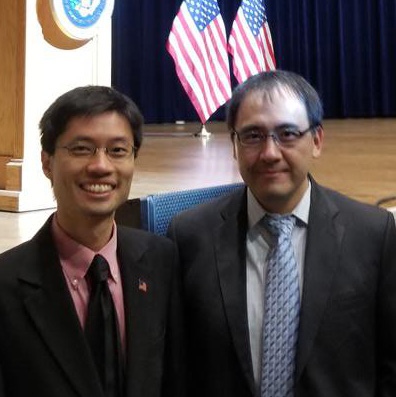
In 2019, they met again at the Presidential Early Career Award for Scientists and Engineers ceremony. Loh had become a Carnegie Mellon mathematics professor and coach of the United States International Mathematical Olympiad team. Zhang was a Rice University bioengineer. Their reunion supplied an unusually tidy photograph: two former school-age competitors, now recognized for work that had taken them far beyond the original contest.
The result from 1996 makes a fine biographical detail. The distance between the two occasions is more interesting. A contest supplies the questions. Building a research career eventually requires choosing your own.
He started by giving DNA instructions
At Caltech, Zhang pursued a version of computing that could fit comfortably inside a chemistry conversation. His work explored DNA molecules as components for circuits. In a 2007 Science paper with Andrew Turberfield, Bernard Yurke, and Winfree, he helped describe engineered reactions and networks catalyzed by DNA. The attraction was the possibility of designing molecular behavior, rather than merely observing it.
A 2009 paper with Winfree examined how to control the speed of DNA strand displacement through toehold exchange. Short exposed stretches of DNA help bring the reacting molecules together. Their model predicted the behavior of 85 different reactions from sequence information. In this setting, the material itself helps determine how the instructions run.
His doctoral thesis, defended in May 2010, was titled Dynamic DNA Strand Displacement Circuits. The language is technical, but the underlying ambition is recognizable: make something complicated behave deliberately. He had completed his Caltech bachelor’s degree in 2005; the doctorate added another way to connect computation with physical materials.
- 1996Second place, national MATHCOUNTS
- 2010Caltech doctorate: DNA circuits
- 2013Joins the Rice faculty
- 2021Leaves academia for entrepreneurship
- 2023Co-founds Biostate AI
An accomplished career, and an exit
After Caltech came postdoctoral work at Harvard’s Wyss Institute, supported by a Life Sciences Research Foundation fellowship sponsored by the Howard Hughes Medical Institute. In 2013, Zhang joined Rice. He became an associate professor in 2019, the same year he received the presidential early-career award. He was the first member of Rice’s bioengineering department to receive that honor.
Those are the recognizable milestones of an academic career. Zhang was also helping create companies. He co-founded NuProbe in 2016 and Torus Biosystems in 2019. In 2021, he left his academic position to concentrate on entrepreneurship. Biostate AI followed in 2023, co-founded with Ashwin Gopinath.
In other words, the move into business developed alongside the university work. It involved taking ideas into organizations with different demands, where a result had to survive decisions about products, people, and money. A professor can become very good at the requirements of a university. Leaving means accepting that the next institution will grade different things.
Zhang’s public account of the transition includes an admission that he lacked an entrepreneurship mentor when he needed one. He has since tried to make himself available to younger scientists considering the same move. The willingness to answer those questions gives the career change an afterlife beyond his own companies.
The general has to leave his desk
Zhang has described two working modes with names borrowed from an adventure: the General and the Hero. The General imagines futures, recruits people, and thinks strategically. The Hero gets close to the immediate problem, learns what is required, and makes difficult decisions. This is his own vocabulary for leadership, rather than a formal management model.
In a 2021 reflection, he said mentors had encouraged him to give the General more room. The advice made sense for someone preparing to lead larger efforts. A team needs a direction and reasons to believe in it. Yet he remained protective of the Hero’s place, arguing that a leader who no longer practices solving hard problems risks becoming rusty.
The tension is familiar to anyone promoted away from work they enjoy. Being useful personally and making other people useful are different occupations. Zhang appears reluctant to retire either part of the job. A general occasionally wants to operate the equipment.
Imagine the future.
Recruit the team.
Choose a direction.
Study the obstacle.
Do the difficult work.
Make the decision.
The skill he nearly undervalued
By February 2025, four years after leaving academia, Zhang had reached a surprising assessment of his university years: teaching had been their most important preparation for running a business. A leader has limited time. For an organization to accomplish more than its founder can personally do, other people need to understand how to think through the work.
He did not present himself as a born classroom performer. He described being impatient and speaking quickly. Some early lectures finished far short of their allotted 75 minutes. Preparing his statistics course involved learning material himself and checking his understanding with synthetic datasets and Matlab.
His solution to the short lectures was to add stories and programming exercises. Students would work on a coding problem for five or ten minutes while he prepared his next explanation. What began as a practical repair became a way of making abstract ideas stick.
The episode complicates the easy picture of an academic abandoning university skills for business skills. One of his useful business skills had been acquired in the classroom, partly by noticing that the original performance was over too quickly.
Experience can become a bad habit
Zhang also writes about expertise with the suspicion of someone who has benefited from it. In a 2021 essay on research review and venture funding, he argued that experienced evaluators can decide too early what an unfamiliar idea is worth. Once that judgment forms, the remaining evidence becomes material for defending it.
He contrasted committee evaluation with fundraising, where different investors can reach independent decisions. A founder can keep looking for a receptive investor. His argument favored room for unconventional ideas and independent judgment, rather than deference to whoever has already acquired authority.
That concern reappears in his writing about learning. In 2023, he paired the ability to acquire knowledge with the ability to discard information that has become wrong, obsolete, or irrelevant. His own example was disarming: asked to draw DNA’s chemical structure from memory, he failed. For someone whose career began with DNA engineering, the anecdote takes a certain confidence to volunteer.
He treated it as evidence that retaining every detail is unnecessary. The question is whether the knowledge still helps with the work in front of you. Even an accomplished memory may benefit from a little editorial supervision.
“The power to learn, and the power to forget.”
David Zhang, 2023
An education that keeps changing the rules
His 2025 essay on learning took the argument toward education. Zhang suggested that rapidly changing tools make adaptability valuable, and that acquiring a fixed body of knowledge offers an incomplete preparation. He was interested in people learning how to learn, assess competing answers, and transfer ideas between fields.
For examples, he looked to video games. A player learns movement, acquires equipment, encounters new rules, and eventually has to manage systems that would have been confusing at the beginning. Zhang discussed Zelda and Civilization as examples of complexity introduced gradually. The lesson, in his account, was that learning can remain engaging while the demands keep increasing.
His interest in games extends beyond educational analogies: he enjoys board games and reads nonfiction, particularly economics and game theory. Together, these interests make sense of the recurring questions in his essays. What are the incentives? Which strategy fits the situation? When do rules that once helped begin to get in the way?
In an August 2024 reflection on vulnerability, he argued for remaining open to fresh attempts even after disappointment. That is a demanding companion to experience. Learn enough to improve your judgment; avoid becoming so protective of that judgment that nothing surprising can enter.
The weekend became eighteen songs
Over the Fourth of July break in 2025, Zhang found a new way to test his judgment: making music with AI. He reported spending 75 hours across four and a half days, producing 18 songs. The experiment began with quick prompts and grew into an elaborate sequence of selection, rewriting, editing, and remastering.
Eventually, some songs took hours. He used Claude to help with lyrics and Suno for music, then listened for details that bothered him. Better control over editing mattered to him as much as improvements in the initial output. He described abandoning time-consuming changes when they led into a dead end.
Two songs left him particularly pleased. The broader question was how he had recognized improvement when he could not write down a complete mathematical definition of musical quality. His ears were making decisions his equations could not fully specify. For a founder trained to quantify things, that is an interesting place to spend a holiday.
75hours spent
18songs created
2personal favorites
Choosing what deserves to exist
In July 2026, Zhang returned publicly to a distinction he had explored in 2020: the artist and the engineer. His categories concern a person’s relationship to a problem. An artist decides what is worth pursuing. An engineer solves a problem the world has presented. Most lives, he argued, involve some combination of both.
He applied the distinction to a future with increasingly capable AI. If execution becomes more readily available, the decision about what to attempt deserves greater attention. This is his argument about the future, with all the uncertainty that entails. It also reads as an account of the choices he has already made.
The student who let an internship lapse now runs Biostate AI in Houston. Along the way came molecular circuits, a professorship, companies, classrooms, and songs. The interests range widely, but the recurring task is quite concrete: decide where to put the next stretch of effort. A correct answer is satisfying. Choosing a question can occupy a life.
Follow the questions
More from Zhang, and a few places to keep reading.