At San Francisco’s Japanese Tea Garden Tea House, the cash register had a peculiar limitation. It could take money. It could not explain the line. In CAKE’s account of the restaurant’s upgrade, guests sometimes waited more than two hours, while manager Tak Matsuba spent as much as 45 minutes a day reconciling bills. The register recorded the sale. Much of the work surrounding that sale remained somebody else’s problem.
- CAKE connects restaurant ordering, payments, kitchen tickets, and reporting.
- Its current POS offer puts the cost inside payment processing.
- Its useful test: fewer handoffs, with the right integrations intact.
A cash register with a queue attached
CAKE replaced the old setup with a point-of-sale system, customer-facing screens, and access to operating data. The company’s case study reports that order times were cut in half and staff tips doubled. Those are results from one customer, reported by the vendor. Still, the mechanism is interesting: a screen made tipping visible, and a different ordering process changed how quickly people could move through.
“They ended up doubling their tips. They were flabbergasted!”
Tak Matsuba · Japanese Tea Garden Tea House
In CAKE’s customer case study
CAKE POS sells into precisely this space between collecting money and running dinner. Its customers include cafes, bars, quick-service counters, full-service dining rooms, and restaurant groups. A terminal is part of the package. So are the connections that carry an order to the kitchen, reconcile a payment, or tell a manager which hours need more staff.
The distance an order travels
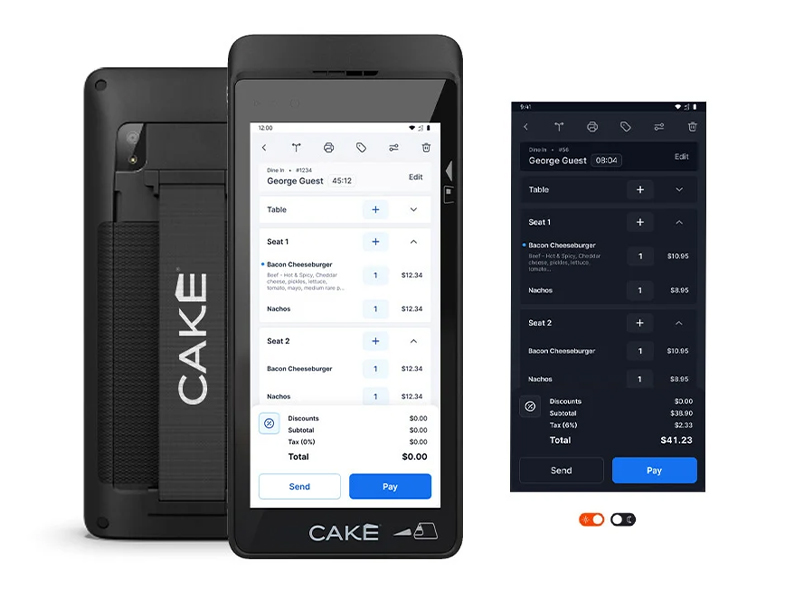
Consider the ordinary journey of a modified order. Someone hears it, records it, sends it to the right station, and eventually collects payment. Each transition creates another opportunity to wait or misunderstand. CAKEpop, the company’s handheld device, lets a server enter orders, split checks, and accept contactless payments beside the guest. The kitchen gets the instruction without the server returning to a fixed terminal first.
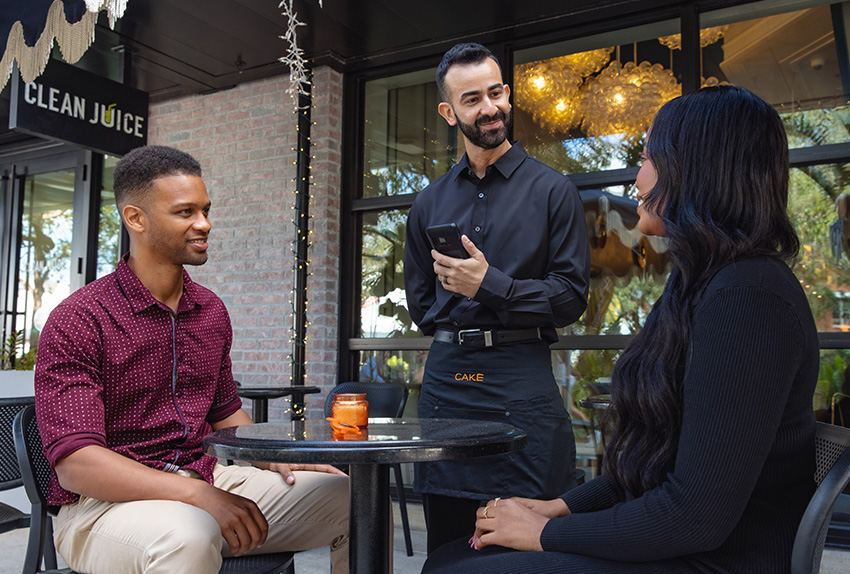
The same logic extends to online ordering. CAKE sends digital orders into the POS and kitchen workflow, reducing manual entry. Guest Manager handles floor maps, reservations, waitlists, and table-ready texts. Reporting covers sales, menu items, payroll, taxes, and sales against labor. Together, these tools give operators ways to address the small coordination problems that accumulate during a rush.
- 01GuestTable · counter · online
- 02CAKE POSOrder and modifiers
- 03KitchenTicket to prep station
- 04ClosePayment and reports
The customer-facing display adds another job at checkout. It can present a special, promote gift cards, or show a QR code while the bill is settled. The same screen that makes a transaction legible can help a restaurant explain what else it offers.
There is also a pleasingly literal example. At Besties Beverages in Tatum, New Mexico, an Epson TM-L100 prints labels for drinks and for prepared ingredients. Names and modifiers travel with the cup. Dates travel with stored supplies. In CAKE’s February 2026 customer story, the practical benefit is clarity. Nobody has to conduct a small investigation to identify a beverage.
A new center, the same kitchen
The company’s origins stretch back to Leapset, co-founded by Mani Kulasooriya and Shanil Fernando. Their earlier services business helped incubate the product. A 2013 account describes the difficult decision to close that profitable operation and concentrate on Leapset. Sysco became an important channel; its foodservice relationships put restaurant technology in front of restaurant owners. Leapset later became CAKE.
Mad Mobile acquired CAKE from Sysco in 2020. The announcement reported more than 5,000 restaurant locations using CAKE at the time. Sysco remains a partner, while Best Buy provides installation options. That combination gives CAKE a position beyond the software itself: a route into restaurants and help getting the equipment working.
Its June 2026 Mia’s Table story shows another side of the proposition. The Houston restaurant brand wanted lower costs, mobility, and a better counter experience, while keeping Olo online ordering, LRS table-location tools, and its existing kitchen-display workflow. CAKE describes an initial rollout at three locations, with two more planned next. Staff used handhelds for curbside and counter service. The appealing detail is the preservation of systems the restaurant already understood.
The bill inside the rate
CAKE’s current pricing pitch reads: “$0 down. No bill. Ever.” Its explanation matters more than the slogan. Hardware, software, updates, and support are covered through the processing rate. The comparison presents Core, Growth, and Scale packages. A restaurant still pays to process payments; the POS expense has moved into that relationship.
The arithmetic deserves attention. On an illustrative $100,000 in monthly card sales, a 0.30-percentage-point difference in processing costs $300. That is a comparison example, not CAKE’s quoted rate. Transaction fees, card mix, and the specific agreement also matter. The sensible buying exercise is to price the whole arrangement against an actual processing statement.
Compare total processing, software, hardware, and service costs.
Package scope deserves the same scrutiny. Guest Manager’s standalone page advertises a starting price of $79 a month. The pricing table marks some equipment or services as optional, and replacement promises carry limits. An operator should ask for the required devices, integrations, installation, support, and exit terms in writing. A memorable slogan cannot specify a restaurant’s entire setup.
Built around the handoff
CAKE competes with Toast, Square, Clover, and other restaurant systems. Its case rests on restaurant hardware, payments, service, and the ability to connect partner tools. Popmenu’s January 2025 partnership announcement added access to interactive menus, websites, and automated marketing. Inventory and accounting needs can involve other providers, including Orca and Shogo. Compatibility belongs in the demonstration.
The limits follow from the same design. An operator who needs a particular payment arrangement or an unusual inventory workflow should establish that fit before signing. A handheld cannot fix an overloaded grill. A reporting dashboard needs consistent menu and labor data. The purchase makes sense when the connections match the operation and the total payment economics work for that restaurant.
What can another operator copy? Trace one busy service before shopping. Identify where orders wait, where information gets typed twice, and which existing tools earn their place. Then test those exact moments. Faster order entry helps only if kitchen capacity and staff routines can absorb it. At the tea house, the revealing question was waiting in the line all along: what happens after the register takes the money?