Caitlin Tucker's career began with a desk that let her see nearly everything and control almost nothing. Fresh from The University of Texas at Austin, she became an office manager in a regional sales office of Level 3 Communications. Salespeople chased accounts. Engineers solved problems. Customer-success teams absorbed what happened after a promise met reality. Tucker sat near the crossroads, unsure of the title she wanted and close enough to notice which work changed the temperature of the room.
She liked the rush of a new customer. She was more interested, however, in the conditions that made the conversation possible. Her particular thrill was building an environment where people became comfortable enough to lower their guard. That discovery led toward event marketing, then regional field marketing at ViaWest, later Flexential. The career looks tidy from a distance. Up close, it began as attention paid to a feeling.
In October 2018, Tucker joined a Colorado startup called Quantum Metric. Her offer arrived on the day the company announced its Series A. She has described the first assignment, building a field program, in the native language of young companies: "throwin' spaghetti at walls and seeing what sticks." The phrase matters. It admits that an elegant program usually begins with inelegant experiments, and that taste is partly the memory of what failed in public.
The office was the first classroom
Before Quantum Metric, Tucker moved from operational support at Level 3 into marketing at McCarthy Building Companies, then through a run of field and programs roles at ViaWest. By 2016, ViaWest had named her its Top Marketer of the Year. In 2017 came a President's Club recognition. The awards say she performed. The sequence says something more useful: she kept moving toward work that put customers, salespeople and a live experience in the same frame.
Field marketing is often treated as the logistical cousin of strategy. The badge scanners, dinner bookings and folding signage do little to dispel the suspicion. Tucker's account gives it a sharper definition. A field marketer designs the social architecture around a commercial conversation. The work is hospitality with a revenue model, part producer and part anthropologist. Who speaks? Who relaxes? Which story travels home?
“I was more attracted to building environments that make people feel comfortable enough to let their guard down and have sales conversations.”Caitlin Tucker, on finding event marketing
That instinct followed her into Quantum Metric, where the annual Quantum LEAP gathering became a visible expression of the brand. Tucker has written about conferences as places to deepen a network, practice skills and rally an organization around customer experience. In her own posts, she praises physical presence, provocative ideas, earnest customer stories, playful audience engagement and deliberate pipeline management in the same breath. The list refuses the false choice between beauty and commercial purpose.
Seven years of context, compounded
Tucker did not parachute into the C-suite. She crossed the company one enlarged remit at a time: Director of Field Marketing, Senior Director of Experience Marketing, Associate Vice President, Vice President of Global Experience Marketing, then Chief Marketing Officer. Each title brought a wider version of the same puzzle. How does a technical product become an experience a buyer can understand, trust and repeat?
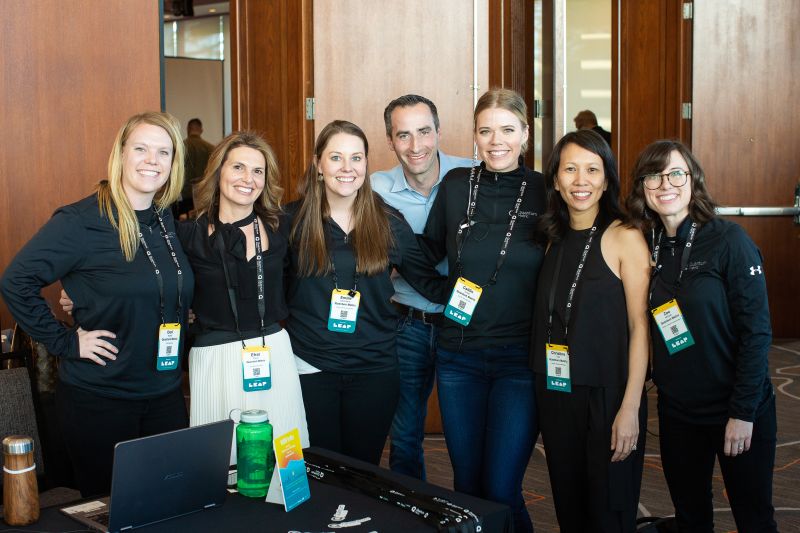
When Tucker announced the CMO role, she reached backward before pointing forward. The accompanying photograph showed members of the original marketing team at the first Quantum LEAP in February 2020. She thanked founder and CEO Mario Ciabarra for the trust and called former CMO Efrat Ravid her mentor, crediting seven years of preparation. The picture made the promotion legible as a long build, not a sudden coronation.
There is an unfashionable lesson in that tenure. Context compounds when someone keeps using it. A customer objection heard in 2019 becomes pattern recognition in 2023. An event experiment becomes a standard. A colleague becomes a mentor, and the mentor's judgment becomes part of the successor's operating system. Staying in one company guarantees none of this. Staying curious can.
The product enters the org chart
Soon after taking the CMO job, Tucker noticed an unusual signal. A large bank was recruiting for a "Digital Analytics Reporting Lead - Quantum Metric." Most company milestones arrive dressed as revenue, pipeline or contract value. This one appeared in an employment listing. The customer was creating a role around the product.
Tucker read that as a vote of confidence. A dedicated hire means a customer is investing budget, responsibility and career capital in a tool. It also marks how far Quantum Metric's name had traveled. When Tucker joined, she recalled spelling the company name on calls and correcting the stray "s" people appended. Now customers were spelling it in job titles.
Brand depth leaves behavioral evidence
It is the kind of observation marketers can steal. Brand strength is not confined to survey answers. It shows up when a customer borrows your vocabulary, rewrites a process or hires someone to own the outcome. Recognition is pleasant. Changed behavior is harder evidence.
From access to understanding
Tucker took the marketing helm as Quantum Metric was changing the argument it makes about analytics. For years, enterprise software promised access: more dashboards, more self-service reporting, more visualizations. Access solved one bottleneck and created another. Someone still had to notice a change, form the right question, investigate it and translate the result before the moment passed.
Her 2026 essay, "Not more dashboards. More understanding," describes a move from assistants that wait for prompts to systems that investigate continuously. Quantum Metric's Felix Agentic is presented as an engine that watches journeys, behavioral signals and technical telemetry, then connects a change to the people affected and the business impact. The marketing language is most persuasive when it becomes a workflow: what changed, why, for whom and how much it matters.
This is also where Tucker's old craft meets the new product. Field marketing was about creating the conditions for a candid human exchange. Agentic analytics is pitched as creating the conditions for a timely institutional exchange. Both try to shorten the distance between a guarded surface and the useful truth underneath.
“Your success is my top priority, and I will work tirelessly to elevate your voices.”Caitlin Tucker, announcing her CMO role
The customer language is not ornamental. Quantum Metric says Tucker's remit covers global brand, demand and customer engagement, while strengthening its enterprise position. Her own framing puts customer voices at the center of that brief. In practice, that means the company story cannot stop at what its software detects. It must show how a person inside a sprawling organization uses the answer to make a decision.
Put your perspective into the room
Tucker's advice to women in technology is unusually concrete. She has recalled being the only woman, or the only person with her skill set, among more senior people. Sitting back can feel prudent. Her conclusion was that progress requires contribution: remind yourself that your perspective and skills are valuable, and that you are in the room for a reason.
The advice belongs beside her commitment to mentoring and support networks for women. It also completes the circle that began at Level 3. Her first lesson was to study the room. The later lesson was to speak into it. Her executive role now asks her to shape which customers are heard, which signals receive attention and which claims the company can prove.
There is playfulness in the way Tucker narrates the work. Spaghetti hits walls. Conferences need not be boring. A missing plural becomes a small marker of brand progress. Yet the operating ideas beneath the jokes are disciplined: run experiments, make people comfortable, notice costly behavior, and connect evidence to action.
Her stated ambition for the new chapter is similarly practical. She wants customers to move from raw access toward instant understanding, autonomous discovery and faster action, while her team proves the value of the dataset underneath. It is a marketer's aspiration phrased as an operating promise. The customer should not have to admire the machinery. The customer should know what happened in time to do something useful about it. Tucker's job is to make that promise credible across a global enterprise market without sanding away the people whose behavior gives the data meaning.
The title may be Chief Marketing Officer, but the through-line is more intimate. Build a room where the important thing can be said. Then make sure someone is ready to hear it.