In March 2020, Cabo Verde’s government put a price on something startup advice usually leaves unpaid: a young founder’s time. The first Bolsa Cabo Verde Digital programme offered 30,000 escudos a month per entrepreneur for six months. It aimed to support up to 100 people working on 50 technology projects. By May, 126 entrepreneurs had applied, representing 88 projects. Before anyone could boast about scale, somebody had to be able to sit down and work.
- Give early founders financial breathing room and practical support.
- Connect training, incubation and international exposure through a public platform.
- Take digital access into island schools, using infrastructure already there.
Cabo Verde Digital, established in 2019, is the government platform connecting these ambitions. Its remit includes technological entrepreneurship, skills and the ICT community. The website addresses people with ideas, existing startups, learners and the diaspora. That is a broad invitation. The programmes behind it are considerably more particular.
A stipend with a socket attached
In a February 2020 interview, Pedro Lopes, then secretary of state for innovation and professional training, described an arrangement with pleasingly little mystery. Partner companies and universities, including CVTelecom, Unitel and NOSi, would provide incubation space, equipment, internet and electricity. Pró-Empresa would supply business support. The founder’s assignment was to turn the idea into a business.
The stipend’s arithmetic is straightforward: six monthly payments of 30,000 escudos come to 180,000 escudos per fully supported founder. That describes the original allowance, before the value of facilities or mentoring. It makes the intervention legible. A scholarship can buy time for a market test; a desk and a connection make that time usable.
Calculated allowance, not total programme cost.
Lopes also acknowledged the obvious hazard: “Nem todas terão sucesso.” Not all would succeed. He envisaged subsequent attempts improving on earlier ones. Here, failure was anticipated before the first cohort had begun. The programme’s logic allowed room for an experiment, rather than requiring applicants to arrive with a success story already polished.
“Nem todas terão sucesso.”Pedro Lopes, February 2020
Twenty-five teams, fifty faces
By September 2025, Bolsa was launching its sixth edition. Fifty young entrepreneurs, organised into 25 startups, began a three-month pre-incubation journey. The published account describes specialist mentoring, technical assistance and business and technology training. It also describes fellows learning from one another. A programme has a curriculum; a cohort gives it company.

The current Bolsa page separates idea development, technical prototyping and entrepreneurial preparation. That sequence matters: market research precedes the prototype, while company formalisation and financing preparation have their own place. It resists the temptation to confuse a working screen with a working business.
Entry is selective. Published criteria include age, residence, educational background, prior participation and availability. This is a structured commitment, with constraints on who can join. A founder should read the edition’s regulation before rearranging a life around it.
The boarding pass comes later
GoGlobal addresses another bottleneck: getting an eligible startup into rooms abroad. Its listed benefits cover preparation, return travel, accommodation, event access and an ecosystem tour. The criteria ask for a functional prototype, at least two direct employees and a business less than ten years old, alongside nationality, residence and compliance requirements. The boarding pass follows some evidence of a business.
Elsewhere in the portfolio, Kodê Verde points learners toward software-development academies and free digital courses. Fintech Islandz advertises workspace, incubation, specialist advice and connections to regulators, incumbents and investors. For a financial-services startup, understanding the rules may be as consequential as writing the code.
Cabo Verde Digital’s expertise lies in assembling these relationships. Its place in the market is between the founder and the institutions a founder needs. A private incubator or coding course can serve one requirement; the public platform connects several. Development-project support sits beside government sponsorship, with partners delivering parts of the work.
The platform also offers ways to make the conversation concrete. Governo Aberto às Startups invites founders to present solutions and discuss obstacles directly with government representatives. Re!nventa’s 2026 hackathon series assigns different challenges to different islands: public services on Santiago, the blue economy on São Vicente, sustainable tourism on Sal and volcanic agritech on Fogo. The geography becomes part of the brief. Participants are asked to build around problems that belong somewhere, rather than pitch an app in search of a purpose.
- 01 / LearnKodê Verde
- 02 / TestBolsa
- 03 / ConnectGoGlobal
A school lab gets another life
Then there is the problem a conference cannot solve: getting digital tools within reach of people elsewhere in the archipelago. In April 2026, Cabo Verde Digital described Brava as a pilot for Skodji Digital. Existing WebLab infrastructure was reactivated and upgraded, with the digital-economy and education ministries working through a shared operational model. The interesting move was to reuse an asset and give it a job.
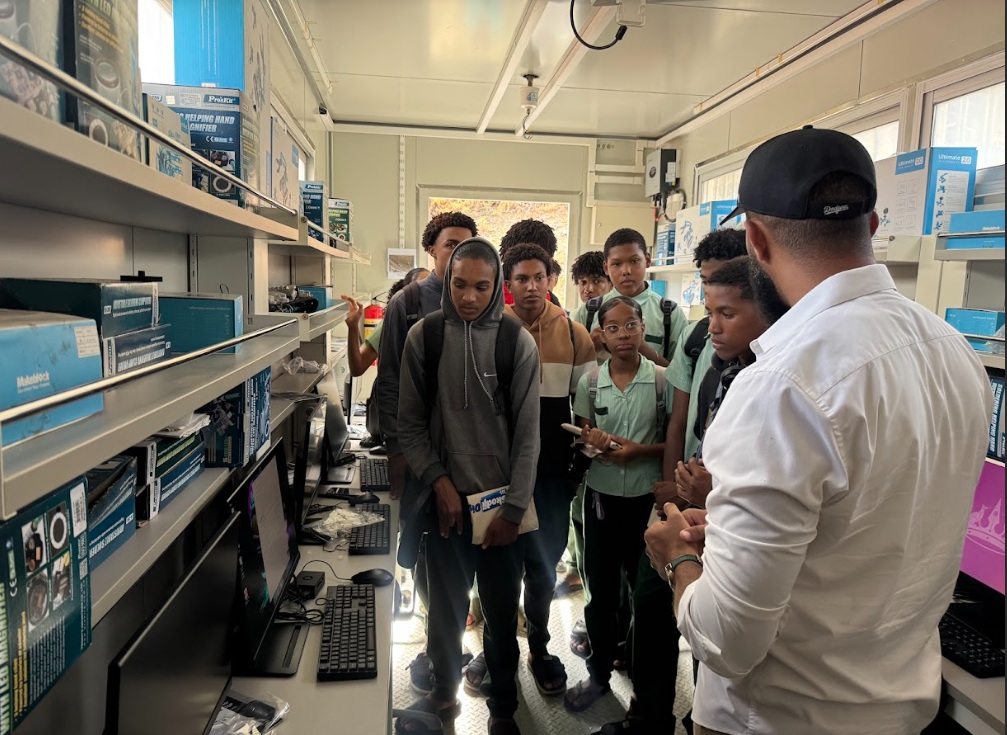
May reports describe São Nicolau hubs with Linux, offline AI tools and Starlink connectivity, supported technically by Rift One. The first phase aims to benefit more than 1,000 young people. That is a target, rather than a completed headcount. On Maio, equipment and connectivity reached Horace Silver Secondary School, where older students joined demonstrations.
Copy the arrangement, check the conditions
The useful lesson is in the arrangement of resources. Pay for the period of uncertainty. Put equipment and support within reach. Prepare founders before sending them abroad. Reuse a school lab when it can bring learning closer to a community. These are practical choices another institution could examine without borrowing Cabo Verde’s geography.
Each depends on people and institutions doing the promised work. A stipend requires funding; a lab requires technical support; international exposure requires preparation. Applications and cohort sizes measure participation. They do not, by themselves, measure enduring businesses.
The connections also run inward. RABIDA offers diaspora founders a structured route to establish or expand operations locally. The startup directory lets visitors filter companies by sector, stage and business model. Together, these services make the ecosystem easier to enter and inspect. For a founder, the sensible starting point is a specific need: skills, an experiment, a specialist introduction or a market. Cabo Verde Digital supplies several doors. The work begins with choosing one.
Find your way in
Explore Cabo Verde Digital, the Bolsa programme, GoGlobal, startup directory and RABIDA. Read the 2020 policy interview or the São Nicolau hub report.
Follow LinkedIn, X, Instagram and Facebook. Watch programme films and event coverage on Cabo Verde Digital’s YouTube channel.