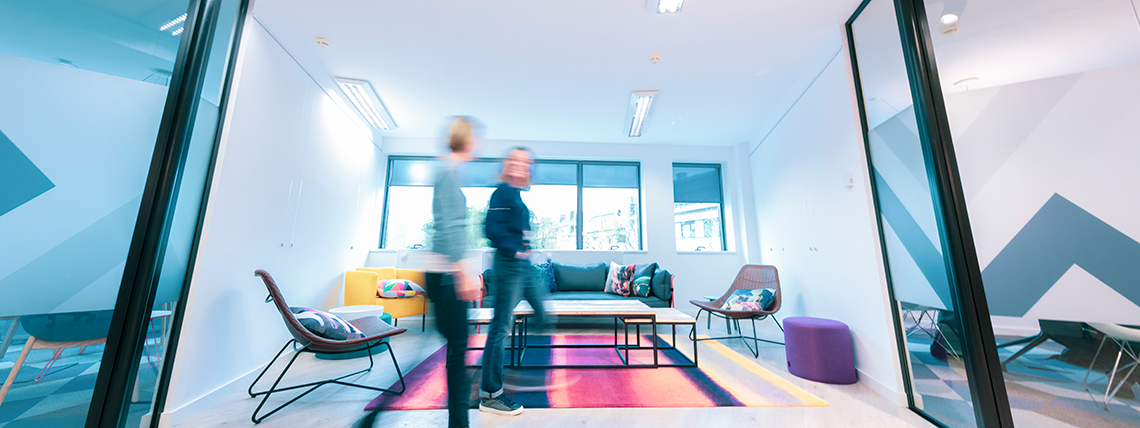
The room is called Big Bang. It has a pitching area, a kitchen, a lounge and, in summer, access to a garden. For a place concerned with the birth of companies, the name is nicely on the nose. But the more revealing detail at Luxembourg’s House of Startups is the guest list: founders, incubator teams, investors, advisers and established businesses, all with reasons to pass through the same address.
HoST occupies nearly 6,000 square metres in the Dôme building near Luxembourg City’s main railway station. Its proposition is physical and organisational at once. Gather the people who help young companies in one place, give them shared infrastructure, then arrange enough useful encounters to make the address worth having.
The Luxembourg Chamber of Commerce established HoST in 2017; the campus opened on June 1, 2018. Today, institutional descriptions identify three main incubators and accelerators supporting up to approximately 175 startups. That figure describes the community served by those hubs. The work behind it is less tidy: choosing companies, coaching founders, finding contacts and persuading people with different priorities to speak to one another.
The Chamber bought into proximity
HoST’s origin gives it a particular place in the market. A Chamber of Commerce already speaks to established businesses. Creating a home for startups puts the companies that might supply them, challenge them or help modernise them within reach. Economic development here has a very practical unit of measurement: an introduction that leads somewhere.
In a 2018 interview, founding chief executive Karin Schintgen described a project bringing together startup support and the innovation needs of existing businesses. The proposed Checkpoint service would connect entrepreneurs with specialists such as lawyers, accountants and marketing professionals. The building was meant to bring expertise into the founder’s working day.
“allow ideas to flow freely”
Carlo Thelen, Luxembourg Chamber of Commerce, on bringing startup actors together
By its first anniversary, HoST reported more than 100 startups across four innovation hubs. Its anniversary account described a next phase focused on developing services for the wider innovation community. The progression is instructive: assembling tenants gave HoST a place to work from; serving connections beyond those tenants gave it a larger job.
Three doors, three different conversations
For a founder, the first useful distinction is between the campus and its resident organisations. HoST brings them together. The specialists run their own offers. Choosing where to apply depends on the company’s product, maturity and customers.
Luxembourg-City Incubator, or LCI, was initiated by the Chamber of Commerce with support from the City of Luxembourg. Its remit includes urban technology, retail, tourism, the environment, construction, housing and logistics. It combines workspace with support for building an innovative business. Its current website lists companies including Helical, ClimateCamp and Elora, showing a community that reaches beyond a narrow municipal-technology brief.
The Luxembourg House of Financial Technology, LHoFT, concentrates on finance. It offers incubation, acceleration, education and connections across financial institutions, investors and other participants in the sector. For an entrepreneur selling into financial services, access to people who understand the industry is a substantial part of the attraction.
Le Village by CA Luxembourg brings the Crédit Agricole network into the mix. It describes its accelerator as serving more mature startups already structured around an initial offer. Its wider network supports introductions to large companies, expert advice and international development. A company trying to expand its sales has a different conversation here from one still working out what to build.
Separate programmes. A shared campus.
There are other kinds of expertise in the house, too. The International Climate Finance Accelerator supports emerging climate finance fund managers. That is a different task from incubating a company making a climate-related product. The campus community also includes the Luxembourg Business Angels Network, venture investor Middlegame Ventures, startup association PULSE and Luxembourg Tech School. The mix gives the word “support” several concrete meanings.
The reach also extends beyond Luxembourg. HoST’s offer includes ecosystem promotion abroad, participation in technology fairs and links across the Greater Region through EU-Tribe. These activities matter to a campus whose residents may need customers outside their home market. An international introduction is another service the organisation can arrange around its resident specialists.
The desk comes with expectations
LCI publishes a fixed-desk price of €395 a month, excluding VAT. A private office costs €445 per desk per month, excluding VAT. Its offer includes business support, round-the-clock access, equipped workspace and practical services such as meeting-room booking and connectivity. These are the incubator’s prices; other resident organisations have their own arrangements.
Fixed desk, excluding VAT.
Admission through selection.
Applicants go through an online application, an eligibility check, a selection committee and onboarding. LCI’s criteria include innovation, scalability, employment creation and an MVP-ready project. It also considers the team, participation in the community and potential economic or social impact in Luxembourg.
Those conditions explain who the offer suits. A founder needs a reason to use the support and a business that fits the programme. Someone seeking only a place to put a laptop should compare ordinary coworking options. A team working on research-intensive technology should also consider Technoport, whose offer explicitly focuses on deep tech and commercialisation. Luxembourg’s support organisations can be collaborators as well as alternatives.
A corporate problem looking for a startup
The Open Innovation Club gives the established-business side of HoST a clear mechanism. A company brings an innovation need: a process to improve, a product to develop or a technology to understand. The club can then search for relevant startups through its networks.
That sequence matters. It begins with a potential customer’s problem, giving entrepreneurs something more useful to respond to than a vague invitation to “innovate.” HoST’s description of its sponsors also says they can become early customers testing startup products and services. The customer, in this arrangement, contributes both commercial knowledge and the possibility of a real transaction.
The practical lesson for founders is to make the introduction easy to act on. Explain the problem you solve, who inside the buyer’s organisation owns it and what a first test would involve. That is an inference from the club’s matching approach, rather than a promise about its results. A shared address can help people meet; the product still has to earn its place in the customer’s business.

There is also a quieter form of help: business mentoring. HoST directs growing startups toward experienced entrepreneurs for individual conversations about managing teams, handling growth and approaching new markets. It broadens the offer beyond finding investors. A founder who has won customers can still need help organising the company that must now deliver for them.
The social calendar does some of the work
HoST’s public events show how the campus tries to keep those encounters happening. A September 2024 invitation welcomed startups, incubator teams, members and guests to its monthly breakfast in the Big Bang area, from 9 to 10:30. Participants could register or simply come along. It was a deliberately uncomplicated reason to meet.
External organisations can also book spaces at HoST. The Forum offers boardroom and training facilities; Big Bang accommodates larger gatherings. The Luxembourg Convention Bureau lists Big Bang at 252 square metres, with reception capacity for 100 people. Event organisers are therefore another customer group, bringing visitors into a building whose usefulness depends partly on who passes through.
There is a pleasingly Luxembourg detail in the campus’s public history. During a December 2021 visit, the then Hereditary Grand Duke saw presentations involving Salonkee and construction-technology company GAMMA AR. He also signed a totem in the coworking area alongside signatures left by the Grand Duke and Grand Duchess. Few office guest books have quite that cast.
Finance gets something it can try
A resident hub’s new offer illustrates how the campus continues to change. On April 13, 2026, LHoFT inaugurated its AI Experience Centre, supported by the Ministry of Finance. It opened with more than 20 live, interactive demonstrations covering areas including wealth management, compliance, risk and sustainability.
LHoFT says the exhibits rotate every six months and that group visits can be arranged. Financial executives and other visitors can see applications working and ask questions about them. The development belongs to LHoFT, while giving the wider address another purpose: a place where prospective users can examine technology firsthand.
HoST also reaches people who never rent a desk through Startup Corner. The podcast features founders, business angels and innovation specialists, with support from the education ministry’s SCRIPT department. Its catalogue includes conversations about dentistry software, municipal technology and supply-chain risk. The range makes entrepreneurship less abstract: people can hear what an actual company is trying to do.
Copy the introductions before the floor plan
For another city or community builder, HoST’s transferable idea is the arrangement of complementary organisations. Put sector expertise, business support and potential buyers within reach, then give them recurring reasons to interact. The breakfasts, corporate searches and specialist programmes make the physical space useful.
That approach needs willing participants. It suits founders who can use local relationships, specialists prepared to share access and established businesses willing to engage with young suppliers. A building full of people who have no reason to collaborate would offer a much weaker proposition. Institutional backing and sustained community work are part of the design.
For a founder considering HoST, the next step is specific: choose the resident hub that fits, examine its admission criteria and arrive with a problem someone there can help solve. For a corporate visitor, bring a brief that a startup can answer. There is plenty of room in the house. The useful question is who you need to meet.
Find your way in
Visit HoST · Apply to LCI · Explore LHoFT · Le Village by CA
Startup Corner interviews · Watch: meet LHoFT · Inside the AI Experience Centre