In 2008, Nasir Zubairi had a banking career worth keeping and a growing desire to leave it. He was at Royal Bank of Scotland. The work had brought him into the machinery of modern markets, where technology moved money at speeds few customers ever needed to contemplate. Yet the prospect of another day at the office had lost its appeal. He resigned and went to business school. For someone paid to understand risk, this was a fairly personal application of the subject.
Nearly two decades later, his career offers an interesting answer to the question of what comes after the trading desk. There have been payments businesses, a Berlin company builder and a Luxembourg institution assembled from scratch. In 2026, he left the Luxembourg House of Financial Technology, the LHoFT, to become CEO of Paytm Europe Payments. The recurring subject is remarkably ordinary: helping financial services become more useful to the people trying to use them.
The banker goes back to class
Zubairi was born in London and studied at the London School of Economics. His early career carried him through capital markets and across continents. His professional biography includes EBS, ICAP, HSBC and RBS, with work in London, New York, Tokyo and Singapore. By the time he became a public advocate for fintech, he had already spent years inside the institutions it proposed to change.
At London Business School in 2008-09, he studied for an MSc and became a Sloan Fellow. He has described being hungry for new knowledge. It is a useful detail in a career that can otherwise look like a tidy succession of appointments: he went back to being a student before he knew precisely what the next business would be.
The entrepreneurial apprenticeship proved considerably less tidy. In a 2015 interview, he recalled how difficult it had been to raise money for his first venture when investors doubted that startups could compete with banks. Building a network took so much selling that, by the weekend, he wanted a break from talking. The public speaker and connector had discovered the limits of his own conversational battery.
His favourite recognition from that period was being voted Best Mentor at the Awards for Enterprise in 2012. He was delighted by the evidence that his help had been useful. There is a whole career philosophy hiding inside that small joke.
“I was so happy to find out that I was useful!”
Nasir Zubairi, on his 2012 mentoring award
A financial problem small enough to recognise
His first entrepreneurial work concerned invoice financing. He later explained that two separate experiences had made him notice how awkward, expensive and risky cash flow could be for smaller businesses. After selling that first business, he worked in payments, pursuing a related problem: helping companies manage the money moving through their operations.
That background gives his fintech vocabulary a particular emphasis. An invoice is an unglamorous object until someone needs it paid. A payment process is easy to ignore until it delays a business. His interest in these subjects began with identifiable friction in customers’ lives, a theme that would survive his move into national institution building.
At Currencycloud, he served as director and head of product marketing in 2012-13. He then became a venture partner at FinLeap in Berlin between 2014 and 2016. The route moved him from selling a financial service to helping build the companies that might deliver the next one. It also put him in regular contact with founders learning that a promising idea still needs customers, capital and a functioning business.
- 2008-09Back to business school
- 2014-16Building with FinLeap
- 2017Launching the LHoFT
- 2026Leading Paytm Europe
A small country with short distances
Luxembourg entered the story through an invitation to speak at ICT Spring in 2015. Zubairi liked the openness he encountered. He moved there with his family in 2016, initially intending to establish a digital custody bank. Instead, he was asked to help Luxembourg for Finance develop a strategy for financial technology and digitalisation. The assignment grew into the LHoFT, launched in 2017.
His description of the country was rooted in access. People could reach senior decision-makers; government, financial institutions and entrepreneurs could actually speak to one another. For a person whose work increasingly involved making introductions, a short distance between the relevant people was a business asset. Luxembourg offered him a place to apply lessons gathered across much larger markets.
The launch involved the decidedly practical business of incorporating a foundation, putting governance in place, assembling a team and establishing a hub in Kirchberg. The original proposition combined public backing with private-sector participation. The government helped drive the initiative, while financial and professional-services partners brought their own needs and capabilities to the table. An institution meant to encourage execution had to begin by executing its own to-do list.
Teaching two sides to hear each other
From the beginning, Zubairi’s advice could be uncomfortable for both startups and banks. In 2017, he urged founders to understand procurement. A bank considering a young supplier needed confidence that the company would still be around to provide its service. A promise of another funding round did little to settle that question.
He also argued that banks underestimated the difficulty of innovation. Ideas were readily available; internal processes and incentives could make implementation painfully slow. The intermediary’s job required a willingness to explain each side’s constraints to the other. There is little theatrical glamour in that work. There is, however, considerable value in a conversation that ends with a contract someone can sign.
Brexit offered another test of his approach. Asked in 2019 how the LHoFT might benefit, he resisted treating disruption as a prize. He wanted the European market to become easier for firms to serve. Helping British businesses establish an EU presence meant dealing with offices, hiring, legal questions and introductions to regulators. The practical welcome mattered more than the victory speech.
young fintech companies housed at the LHoFT
companies had passed through its doors
The less photogenic work
By 2022, the LHoFT had reached capacity. Its next phase put more emphasis on education and talent, alongside sustainable finance. Some 300 digital workshops had drawn more than 11,000 participants. Zubairi wanted financial employees, particularly middle managers, to understand technology well enough to work with it. The task involved a great deal more than giving startups somewhere to sit.
Financial inclusion had an equally concrete place in the programme. Catapult Inclusion Africa supported businesses working to broaden access to financial services. Sustainable finance raised another set of practical questions: where to find the right data, how to handle reporting and compliance, and how to bring useful solutions into existing institutions. In a 2023 interview, Zubairi described governance as a major focus for Luxembourg’s fintech offering. He also identified room for more environmentally focused solutions.
By late 2024, another initiative showed the same preference for shared problems. Catapult: Future Foundation invited firms to work on secure data and document exchange for the financial industry. Zubairi had chaired a working group on shared infrastructure; a subsequent steering committee identified eleven priorities. Data exchange came first.
The idea was to reduce the repeated effort involved when institutions each wrestled with similar operational obstacles. Firms would help define requirements and evaluate proposals together. A five-day bootcamp was planned for 2025. It is hard to put document exchange on a glamorous poster. It is easier to imagine why the people handling those documents would care.
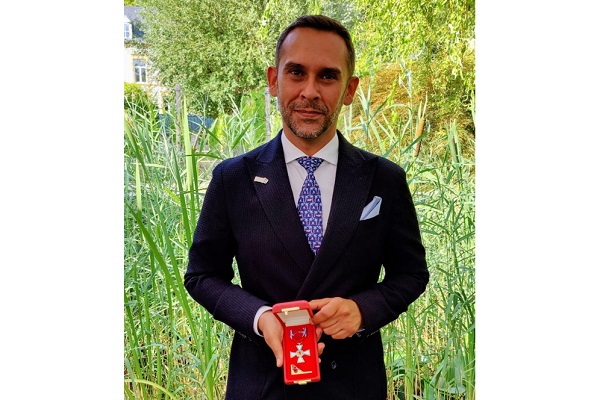
The medal and the people behind it
On 18 July 2022, Zubairi received the Officer of the Order of Merit of the Grand Duchy of Luxembourg for services to the economy. He described the honour as recognition of the LHoFT’s collective work. For a British professional who had arrived only six years earlier, it also reflected the welcome he felt the country had given him.
His connections extended beyond the institution: advisory work involving finance and technology at the IMF, policy work at the OECD and board experience at SEB. These roles put him in conversations about how financial change should work at the level of institutions and rules. They also helped explain why a former trader had become comfortable translating between entrepreneurs, established finance and public policy.
Away from those conversations, he has listed cricket, snowboarding, gaming and family among his interests. Education also keeps returning to his public comments. His curiosity about how people learn reaches beyond professional training to the way schools prepare children for the future. A career spent adopting new tools appears to have left him impatient with learning methods that stand still.
Back to the merchant
In March 2026, the LHoFT announced that its founding CEO would leave that summer to lead Paytm’s European business from Luxembourg. Paytm Europe Payments had been incorporated in January. The move brought Zubairi back to a commercial operating role, with a familiar customer in view: the merchant who needs payments to work.
By October, his public professional profile identified him as CEO of Paytm Europe Payments S.A. His farewell to the LHoFT thanked the founders, institutions, partners and colleagues who had helped build it. He gave particular credit to the team. The institution would continue with the relationships and capabilities accumulated over nearly a decade.
His new title changes the assignment. The underlying test remains recognisable from his early work with invoices: whether a financial service helps a business get on with its day. After the trading desks, the classrooms, the startup pitches and the national honour, usefulness is still a demanding ambition. It has the additional virtue of being something a customer can judge.