At an early university outreach visit, the people arriving from PICTI encountered a security guard with a reasonable question: where were the children? Laith Kassis, a member of the team that started the incubator in 2004, later recalled that the guard had understood “incubator” to mean a nursery. Before anyone could explain a startup, somebody had to explain the institution meant to help one.
The misunderstanding is amusing. It also identifies the size of the assignment. Palestine Information and Communication Technology Incubator was helping introduce a way of doing business, alongside the businesses themselves. A promising idea needed people who understood what should happen next.
- PICTI helps Palestinian technology founders turn ideas into legitimate businesses.
- Its support combines mentoring, training, technical assistance, legal help and funding connections.
- Project eligibility matters: a training place and a funded incubation place are different offers.
A business needs somewhere to go next
PICTI describes itself as Palestine’s first nonprofit ICT incubator. Its beneficiaries include technology entrepreneurs, small businesses and freelancers. Its mission contains a revealing ambition: “a sustainable company with an international ambition.” The destination is a working enterprise with customers beyond the founder’s immediate surroundings.
Look at the services and the theory becomes practical. Training addresses leadership, team management and business tools. One-to-one mentoring examines goals and weaknesses. Technical assistance helps teams apply technology. Legal support helps an idea become a legitimate business. Networking connects founders with their industries, donors and investors.
For a founder, the attraction is having related problems handled together. A better pitch may expose a weak business model. A plausible business model may still require legal work. A mentor’s introduction becomes more useful when the team can explain what it sells. Each service makes the next one easier to use.
PICTI’s expertise sits at that junction between technology and business development. Its startup directory, organized around West Bank and Gaza ventures, includes categories such as education, fintech, agritech and e-commerce. The incubator’s role is to help the people building these businesses, rather than sell one software product of its own.
Sixty teams, nine places
The mechanics become visible in From Innovation to Creation, a project funded by the European Union with SPARK as a collaborator. Its published schedule ran from October 2022 through September 2023. The design called for training 60 technology-led teams, then selecting nine winners for a six-month incubation program.
Published targets for the 2022-2023 project, not a report of completed results.
The planned package included seed funding, sector-specific investor connections, branding and a listing in the startup directory. Even branding belongs in this sequence: a team must become intelligible to customers and funders. The program tied social entrepreneurship, green technology and digital technology to an explicit selection process.
The copyable principle is straightforward. Offer a wider group useful preparation before concentrating expensive support on a smaller cohort. But applicants should read the particular call carefully. Training does not automatically confer a grant, and selection does not establish that a business will survive.
The money has a job description
PICTI’s public record shows a nonprofit working through funded projects and institutional partnerships. Its historical Gaza workspace also offered daily, weekly and monthly rentals. This creates several routes into support: an entrepreneur might need a place to work, a specific course or an eligible project cohort.
Med Pearls provides a concrete example of what money was intended to buy. The Mediterranean tourism partnership included support for ICT solutions applied to slow-tourism products. A Palestinian call advertised in 2022 allowed eligible applicants to request up to €25,000. Here, software development was attached to an industry use case.
That grant ceiling was an applicant-level offer, subject to the call’s rules. By contrast, the approximately €2.8 million budget announced for EUSEEDS covers a regional consortium. Approximately €2.5 million, or 89%, comes from European Union co-financing. These numbers describe different financial objects. Neither is a valuation of PICTI.
“We experimented with different incubation models”Laith Kassis, reflecting in 2014
Kassis’s account also records an early setback: a proposed seed fund failed to raise its intended capital. His reflection points toward a broader support system as a condition for successful startups. PICTI’s own annual report later documents a practical shift toward acceleration and commercialization through a Business and Innovation Center established in 2012.
The next connection is a university
PICTI’s partnerships extend beyond the usual founder-and-investor pairing. Equal rooting, funded by Sweden’s development agency Sida, set targets of eight women-led startups and 47 four-month internships. Entrepreneurship and employment appear together, acknowledging that founding a company is one route to earning a living.
On January 29, 2026, PICTI announced that EUSEEDS had selected 24 universities across five Eastern Mediterranean countries. Six were Palestinian institutions, including Al-Aqsa University in Gaza and universities in Jenin, Bethlehem, Hebron, Abu Dis and Nablus. PICTI is the Palestinian partner; the initiative connects digital skills, employability and student entrepreneurship.
Its market position is therefore broad business support anchored in Palestinian ICT, with access to international cooperation networks. Gaza Sky Geeks offers another route through technical training, mentorship and company advice. For an applicant, the useful comparison is the available program, its eligibility and the help needed at that moment.
A desk is only useful if you can reach it
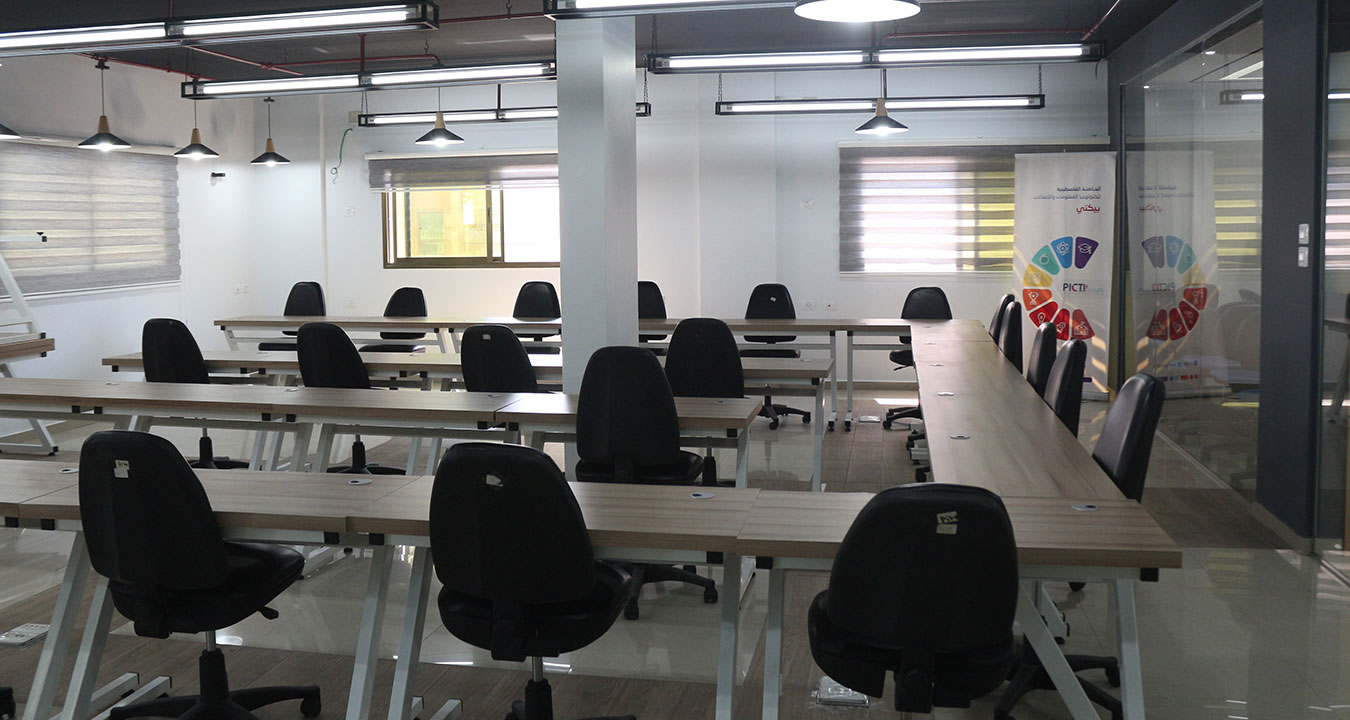
The limits are painfully concrete. In January 2024, PICTI reported that repeated Israeli airstrikes had significantly affected its Gaza office building and displaced its staff. Its account dates the opening of the coworking spaces to early 2022. A workspace photograph needs that history beside it.
Mentorship and investor introductions depend on people being able to meet, work and follow through. Physical access, functioning infrastructure, eligible funding and reachable customers are conditions of the model. PICTI’s story gives other incubators a useful discipline: arrange support around those dependencies. A founder should be able to see the next practical step, and have somewhere to take it.