Rick Hendrick wanted an ocean view. Bruton Smith had a racetrack to sell him. When Smith called about buying a condominium at Charlotte Motor Speedway, Hendrick explained that his idea of a second home involved the sea, rather than stock cars. Two years later, he bought one anyway. It cost him more. Smith had a way of making yesterday’s peculiar proposition look like tomorrow’s missed opportunity.
A home above turn one was an unusually literal expression of his business philosophy. People loved racing. Why assume they wanted to leave? Give them somewhere to sit, somewhere to eat, somewhere to watch the replay. Perhaps somewhere to keep their slippers. Over several decades, the founder of Sonic Automotive and Speedway Motorsports kept enlarging his answer to a fairly ordinary question: what would make someone want to come back?
Before those additions came a subtraction. Smith lost control of the speedway he had helped create. The return took years, and it ran through a Ford dealership in Illinois. His career becomes more interesting when the bankrupt track and the showroom are allowed into the same picture. The cars he sold helped him recover the place where other people raced them.
The farm had everything except spending money
Ollen Bruton Smith was born on March 2, 1927, near Oakboro, North Carolina, the youngest of nine children. His family’s farm supplied the essentials of life and an education in work. It also supplied a persuasive reason to leave. He later recalled long days of labor that produced food and shelter without much money. The arrangement did little to recommend farming as his future occupation.
Racing offered another possibility. As a teenager, Smith bought a race car for $700 and tried driving. He believed he could compete. His mother had reservations and began praying that he would stop. Smith’s account of the negotiations was succinct: “You can’t fight your mom and God, so I stopped driving.” Even an ambitious young businessman could recognize an unfavorable balance of power.
Promotion kept him close to the engines. By 1949, he was running the National Stock Car Racing Association, competing with Bill France Sr.’s NASCAR. Merger discussions followed, but Smith’s Army service interrupted them. He spent two years serving stateside as a paratrooper; when he returned, his association had folded. He resumed promoting, taking over events at the Charlotte Fairgrounds in 1954.
That early experience matters because it put the paying crowd at the center of his working life. A driver could concentrate on beating the car ahead. A promoter had to persuade people to spend an afternoon watching. Smith would eventually operate on a much larger scale, but he retained the promoter’s interest in the person deciding whether the ticket was worth buying.
Granite is an expensive surprise
Smith and driver Curtis Turner began building Charlotte Motor Speedway in 1959. Their plan was a 1.5-mile superspeedway outside Charlotte, with a 600-mile opening race. The World 600 ran on June 19, 1960. The distance gave the new venue an immediate identity: a long examination of machinery and patience, staged by two partners whose own finances were already being examined rather severely.
Construction encountered granite that had to be removed, sending costs upward. Debt outlasted the opening-day excitement. The speedway entered bankruptcy reorganization in 1961, and Smith left in 1962. A completed track could still be a failing business. People could buy tickets, cars could circulate, and the person who had imagined the enterprise could find himself outside its management.
He moved into other business ventures in Texas and Illinois. In 1966, he opened Frontier Ford in Rockford, Illinois. Dealerships gave him another way to turn his interest in automobiles into a livelihood. Meanwhile, he began buying stock in Charlotte Motor Speedway. The return was assembled through share purchases, rather than announced by a triumphant lap.
By 1975, he was again the majority stockholder and back in charge of daily operations. Turner had died in 1970. Smith’s second spell at Charlotte therefore carried the memory of a partnership as well as the satisfaction of recovering an asset. He hired H.A. “Humpy” Wheeler as general manager. Together, they began expanding what a trip to the speedway could include.
A room with a very loud view
The improvements ranged from the necessary to the improbable. Charlotte added and modernized concessions and restrooms, expanded grandstands and built suites. Then, in 1984, came 40 condominiums overlooking turn one. A racing venue had acquired year-round residents. For anyone accustomed to a grandstand bench and a long walk to the car, this represented a considerable revision of the afternoon’s possibilities.
Hendrick’s eventual purchase gave Smith’s idea a pleasing little endorsement. The initial objection was perfectly reasonable: an ocean-view condominium sounded more restful. Smith was selling something with a different appeal, proximity to a sport its customers cared about. He understood that affection for racing could support more than admission. Some people would buy a seat; others would buy an address.
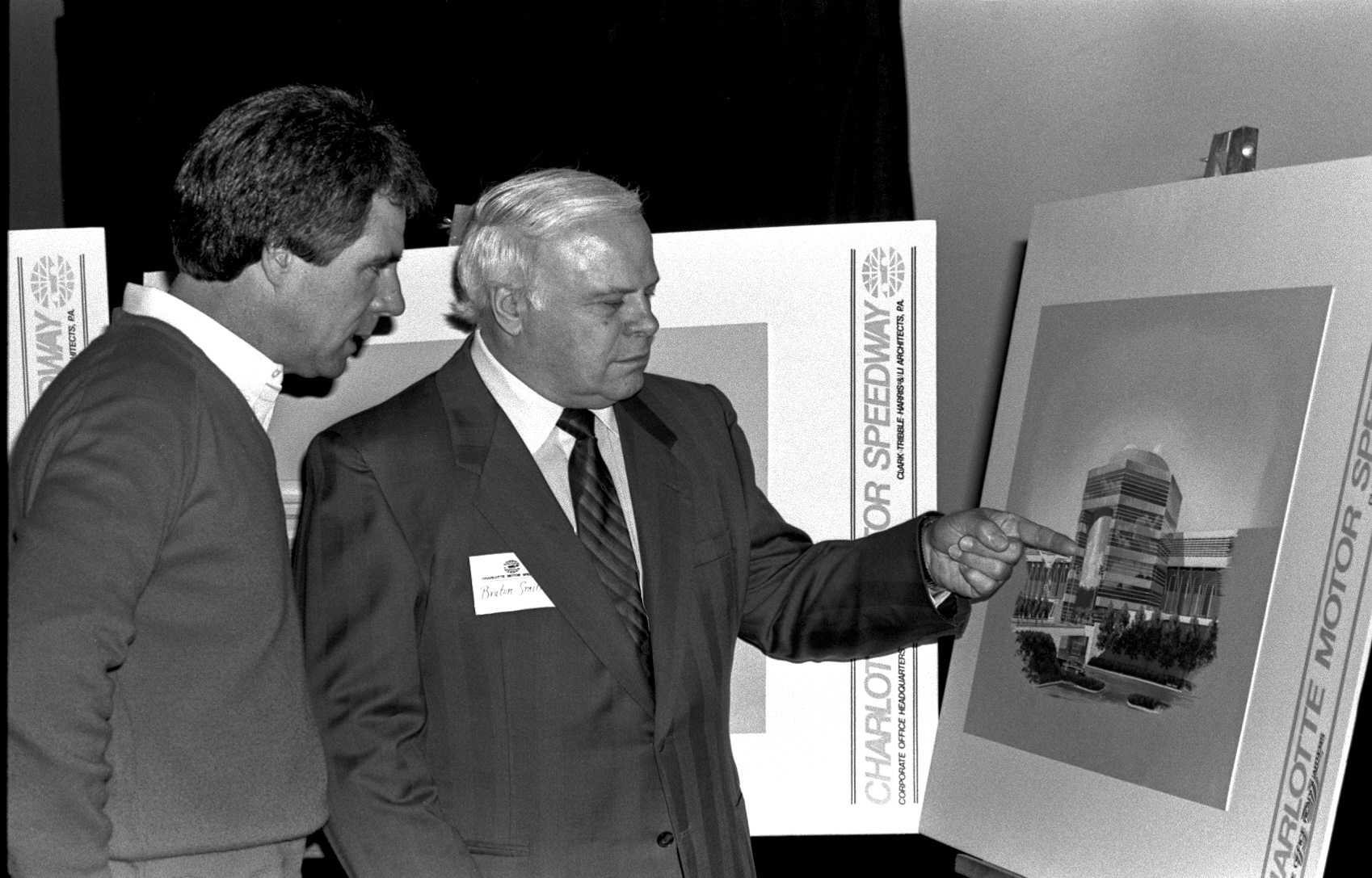
Smith Tower opened in 1988, a seven-story building that brought offices, ticket operations and The Speedway Club into the complex. In 1992, a permanent MUSCO lighting system made Charlotte the first modern superspeedway to hold night racing. The physical place kept changing around the oval. Hospitality and engineering became part of the show, alongside the competitors who had originally drawn the crowd.
The ambition could be measured in light fixtures: 1,200 of them in that 1992 installation. Later, it could be measured in screen area. Charlotte added a 16,000-square-foot high-definition display in 2011. Texas got Big Hoss TV; Bristol got Colossus. A spectator who had come to see fast cars was increasingly being offered help seeing everything else that happened to them.
“When I say, ‘we work for the fans,’ I really take it to heart.”
Bruton Smith, 2016
Two businesses, one showroom office
The speedways became a network. Atlanta joined in 1990, Bristol and Sonoma in 1996, and Texas Motor Speedway opened in 1997. Speedway Motorsports went public on the New York Stock Exchange in 1995. The collection of venues placed Smith’s business across regions with different racing traditions, rather than leaving it dependent on a single North Carolina oval.
His automotive retail company followed onto the exchange in November 1997. Sonic Automotive launched as a public company with 20 stores representing 15 brands. Smith was 70. The dealerships that had once helped finance his return to racing now had their own public-company future. Selling cars was a substantial enterprise in its own right, with its own customers, employees and demands.
For all the corporate scale, he kept his primary office at Town & Country Ford in Charlotte. The location suited his view that dealership managers belonged in the showroom, close to customers and the people serving them. One could own racetracks, take companies public and still choose to spend the working day where somebody might be asking about a trade-in.
His sons worked within those businesses. Scott and David held executive roles at Sonic; Marcus took leadership at Speedway Motorsports. The family name appeared in the boardroom and at the track, but Smith’s own preferred office remained a useful detail about his priorities. The business was large enough to require corporate machinery. He still wanted to be near its everyday transactions.
A sharp elbow, followed by a handshake
Smith’s relationship with NASCAR included competition, arguments and cooperation. He had challenged the organization as a young promoter; his venues later depended on the races it sanctioned. Both parties had reasons to disagree and reasons to continue doing business. The resulting relationship could be abrasive without being disposable. A sport with expensive tracks and a limited calendar made negotiation part of the spectacle.
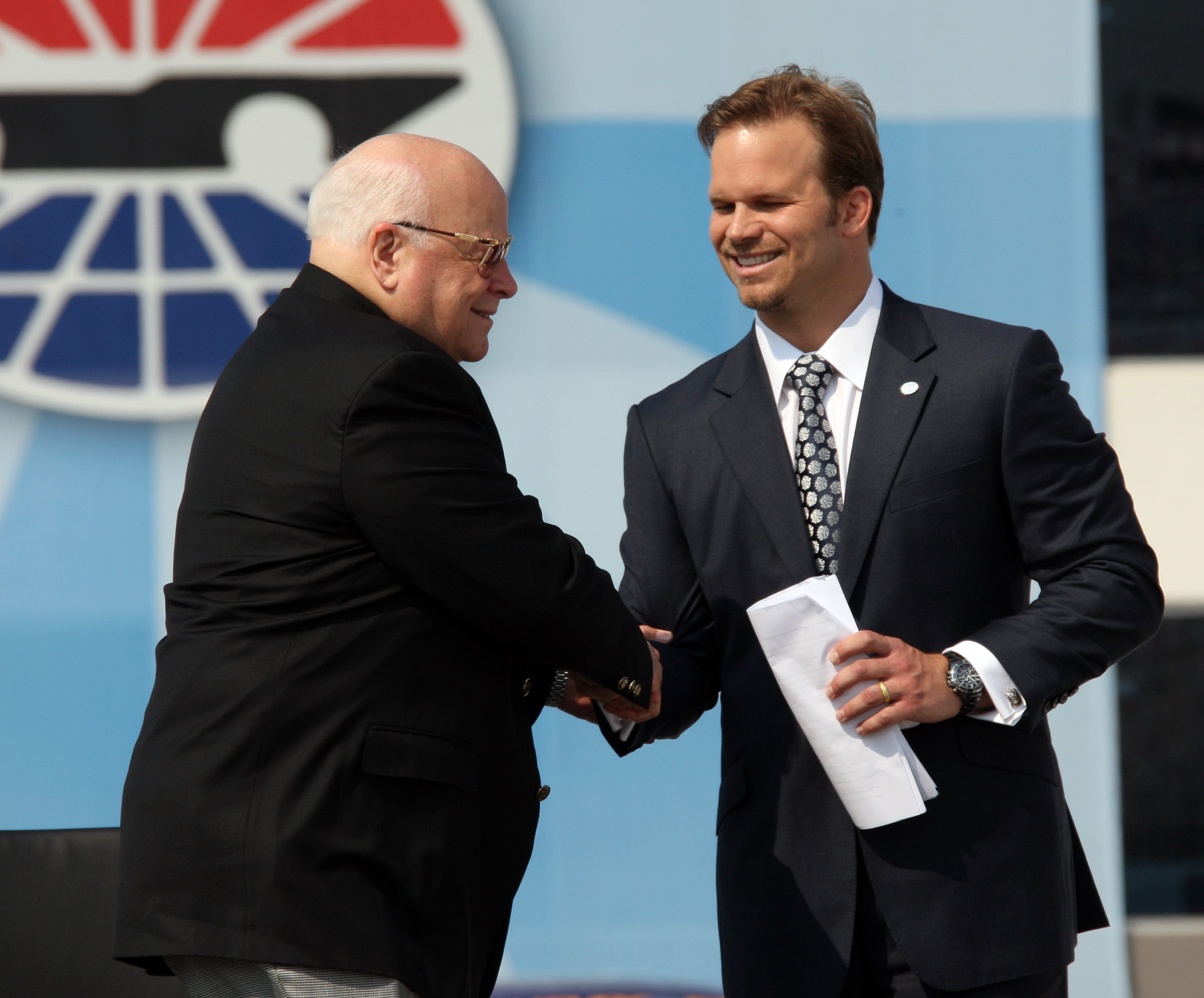
When Smith was elected to the NASCAR Hall of Fame’s 2016 class, NASCAR chairman Brian France supported his candidacy. Smith received 68 percent of the vote. The induction put the promoter alongside drivers, including Turner, his former Charlotte partner. A career spent arranging the place where competition happened had earned recognition among the people who competed.
He also understood the pleasure of a well-placed tease. Asked about the road named after him near Charlotte Motor Speedway, he wished for special dispensation if caught speeding. Then he compared it with another road bearing his name in Georgia, which he considered nicer. Even a civic compliment could become an opening for a little competitive assessment.
The work beyond the gates
In 1982, Smith founded Speedway Children’s Charities. Its chapters developed around the racing communities, funding local organizations that help children. The institution gave the venues another relationship with their surroundings, one that continued between race weekends. Education, food and other everyday needs could draw support from the same network that sold tickets and staged events.
By the end of 2025, the charity’s cumulative grants approached $80 million. That figure belongs to the continuing organization and the people who sustained it, as well as to its founder. Smith died on June 22, 2022, aged 95. His businesses and charitable organization carried on, making the later chapters of his legacy the work of other hands.
Consider the distance between the farm and that showroom office. Smith spent decades acquiring and building, yet the details that explain him best remain wonderfully physical: granite under a construction site, stock certificates buying a route back, a condominium above a turn, lights over an oval. His ambitions tended to leave something that could be visited.
Hendrick eventually got his racetrack view. Smith got a customer who had initially preferred the ocean. Somewhere in that small, expensive change of mind is the promoter’s satisfaction: an idea that sounded odd had found its buyer, and the place was ready for another improvement.