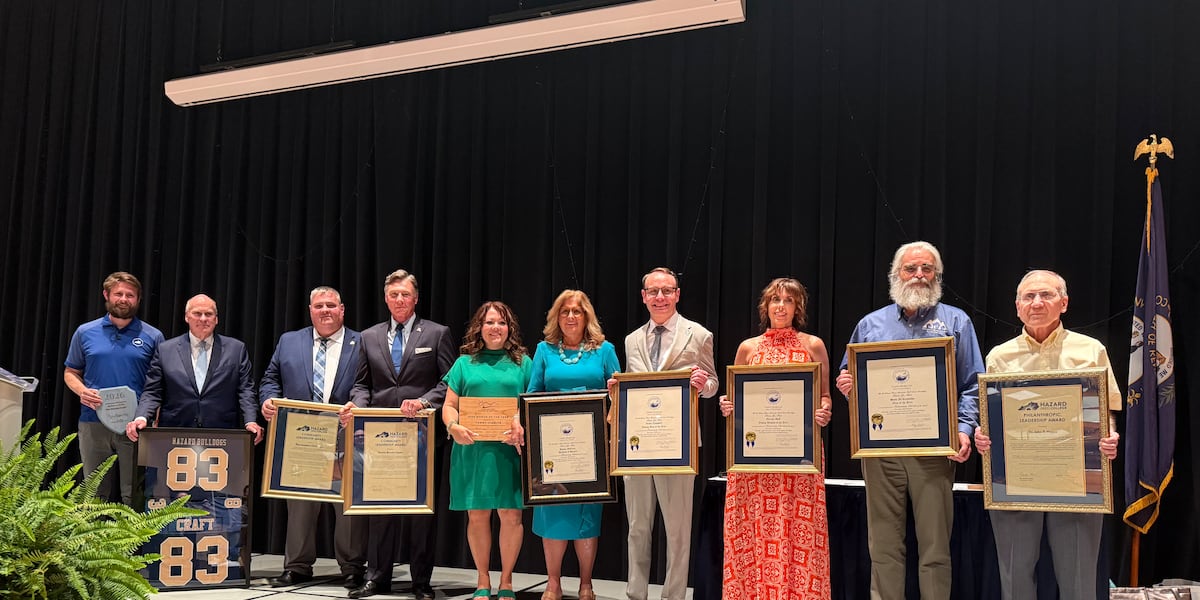
The road home, for Joe Craft, comes with a soundtrack. Drive off the Mountain Parkway, see the mountains, turn on the Hazard radio station. In September 2026, back in the eastern Kentucky town where he grew up, he described that sequence while accepting recognition as William D. Gorman Humanitarian of the Year. “It’s home...it’s home,” he said. For someone whose working life has involved corporate reorganizations, public markets and coal contracts stretching years into the future, the directions were pleasantly uncomplicated.
Craft has been president and chief executive of Alliance Resource Partners since August 1999. He added the chairmanship in January 2019. The business is based in Tulsa, Oklahoma; his public commitments keep drawing a map of Kentucky. Follow his name and you find basketball practice courts in Lexington, football facilities, a science and mathematics academy in Morehead, and the hometown that still supplies the radio station.
There is something revealing about the places where a person chooses to spend money after making it. With Craft, the pattern is unusually legible. Coal made the business possible. Kentucky furnished his education. The institutions he supports bring those experiences into public view, sometimes with considerable fanfare and sometimes with the quieter transaction of a teenager getting a place in a college classroom.
An accountant’s route into the coal business
Joseph W. Craft III was born and raised in Hazard. He left for the University of Kentucky, completing an accounting degree in 1972 and a law degree in 1976. Those are useful qualifications for someone who will eventually have to understand both what an asset earns and what the paperwork says it owns. They also make his later career less mysterious than a label such as coal magnate might suggest.
Before MAPCO, he worked as an attorney at Falcon Coal Corporation and Diamond Shamrock Coal Corporation. At MAPCO, his responsibilities included general counsel and chief financial officer; he became president of MAPCO Coal in 1986. He also completed the senior executive program at MIT’s Sloan School of Management. His preparation crossed legal, financial and operating work, rather than staying inside one professional compartment.
The consequential ownership change came in 1996, when Craft led a management buyout of MAPCO’s coal division. The business became Alliance Coal. In 1999 came the public offering of Alliance Resource Partners, the coal industry’s first publicly traded master limited partnership. The progression matters: he had been running coal operations before he helped buy them, and the stock-market chapter followed the buyout.
By 2008, his work had earned Ernst & Young’s Southwest regional Entrepreneur of the Year recognition in energy, chemicals and mining. The distinction fits a career in which entrepreneurship arrived through an existing business. Craft’s starting material was a coal division with a corporate parent, rather than a new product waiting for its first customer. His task was to give that operation a different ownership and financial future.
The donation that doubled after a tour
In the summer of 2005, Craft pledged $3 million toward Kentucky’s new basketball practice facility. After touring it, he doubled the commitment to $6 million, the sum requested for naming rights. The university announced the gift in August 2006. At that point, it was the largest private gift in UK Athletics history. A site visit had become a rather expensive afternoon.
The Joe Craft Center opened in 2007, serving the men’s and women’s basketball teams. Practice buildings have a particular place in sports philanthropy: the donor’s name accompanies the work before the crowd arrives. Repeated shots, staff offices and the daily mechanics of a program give the gift a life beyond the ceremony. Craft’s attachment to UK became part of the players’ ordinary surroundings.
He also assembled the Difference Makers, a group of supporters whose pledge of up to $7 million helped make the Wildcat Coal Lodge possible. That name deliberately acknowledged the industry’s importance to Kentucky. The distinction between those gifts is worth keeping: the basketball facility involved Craft’s own pledge, while the lodge was a collective undertaking he organized. Both show how he could bring money and other people to the same project.
Football followed. By 2016, his gifts toward a new training facility totaled $4.79 million. In 2022, Joe and Kelly Craft gave $7.5 million toward renovating the indoor football practice field and constructing a new indoor track facility. They asked that the track facility honor Jim Green, the track star who became the university’s first Black athlete to graduate, in 1971. The recognition went beyond their own surname.
A different kind of recruiting class
Morehead supplies another answer to the question of what Craft wants his money to do. The Craft Academy for Excellence in Science and Mathematics opened in August 2015. Joe and Kelly initially pledged $4 million. In 2019, another $3.5 million commitment over five years brought their total support to just over $10 million. The scale grew through successive commitments, rather than stopping with the opening.
The academy gives academically exceptional Kentucky students a residential college experience during their final two years of high school. They live on Morehead State’s campus and take college courses while completing high school. Its curriculum includes science and mathematics alongside entrepreneurship, design, creativity and civic engagement. A student can be interested in engineering without being asked to leave every other interest at the door.
Craft Academy, Morehead State University
Selection involves grades, test scores, essays, recommendations and interviews. Tuition, housing and a meal plan carry no charge to students; books and some personal expenses remain their responsibility. These details give the project substance. Opportunity becomes a specific arrangement: a room, classes, meals, academic expectations and a route toward college credit. It takes administration as well as generosity to keep that arrangement working.
By the class of 2027, the academy was announcing a 120-member intake. Its funding combines contributions from the Crafts with support from the Commonwealth of Kentucky. That partnership is part of the story, especially for a donor so closely associated with private enterprise. Public funding and private giving meet in an institution designed around students who are ready to attempt college work early.
The convictions travel with the money
Craft set out his philanthropic intentions in an October 2012 Giving Pledge letter. He credited the energy industry, private investment and economic freedom with giving him the chance to build a business. He committed the vast majority of his resources to charitable purposes, with particular interest in individual responsibility, reducing poverty and opening opportunities. His account of success is explicitly tied to a view of how society should work.
“I am excited to think about breaking barriers and providing opportunities.”Joe Craft, Giving Pledge letter, 2012
That outlook found an academic home in 2019, when his foundation made a $3 million gift to the University of Kentucky’s Institute for the Study of Free Enterprise. The commitment supported faculty positions, doctoral fellowships and research, among other work. An accounting graduate had returned to his business college as a donor interested in the economic system that, in his telling, made his career possible.
His institutional connections extend into business advocacy and finance. He serves on the boards of the National Mining Association and America’s Power, where he is a former chairman. He is also a director and former chairman of the Kentucky Chamber of Commerce. At BOK Financial, he has been a director since 2007 and has chaired the compensation committee since 2014. These roles place him in rooms where industry, banking and public policy overlap.
The overlap also includes electoral politics. Joe and Kelly Craft have donated millions of dollars to Republican candidates. Kelly, whom he married in 2016, served as U.S. ambassador to Canada and then to the United Nations, and ran for Kentucky governor in 2023. Their giving and political involvement are both parts of their public lives. The basketball supporter and the energy-policy advocate share the same calendar.
The ham has a very good agent
For a less solemn illustration of their approach, consider the Kentucky State Fair. In 2024, the Crafts bid $10.5 million for a championship country ham at the annual charity breakfast. The money was directed toward the Boys and Girls Club of Kentucky and rebuilding homes in eastern Kentucky after the 2022 floods. Kentucky has found a fundraising vehicle with unusually good carving potential.
In 2025, they joined Central Bank in a $10 million winning bid, contributing half apiece. The recipients included educational efforts, the Craft Academy, the Barren County Boys and Girls Club and homebuilding work. It was the fifth consecutive year the Crafts had participated in the winning offer. The ham supplies the spectacle; the donations explain why the bidding bears so little resemblance to a grocery bill.
Still working on the next contract
Meanwhile, Alliance continues to change under its long-serving chief executive. In July 2026, it completed a $206.2 million acquisition of oil and gas mineral interests. Its second-quarter royalty revenue from oil and gas reached $46.3 million. Coal remains central to the business, while mineral ownership gives it another way to earn from energy production. Craft’s career has now stretched across several versions of the company he helped buy.
The quarter also brought 21.2 million additional tons of committed and priced coal sales covering 2026 through 2031. Those agreements belong to a different clock from a charity auction or a basketball season. They ask management to plan years ahead while answering for current production, prices and costs. Craft remains occupied with that work more than a quarter-century after Alliance’s public debut.
Then comes the drive back to Hazard. At Civic Night, he spoke of dreams and what people might achieve. The mountains and the radio station made the larger career briefly local again. His name can be found on a practice building or a school, but his description of home required neither. It needed a road he knew, a familiar landscape, and something worth tuning in for.
Keep following the story
Alliance Resource Partners / Craft’s leadership biography ↗ Joe and Kelly Craft / The Giving Pledge letter ↗ Craft Academy / The student experience and admissions ↗ Back in Hazard / Civic Night, September 2026 ↗ Kentucky’s charity breakfast / The 2025 ham auction ↗WATCH & LISTEN
YouTube / Craft on energy security, Texas Public Policy Foundation, 2022 ↗ KET / Kentucky Farm Bureau Ham Breakfast and Auction, 2025 ↗