Consider the glue on an envelope. You probably haven’t. At Cenveo, the distance between an adhesive line and a paper edge belongs in the product description. Its Executive envelopes use edge-tight gumming to keep inserts from catching during high-speed operations. A little paper pocket turns out to be an interface between machines. Get the pocket wrong, and everything behind it has to wait.
- Cenveo sells envelopes to businesses, marketers, government agencies and distributors.
- Its advantage combines specialized construction, decorative finishes and a nationwide production network.
- A financial restructuring and a string of asset sales brought the business back to envelopes.
This is the useful way into Cenveo: through the ordinary object, then outward to the system around it. The company’s current website reports 22 billion envelopes manufactured annually. At that scale, a crease, a seam or a production interruption becomes a business question. So does the decision to make other things.
01 / A small pocket with two jobs
An envelope must survive its journey and persuade somebody to open it. Those jobs produce two different engineering briefs. A financial statement needs predictable insertion, reliable sealing and privacy. A fundraising appeal needs attention. An election mailing needs clearly differentiated components that get the ballot out and the response back.
Cenveo serves these needs with business envelopes, direct-mail formats, wholesale stock and vote-by-mail supplies. Its election offering includes outer envelopes, secrecy sleeves and reply envelopes. A Vermont elections bulletin identifies Cenveo as its absentee-envelope vendor. These are practical products for institutions with schedules, procedures and large quantities of paper to move.
Its business model is straightforward: sell physical envelopes, standard or customized, directly and through merchants and distributors. Custom jobs begin with specifications and a quote. The interesting expertise sits between the artwork and the shipment: paper selection, converting, printing, construction and finishing.
02 / The machine has an opinion
The Executive range makes that expertise visible. Alongside the adhesive placement are diagonal side seams for high-speed opening equipment and dry packing to prevent envelopes sticking inside their container. Cenveo dates the proprietary design to the late 1940s. Longevity here has an explanation: equipment still has to handle paper reliably.
For a buyer, the implication is to evaluate the whole mailing operation. A cheaper envelope that behaves badly in an inserter can be an expensive purchase. That is an operational inference, rather than a published Cenveo savings calculation. The right comparison includes how the envelope runs, seals and arrives.
“While the core product has not changed much, the presentation, construction efficiency and delivery method has.”Cenveo, manufacturing capabilities
Cenveo also offers Envelock, a tamper-evident option. Its green pattern provides evidence of opening; additional micro-perforation can be added to the flap. The distinction matters to a procurement team: a visible sign of interference is a specific function, with more meaning than a vague promise of security.
03 / Then somebody added coconut
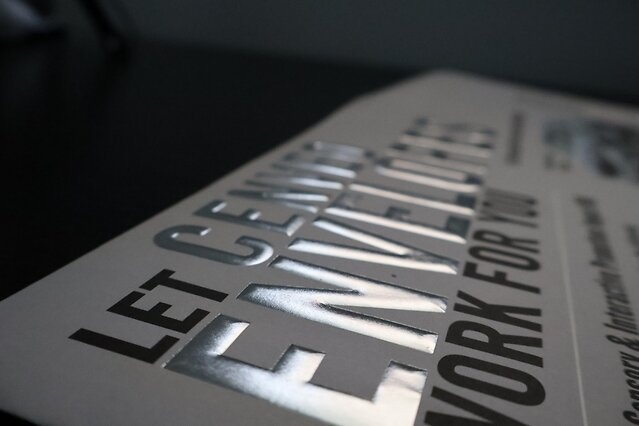
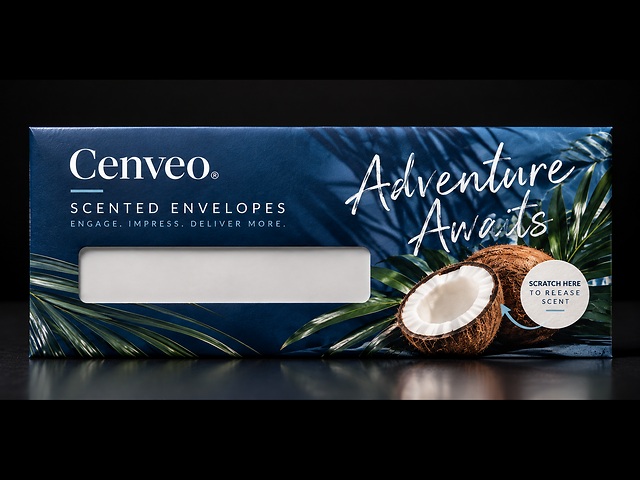
The other side of the catalog is less restrained. Metallic inks, holographic foil, embossing, scented panels and interactive openings make the envelope part of the creative work. One example has a coconut scratch-and-sniff panel. Another resembles a leather wallet. The container becomes part of the offer before the letter comes out.
A marketer can use those options to create a controlled test: send a plain version and an enhanced version to comparable audiences, then compare contribution after production and postage. This is a buying discipline the reader can copy. Texture alone proves nothing about profitability. Neither does a clever opening.
There are constraints. Cenveo notes that extended trailing-edge shapes require USPS approval. An imaginative outline still has to fit a delivery system. Where the audience has little reason to respond, or the extra production cost exceeds the additional return, a more elaborate envelope has a weak case.
04 / The expensive part was the balance sheet
Cenveo’s corporate history has its own construction problem. Predecessor Mail-Well was formed in 1994, pursuing consolidation in a fragmented industry. The Cenveo name arrived in 2004. Over time, the business stretched across printing, labels, packaging and publishing services. Envelope production became one activity inside a much broader company.
The documented financial break came in 2018. On emerging from Chapter 11 that September, Cenveo reported reducing debt from approximately $1.1 billion to about $300 million. It also secured roughly $235 million in exit term-loan financing. The debt reduction was a restructuring outcome, not cash earned from selling more envelopes.
Approximate debt reported at emergence. Historical figures, not today’s balance sheet.
The narrowing continued. In 2019, Cenveo sold long-run label and receipt-paper assets to Iconex; some proceeds funded $46 million in debt repayments. Publishing services went to CJK Group in 2020. The Custom Labels Group went to Brook + Whittle in 2022. These were changes to what Cenveo actually owned and operated.
05 / A company with a shorter brief
In July 2022, management announced a buyout that made the Burton family the majority shareholder. The remaining business was described as exclusively envelope-focused. CEO Rob Burton, president Mike Burton, CFO Mark Hiltwein and strategy chief Ayman Zameli led the transaction. Financial terms were undisclosed.
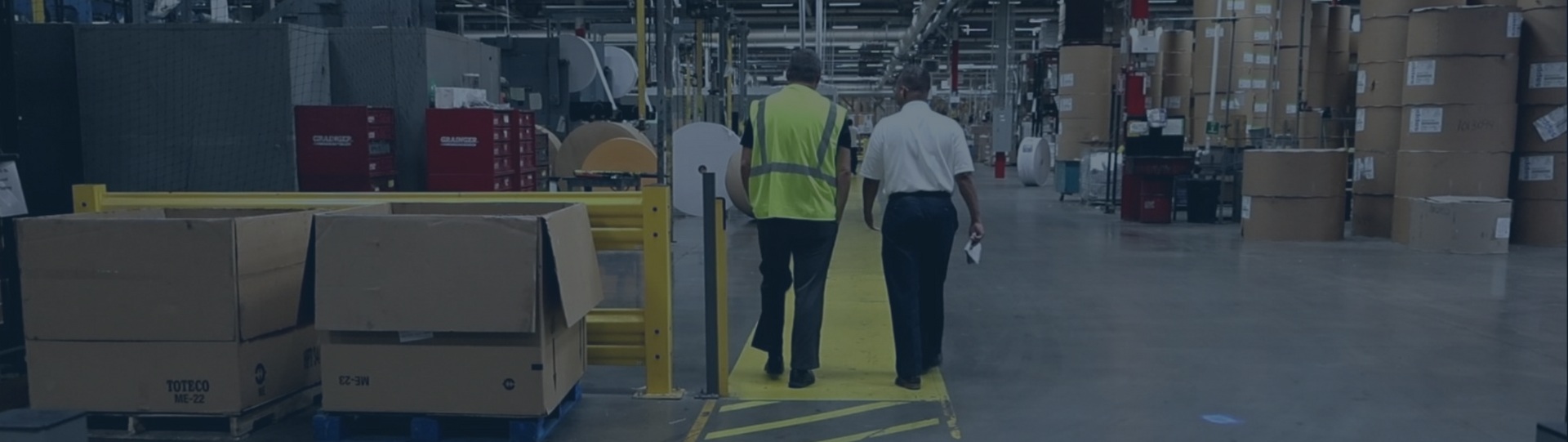
Today, the sales argument includes continuity. Cenveo advertises eleven manufacturing locations with similar equipment, so the network itself becomes part of the service. SupremeX and regional converters offer alternatives; buyers should compare the actual job, location and delivery requirements. Scale helps explain Cenveo’s position without settling every purchasing decision.
Focus also changes how the company measures itself. Cenveo says it recalculated environmental baselines in 2025 to account for structural changes. Its published 2030 goals include reducing Scope 1 and 2 greenhouse-gas emissions by 50% against a 2017 baseline and maintaining waste diversion above 92%. Those are targets, not completed achievements.
For a prospective customer, the next step is concrete: bring the supplier a size, quantity, delivery date and artwork, then discuss construction and finishes. Request samples and check compatibility with the actual mailing equipment. The most useful demonstration may be an uneventful run through the inserter.
The envelope is a good place to end because it sets a demanding standard. It must work in a machine, survive a journey and make sense in somebody’s hands. Cenveo’s story asks a similarly practical question of a company: how much complexity belongs around the thing you know how to make?