An envelope is a modest thing to build a career around. It has a front, a back, a flap and an appointment somewhere else. Most people notice it for a few seconds, if that. Rob Burton has spent years working inside the much less modest business behind it: factories, financing, acquisitions, customers and the recurring question of what a company should keep doing.
In July 2022, Burton and three fellow Cenveo executives completed a management buyout. The business they bought had shed its former breadth and concentrated on envelopes. Management owned all of it; the Burton family held the majority. After years in investor relations and corporate operations, Burton was helping buy the enterprise whose decisions he had long helped explain.
There is another place to find him: Greenwich, Connecticut, where he has worked on athletic facilities and community boards. The scale changes. The practical questions remain recognisable. What needs investment? Who will pay? Can something people already depend on be made to work better? A bleacher has rather less patience for a persuasive presentation than an investor does.
An education in the machinery of companies
Burton studied economics at Vanderbilt University, with a minor in business administration. His early career ran through the printing industry, including management and investor-relations work at World Color Press between 1996 and 1999. Later came senior investor-relations and corporate-communications roles at Moore Corporation and Moore Wallace. The work placed him where a manufacturing business meets the people supplying its capital.
His next step was Burton Capital Management, where he served as president and primary investment officer before joining Cenveo in September 2005. His father, Robert G. Burton Sr., became Cenveo’s chairman and chief executive that year. His brother Mike also joined. The family connection was part of the company’s leadership structure, alongside the individual responsibilities each held.
Rob’s assignments at Cenveo covered investor relations, treasury, human resources and legal affairs. Corporate operations added mergers and acquisitions and information technology to the brief. These are the departments a customer rarely sees, although their decisions eventually turn up in a delivery date, a bill or the ability to take an order.
Securities filings place his promotion to president in August 2011. By then, he had worked across several of the functions required to finance and administer the business. His route toward the chief executive’s office passed through the coordination of people, money and corporate transactions, with printing as the continuous industrial backdrop.
- 2005Joins Cenveo
- 2011Becomes president
- 2018Takes CEO role
- 2022Co-leads buyout
The September that changed the job
Burton became chief executive in September 2018, when Cenveo emerged from Chapter 11. His brother became president. This was a change in ownership, financing and leadership at once, following a court-supervised restructuring. The executive title arrived with the responsibility of operating the company after that process.
The financial reset was substantial. Debt fell from approximately $1.1 billion to about $300 million, a reduction of more than $800 million. The company also announced more than $65 million of liquidity and approximately $235 million of term-loan exit financing. Those figures describe the 2018 restructuring, rather than the company’s finances today.
The reorganised business operated as Cenveo Worldwide Limited. It was privately held, with institutional investors comprising its largest shareholders. A new board included Burton and four new directors, with James Continenza as chairman. Burton’s first period as CEO therefore began within a newly constituted system of oversight as well as a different capital structure.
Bankruptcy makes an awkward opening chapter for any leadership story. It belongs here because it explains the starting conditions. The later management buyout followed this reset by nearly four years. Treating the two events as one smooth transaction would erase the interval during which the business itself changed.
Approximate figures announced September 7, 2018. Historical debt figures, not current balances.
Making the company smaller on purpose
Cenveo’s former range included commercial printing and labels as well as envelopes. During Burton’s tenure as CEO, that range narrowed. In 2021, its commercial print division, including plants in Eureka, Missouri, and Amarillo and San Antonio, Texas, went to the business being assembled as ColorArt, backed by JAL Equity.
The Custom Labels Group followed a different route. In April 2022, Brook + Whittle announced an agreement to acquire it. The buyer wanted the group’s capabilities in short runs, digital systems and quick turnaround. A business can be worth selling precisely because another owner wants to build around what it already does.
The separation also had a less photogenic side. AlixPartners, which advised Cenveo, described work to divide corporate shared services between labels and envelopes, develop separate long-term business plans and support diligence. Selling a division requires working out which systems and services it shares with everything left behind. The announcement is the tidy part.
By June, AlixPartners was describing the labels sale as completed. The sequence matters: commercial printing departed, labels departed, and the remaining company became focused on envelopes. Burton’s experience in transactions and corporate operations had a direct application in changing the boundaries of the business he led.
Buying the business that remained
The July 2022 buyout was led by Burton, president Mike Burton, chief financial officer Mark Hiltwein and chief strategy officer Ayman Zameli. It made Cenveo wholly management-owned, with the Burton family the majority shareholder. The ownership belonged to a group of managers; describing Burton as an owner should preserve that distinction.
“I am grateful for this opportunity,” Burton said when the deal was announced. The existing management team stayed in place. The transaction paired a change in who owned the shares with continuity in who ran the company. Its financial terms were undisclosed, so the ownership milestone carries more public detail than its price.
For Burton, the move connected the financial and operating sides of his career. A former investment officer and investor-relations executive was now a CEO participating in a buyout. It also concentrated the team’s attention on one product family. An envelope may look simple from a kitchen table; choosing to own a company devoted to making it is a considerable commitment.
Burton family: majority shareholder
The other kind of capital project
Burton’s Greenwich work supplies a different measure of what attracts his attention. He helped found the Greenwich Athletic Foundation in 2017 and became its president. That year, the foundation secured approval for a $110,000 donation for Greenwich High School gym bleachers after 45 days of research and fundraising. It also backed a new audio system at Dorothy Hamill Rink.
In 2019, Cardinal Stadium required an interim solution. Its home bleachers had been closed, and the foundation provided a $120,000 gift that included rental equipment to support them. The work was intended to reopen the seating for the football season while the longer-term replacement was being resolved. It was an immediate expense attached to a very visible local problem.
The distinction between temporary support and permanent construction is familiar to anyone who has managed an ageing building. One keeps the calendar moving; the other demands agreement about what to build and how to fund it. At Cardinal Stadium, the foundation participated in both conversations. A season has a starting date even when a construction debate does not have an ending.
Later in 2019, the foundation pledged to raise at least $1 million for the stadium, conditional on the inclusion of team rooms beneath the home bleachers. Burton argued for that configuration. The condition attached a specific design choice to the fundraising promise, making clear what the group wanted its contribution to help accomplish.
December committee minutes place him among school officials, town staff, architects and other representatives discussing stadium plans. Their subjects included room locations, the site’s grade and the difficulties posed by the water table. These are the details that sit between a generous intention and a usable building. Giving money does not remove the need to decide where the rooms go.
In January 2020, after a water leak closed the high school gyms, Burton attended a special school-board meeting with fellow foundation member Rich Fulton. The foundation called for repairs and reiterated its readiness to contribute to the stadium project. Different problems kept bringing its members back to the same public institutions. The work continued after the first donation had been accepted.
“We want to get this done and move on to the next project.”Rob Burton, on Cardinal Stadium, January 2020
A return address in Greenwich
Burton has described Greenwich as home since 1985. He graduated from Greenwich High School in 1993, left for college and returned to raise a family. In a November 2025 public letter, he wrote about four children who had attended local public and private schools, and about friendships from his own school years that had lasted into adulthood.
The letter endorsed Matt DesChamps for the town’s Board of Estimate and Taxation. Its broader concern was the relationship between budgeting and reinvestment. Burton argued that keeping taxes low and maintaining town services could coexist, and pointed to ageing school and athletic facilities as evidence of work still needed. His corporate vocabulary had acquired a distinctly municipal application.
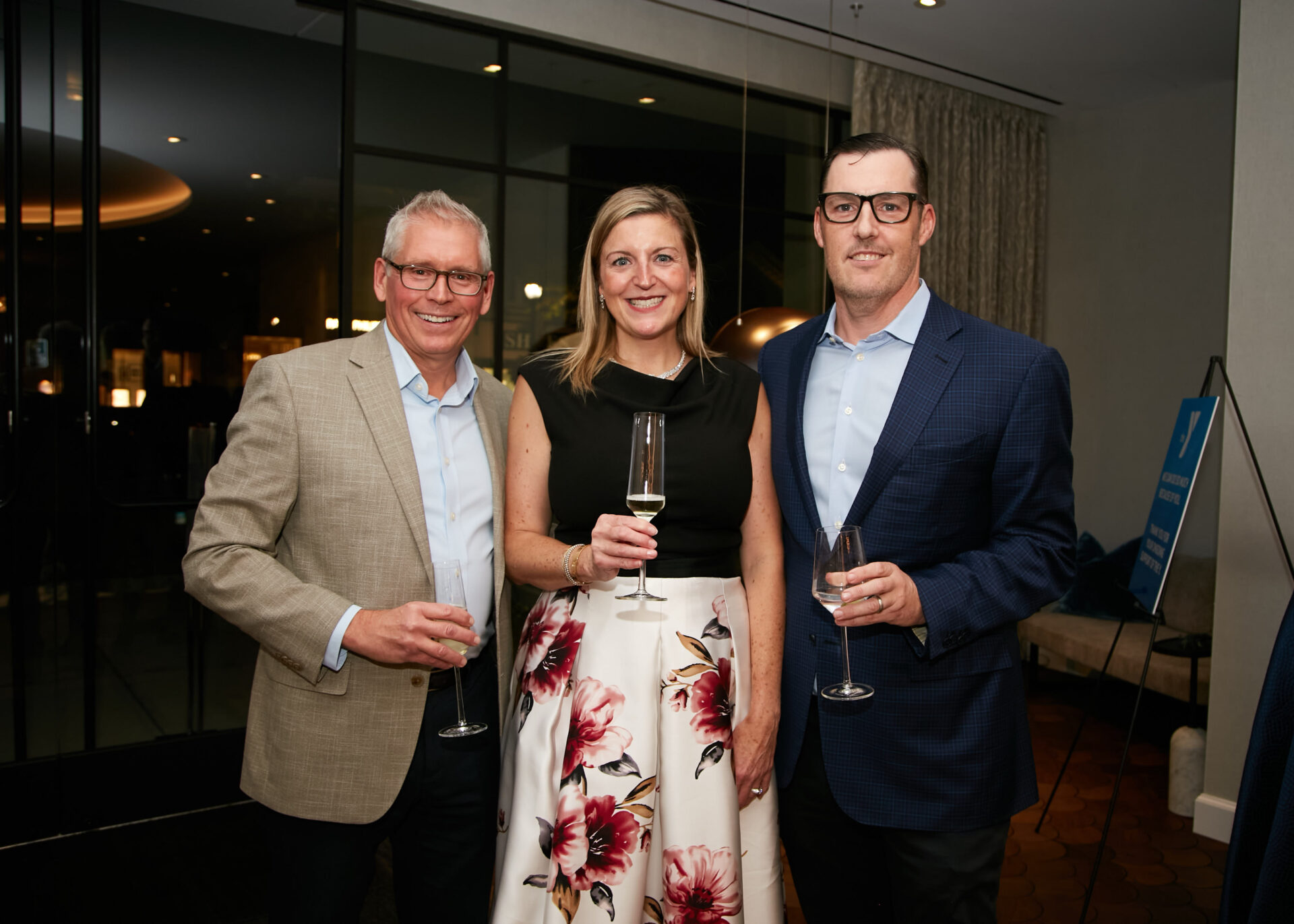
His community responsibilities also extend to the YMCA of Greenwich, whose current board roster lists him as chair. A photograph from an October 2025 YMCA celebration places him alongside Matthew Skaarup and Michelle Wellington. Here the setting is a gathering of local supporters, another part of the institutional life he has chosen to remain involved in.
An ordinary object still has work to do
Today, Cenveo presents itself around envelopes, with eleven manufacturing facilities listed on its company page. Its products include standard and custom formats, direct-mail pieces and vote-by-mail offerings. Its direct-mail range uses treatments such as embossing and die-cutting to make a piece of post more noticeable. Even an everyday object leaves room for detailed decisions about how it will be used.
That gives Burton’s career a concrete centre. The corporate transactions changed who owned the factories and which activities belonged inside the company. The factories continue making an object intended to carry something to somebody. In Greenwich, the facilities discussions concern places where people gather. Both kinds of work put practical demands behind otherwise familiar objects and settings.
Burton’s public story returns repeatedly to those demands: financing a business, separating its parts, buying what remains, or finding a way to put spectators back in their seats. The envelope and the bleacher are useful companions in that story. Neither requires much ceremony. Both become remarkably interesting when somebody has to pay for keeping them in service.
Follow the paper trail
Cenveo leadership · Rob Burton on LinkedIn · Cenveo website · Company blog
The 2022 management buyout · The 2018 restructuring · YMCA board · Burton’s 2025 Greenwich letter