Andrea F. Rabney has spent much of her working life helping companies explain what happens next. In September 2026, the next chapter belonged to her own firm. Argot Partners, which she co-founded with David M. F. Pitts in 2007, was handing its operating leadership to two colleagues. Laura Perry would become chief executive. Maeve Conneighton would become president while remaining chief commercial officer. Rabney would become Chair.
“I'm not going anywhere,” she wrote. She would keep advising clients. But there was something else in her announcement: pride in seeing the organization stand on its own. For someone whose profession involves choosing words, that was a revealing choice of emphasis. The achievement she singled out was a business able to put other people in charge.
It is a useful place to enter her story. Founding a consultancy makes your experience the product. Clients arrive because they trust your judgment. Building an organization requires that trust to travel: into colleagues, working relationships and decisions that happen without the founder in the room. Rabney’s new title gives that otherwise abstract problem a nameplate.
A beginning in the small print
Her career began at Smith Barney Shearson, where she worked as a compliance analyst. It is an unusually apt starting point for a communications executive. Compliance concerns itself with the gap between what an organization wants to do and what it can properly say or promise. Language comes with obligations. An attractive sentence may still require a second look.
Rabney earned a Bachelor of Arts from Boston University and a Juris Doctor from Touro’s Jacob D. Fuchsberg Law Center. She was admitted to practice law in New York in 1993. The qualifications place legal training alongside financial-services experience early in her working life, before the company-building years for which she is now known.
Those facts suggest a useful way to read her later career, without turning a degree into a personality test. Corporate communication operates among competing demands. A message must be understandable, accurate and suited to its audience. Legal and financial considerations help determine its boundaries. A communications adviser has to notice those boundaries before someone else discovers them in print.
There is room for elegance in this work, although elegance occasionally consists of removing the sentence everyone liked. A corporate announcement must survive readers who have very different reasons for opening it. That is a practical problem, and Rabney would spend years meeting it from inside a company.
Thirteen years on the inside
At ImClone Systems, Rabney led corporate communications for 13 years. She served as vice president and sat on the Management Committee. The combination matters. Her job placed her within the company’s management structure, close to the decisions that would eventually require an explanation beyond it.
Her tenure included communications responsibilities around a $2 billion strategic partnership with Bristol-Myers Squibb, government investigations, a review of strategic alternatives and a consent solicitation by investor Carl Icahn. These were different kinds of corporate events. Together, they put partnership negotiations, scrutiny and shareholder pressure on the communications agenda.
For an outside reader, such a list can become a procession of financial nouns. Inside a company, each noun creates work. Who needs to hear the news first? What can be said? How does management explain a decision to people who may disagree with it? How much background does a new reader need before the announcement begins to make sense?
Rabney and Pitts worked together at ImClone. He brought experience in special situations communications; their collaboration preceded their decision to start Argot. The founding partnership therefore had an earlier working history. They had already dealt with consequential corporate communications together before putting their names behind a consultancy.
A firm built around the difficult conversation
Argot opened in 2007 as a specialist strategic communications consultancy. Rabney’s counsel would cover corporate positioning, mergers and acquisitions, financing and shareholder activism. Those areas share a feature: the company is asking people outside its walls to understand a change, make a judgment or commit something of their own.
The product of a consultancy can be difficult to point to. There may be a presentation, a statement, an investor meeting or a carefully prepared executive. The useful work often happens before any of those appears. Someone has to decide which question the communication should answer and whether the company is ready to answer it.
Argot’s practice connects investor relations with corporate and financial communications, media work and creative services. Its investor-relations offering includes outreach, relationship management and preparation for company announcements. In practical terms, that puts the written explanation beside the conversations that follow it. The announcement begins a relationship with its readers; it rarely finishes one.
Argot also developed Acumen, a relationship-management platform designed for its specialist market. It tracks connections with investors, analysts, bankers and media. A platform of that kind gives an advisory practice somewhere to keep the history behind a conversation: who has been involved and how relationships connect. It is a concrete accompaniment to the less tangible business of counsel.
The combination of relationships and preparation helps explain why a communications business needs more than a well-written announcement. An investor may have followed a company for years; a reporter may be encountering it for the first time. The adviser has to account for both kinds of knowledge. The same company appears in each conversation, but the starting point differs.
For Rabney, the move from ImClone to Argot changed the scale of the brief. In-house leadership brings sustained knowledge of one organization. Consulting requires an adviser to learn the circumstances of many organizations while bringing earlier experience to each. Familiarity with a situation helps, provided it does not become an excuse to stop asking questions.
That distinction is central to understanding a founder-led advisory business. Past experience earns the meeting. The work in the meeting still has to fit the client. Argot’s structure gives Rabney’s earlier corporate experience a setting in which it can be used repeatedly, alongside the different experience of colleagues.
The company gets a wider circle
In January 2023, Danforth Advisors announced its acquisition of Argot. Rabney and Pitts would continue leading the firm. The announcement placed strategic communications alongside Danforth’s existing business-support capabilities, including finance and accounting, human resources, risk management and executive advisory work.
For a consultancy founder, an acquisition introduces a second organizational story. The business retains its clients and working relationships while entering a larger arrangement. What the combination makes possible depends on how people use the additional capabilities. A longer list of services is easy to print. Coordinating them is the assignment.
“We aligned quickly with Danforth,” Rabney said at the time. Her comments focused on the fit between the businesses and the potential to make their work together more efficient. The emphasis was operational: how could the arrangement help clients get things done?
Argot’s approach also makes senior involvement an explicit part of its offer. Its description of the client relationship promises continued access to senior leaders, teams that evolve with changing business needs and coordination between investor and public relations. Those commitments give the later succession a practical significance. Leadership changes within a firm whose offer includes access to leadership.
“I'm not going anywhere.”
Andrea F. Rabney, on becoming Chair
The work has other faces
In January 2026, Rabney shared Argot’s team collage from a conference week in San Francisco. Her accompanying message thanked the team and the firm’s clients, then looked ahead to the year. The photographs show people gathered together and working at tables, the unglamorous infrastructure of an industry week.
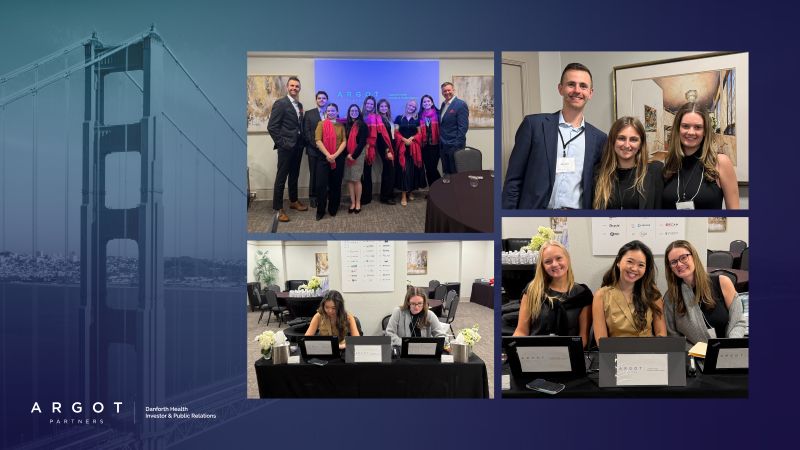
The image belongs in a founder’s story because a professional-services business depends on people doing the work together. Someone prepares the material. Someone manages the meeting. Someone remembers the follow-up. A founder may help establish the standard, but the client encounters the firm through many separate acts of attention.
It would be easy to treat the collage as a cheerful interruption between corporate milestones. It is also a reminder of what a succession transfers: responsibility for a working group of people, with clients expecting the next call to go well.
Letting the next names lead
The September handoff put Perry, previously chief operating officer, into the CEO role. Conneighton added the presidency to her commercial responsibilities. Pitts became Vice Chair. Argot described a transition prepared over several years, with the incoming leaders already central to the firm’s daily business.
That preparation changes the meaning of the announcement. The operating titles recognize colleagues who had already been running the business day to day. Rabney remains available for strategic counsel while they take expanded responsibility. Continuity is part of the arrangement, with a visible change in who leads.
Rabney called seeing the firm in their hands “one of the proudest moments of my career.” The wording makes the handoff personal without making it sentimental. After the compliance work, legal education, long in-house tenure, founding partnership and acquisition, she was drawing attention to the people ready to take over.
A consultancy begins by asking clients to trust its founders. Its next chapter asks those clients to trust the organization the founders have built. Rabney now occupies a different place in that relationship: still involved, still advising, and leaving the operating decisions to the colleagues whose turn has arrived.
She has spent a career helping companies explain a change. This one has a particularly clear cast of characters. Perry is CEO. Conneighton is President. Rabney is Chair. The names on the next chapter are already there.