An accountant is an unlikely person to put in charge of a steelmaking experiment. Accountants are supposed to notice when the numbers refuse to cooperate. Keith E. Busse became useful precisely where the spreadsheet met the factory floor. Before he co-founded Steel Dynamics in 1993, he had helped Nucor attempt something the steel business had spent years trying to make practical: casting thin slabs of steel on a commercial scale.
At Crawfordsville, Indiana, the challenge was physical, expensive and thoroughly unforgiving. Molten steel had to pass through machinery that could turn it into a thinner starting point for sheet production. Busse was responsible for the project; Mark Millett led the melt shop. Richard P. Teets Jr. was another key member of the team. Their later company began with experience earned together, rather than introductions made over a pitch deck.
A kitchen table before a corner office
Busse was born in Fort Wayne in 1943. His father, Earl, was a firefighter. The household could not afford to send him away to college, so his route into business stayed local. A $750 loan from his godfather helped him attend International Business College. He studied, pumped gas at a Montgomery Ward auto center, and sometimes unloaded batteries after his shift. Homework waited until he got home.
That combination of practical work and formal education continued. He completed an accounting associate degree in 1963, later studied business finance at Saint Francis College, and earned an Indiana University MBA in 1978. His first accounting job, at McGill Bearing in Valparaiso, put him close to manufacturing. Bearings were being made; he was compiling the numbers. The interesting part was watching the relationship between the two.
The biographical detail matters because his eventual authority in a mill did not come from a metallurgy degree. He had to learn how a business worked through its costs, equipment and people. His education accumulated alongside employment. There was no clean interval when learning ended and the serious work began.
The accountant gets the hot job
He joined Nucor in 1972 and stayed for 21 years, advancing through management to vice president. His responsibilities included the Vulcraft operation in St. Joe, Indiana. In 1986, Nucor put him in charge of constructing and running its thin-slab flat-rolled steel minimill at Crawfordsville. A career that began with financial records now involved a technology with very little room for polite approximation.
Thin-slab casting offered minimills a way into flat-rolled steel, an important market associated with the large integrated producers. The appeal was efficiency. The difficulty was persuading a complicated industrial process to behave reliably enough to support an actual business. Equipment could be ordered; dependable production still had to be achieved.
Busse's manner did little to preserve the stereotype of the quiet accountant. In the Crawfordsville years, he could argue vigorously with Nucor chairman Ken Iverson and move comfortably among the people building the mill. Iverson was also a mentor. Their connection gives the later departure some texture: Busse's new venture grew out of an employer that had taught him a great deal about making steel and organizing work.
“Of course they looked at me like I was absolutely nuts.”Keith Busse, recalling his startup proposal
Three colleagues, one expensive suggestion
The proposal arrived over a beer at a Holiday Inn. Busse suggested to Millett and Teets that they start a steel company of their own. Their reaction, in his later telling, was less than immediate applause. It is an appealingly ordinary setting for an unusually capital-intensive idea. A hotel bar can accommodate a business plan rather more easily than a steel furnace.
The three founded Steel Dynamics in 1993. They were bringing operating knowledge, a shared history and a plan to investors. The company's account of its first decade records more than $385 million in private capital raised for its initial minimill. That figure supplies a useful correction to the romantic image of three people simply deciding to have a go. Their decision required other people to commit substantial money.
Construction was only the first test. A new steel business needed customers, reliable output and a competitive cost structure. The founders had worked together on a demanding mill before. Now the organization surrounding the machinery would be theirs to build as well. The independence was real; so were the bills.
Butler makes the case
The first Steel Dynamics mill began producing steel in Butler, Indiana, in 1996. That year also brought its Nasdaq listing under STLD. Production and public ownership arrived close together, but they asked different questions of the founders. Could the plant make steel? Could the company keep earning the confidence of people who had financed it?
At Butler, the original production capacity was 1.2 million tons a year. A cold mill followed in late 1997; expansion increased annual capacity to 2.2 million tons in 1998. In 2009 the operation reached annual production capacity of 3 million tons. The progression makes the business easier to understand than a single enormous number does. The original site kept changing, adding equipment and products as it grew.
Elsewhere, the company moved into steel joists and deck, structural steel and specialty bar products. In 2002 it began operating its Columbia City mill and acquired a mill in Pittsboro. Those moves widened what Steel Dynamics could sell. A startup associated with one flat-roll plant was becoming a business with several ways to serve industrial and construction customers.
The geography was part of the calculation
Indiana supplied more than a familiar address. In 2000, explaining the location of a new facility, Busse described the concentration of steel consumption across Indiana, Illinois, Michigan and Ohio. Northeast Indiana sat near the middle of that customer territory. His site-selection arithmetic began with market opportunities, then energy and transportation.
It is a useful glimpse of his commercial instincts. The factory could be technically impressive and still be in the wrong place. Customers, freight and power had to fit the plan. Busse likened the region to the center of a dartboard, an image rather easier to carry away than a site-selection matrix.
His argument also reflected his view of an industry still capable of renewal. New processes could change the economics of making steel. A business built around those processes could challenge established producers. The opportunity lay in doing the work differently enough to make the numbers hold, then continuing to invest when the first plant was running.
Counting jobs, then handing over the keys
Recognition followed. In 2005, the Association for Iron & Steel Technology named Busse Steelmaker of the Year for his contributions to thin-slab casting and the creation of Steel Dynamics. In accepting, he pointed to 1,700 new jobs. The following year, the Steel Manufacturers Association honored him with its Kenneth Iverson-Marvin Selig Award. He had chaired the association from 2004 to 2006.
Inside Steel Dynamics, his responsibilities changed as the company expanded. In 2007, he moved from president and CEO to chairman and CEO, while Millett and Teets took leadership of operating groups. The reorganization reflected a company whose range had outgrown its earlier reporting structure. Building the business also meant rearranging who made its decisions.
Busse retired as CEO at the end of 2011, with Millett succeeding him on January 1, 2012. He remained chairman at that transition. Eighteen years after the founding, the next chapter depended on a colleague who had been there from the beginning. The partnership that made the departure from Nucor possible also supplied the succession.
A collection with a very particular number
Outside steel, Busse pursued Corvettes with an accountant's apparent appreciation for matching numbers. He owned a 1953 Corvette bearing serial number 35. When the model's fiftieth anniversary approached, he wanted the corresponding 2003 car. Chevrolet initially offered him number 1035, because the earliest cars had been reserved for other uses. Number 35 had gone to Le Mans as a pace car.
He eventually located that car through a European dealership and brought it to the United States. His associated collection extended to a numbered pedal car and a commemorative factory brick, both carrying 35. A brick is a wonderfully unglamorous addition to a sports-car collection. In this case, it had the correct number, which was apparently qualification enough.
There was a separate collecting project, too: 16 Corvette Indianapolis pace-car examples, spanning editions offered to buyers and specially authorized duplicates. The whole set sold as one lot for $1.76 million at Mecum's Indianapolis auction in May 2018. Proceeds benefited the Keith Busse Automotive and Classic Art Foundation. The collection had become a means of funding something beyond the garage.
The next entrance bears his name
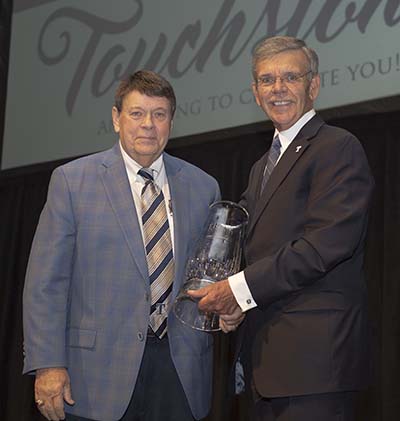
His educational connections stayed close to home. Saint Francis opened its Keith Busse School of Business and Entrepreneurial Leadership in a restored downtown Fort Wayne building in 2016. At Trine University, he became a trustee in 2003 and helped guide campus construction and improvement. The university presented him with its Pillar of Success award in 2021.
By September 2026, he was serving as Trine's board vice chair and chair of its Executive Committee. That month, the university announced plans for Keith Busse Parkway, a four-lane connection from U.S. 20 to Thunder Drive, intended to open by the beginning of the 2027-28 school year. The project is meant to improve access to the west campus.
There is a pleasing practicality to that honor. A road has work to do: move people, ease a bottleneck, connect one place to another. Busse's name will sit on something useful. For a career spent moving between financial calculations and physical construction, that seems an apt place to put it.