Jeff Albert’s musical biography contains a small joke at his expense. After listing his experience singing tenor, baritone, and bass, his quartet mates express the hope that he will eventually settle on the right part. He currently supplies Coalition’s bass line. In business, too, he has moved between roles, with a career that has carried him from financial services into industrial operations and, now, the leadership of Ambassador Enterprises. Knowing your part is useful. Knowing how the parts fit together becomes rather more useful when the assignment gets bigger.
In February 2025, Albert was named chief executive of the Fort Wayne enterprise, succeeding founder Daryle Doden. He arrived from SOLV Holdings, an Ambassador growth platform he had led since its inception in 2019. By 2024, SOLV reported annual revenue of $1 billion and more than 2,000 employees across its companies. That is the large number in this story. The quieter question is what happens when an organization built around a founder puts its future into somebody else’s hands.
The problem of the next person
Doden had announced his intention to step down in August 2024, allowing a six-to-eighteen-month window for the transition. His planning had begun years earlier. He and his wife, Brenda, established the Doden Legacy Trust as a successor ownership structure; a board was formed in 2022. The architecture gave different people responsibility for ownership, governance, and management. A founder could step away from executive authority without asking the organization to invent its next operating system overnight.
That distinction matters to Albert’s appointment. He had already served as a Doden Legacy Trustee and as AE Holdings board chair. He knew the enterprise through its businesses and through its governance. The CEO search involved CarterBaldwin Executive Search and considered candidates beyond the organization. An internal appointment followed an external search, giving the handover a different character from an automatic promotion.
Any succession has an awkward practical feature: the people who know the business best are usually already doing something important. Moving one creates a vacancy elsewhere. Albert’s departure required SOLV to name its next chief executive. Mike Butchko took that role. The transfer therefore asked more of the enterprise than choosing a new name for one office door. Several people had to be ready for a different share of responsibility.
“We aim to be helpful, not heroic.”
Jeff Albert, 2025 CEO reflection
Albert’s formulation is appealing partly because it leaves so little room for theatrical leadership. Helpfulness can be tested. Did the work become clearer? Did someone acquire the authority to do it? Can a commitment survive a change in personnel? Those are less glamorous questions than who will succeed a founder, but they are the questions that make the succession function.
Before the holding company, the working business
Albert’s route to investment management passed through the organizations that investors eventually have to understand. He spent 22 years in financial services, reaching chief information officer roles in two Lincoln Financial Group businesses. Another 12 years took him into rebar fabrication and contracting with Ambassador Steel and Harris Rebar. He later served as president of Wagner-Meinert, whose work includes engineering, construction, and service for industrial customers.
His education also spans several institutions: a bachelor’s degree at Purdue University Fort Wayne, executive education at Indiana University’s Kelley School of Business, and an MBA at Notre Dame’s Mendoza College of Business, completed magna cum laude. The outline suggests a career assembled over time, across technical and commercial responsibilities. Its distinguishing feature is the movement between businesses with very different work on the ground.
A 2015 account offers a more concrete glimpse of Albert as an operator. At Wagner-Meinert, employee surveys and focus groups helped identify things the team could improve. Leadership used that feedback to plan work on the business. There is no need to dress this up as an exotic management discovery. Asking employees where the difficulties are is an ordinary act. Acting on their answers is where it acquires consequence.
The same account placed Wagner-Meinert in food processing and distribution, industrial manufacturing, refrigeration, and mechanical services. Those are settings where an organization’s promises have physical consequences. Work must be designed, built, maintained, and coordinated. A strategy can sound splendid in a meeting; eventually somebody has to make the system run. This earlier chapter gives Albert’s subsequent holding-company role an operational setting.
The arithmetic of growing together
SOLV’s annual figures make its expansion visible. In 2022, the platform reported $600 million in annual revenue and 1,050 employees. The 2023 figures were $750 million and 1,500. In 2024, they reached $1 billion and 2,000. These are portfolio totals, covering businesses with their own leaders and workforces. They measure an expanding organization; they do not, by themselves, tell the whole story of what happened inside each company.
Portfolio figures for the stated years. Acquisition activity contributes to scale; this chart does not represent organic growth or investment returns.
Acquisitions were part of that growth. The 2022 account described expansion into audio, visual, lighting, and acoustic services, as well as metal fabrication and cutting. QuikCut and Stream Tek joined the picture, alongside Custom Sound Design and its acquisition of Omnicoustics. Putting these businesses under one platform created a larger collection of capabilities, while leaving the practical task of making the relationships productive.
QuikCut’s Mark Webb described a relationship that preceded the transaction. He had not initially been seeking an investor. Friendship and mutual respect developed with people from SOLV and Ambassador before the partnership followed. That sequence gives the language of legacy investing some substance: the deal arrived after the people had begun to know one another.
Albert has addressed the seller’s perspective directly. “Selling a business can be an emotional process,” he said in 2023. A price can be negotiated in a room. A founder’s identification with a company has usually taken years to form. Names, colleagues, customers, and habits are part of what changes hands. An investor who wants continuity has to take those attachments seriously, even when they do not fit neatly into a valuation model.
SOLV’s contracting, metals, and business-to-business products divisions gave that approach several settings. A 2024 metals acquisition announcement emphasized strengthening capabilities and broadening what customers could obtain from the portfolio. The ambition was operational as well as financial: more businesses, with more ways to meet a customer’s needs. For the executive above the divisions, scale brings a growing obligation to make leadership and coordination keep pace.
A bass line, and a sense of humor
Coalition offers a view of Albert away from those portfolio figures. The quartet includes Brian Eager, Dan Johnson, and Jeff Goshorn. Its members had spent decades singing around one another in Fort Wayne’s Summit City Chorus before forming the group in 2017. Albert’s own musical history includes six years directing the chorus and competition experience with several quartets. A long-running hobby has accumulated its own responsibilities.
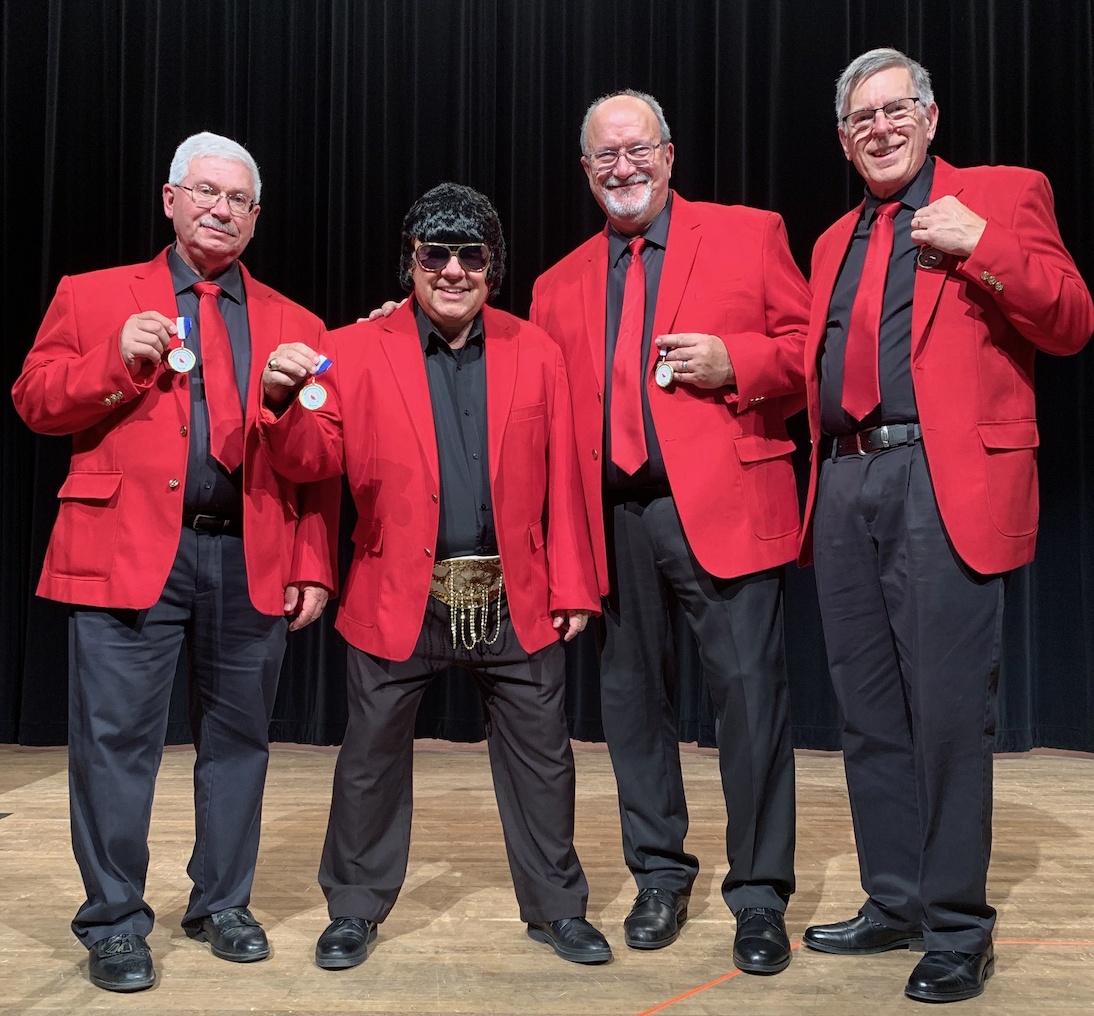
The group’s repertoire goes well beyond the striped-jacket stereotype: gospel, doo-wop, classic rock, country, Beatles songs, and Sinatra. Its own explanation of barbershop describes a melody held together by complementary voices. The lead carries the tune; tenor, bass, and baritone give it a particular shape. A bass singer has a consequential job without needing to occupy every inch of the musical foreground.
One performance supplied a comic demonstration of the group’s familiarity. They began with three singers while the bass was absent. The baritone was ready to cover the coming solo. Then the missing singer arrived, stepped into position, and took the part just in time. Some listeners apparently assumed the entrance had been arranged. Years of shared experience had given the group enough room to absorb an imperfect start.
The story is a quartet anecdote, rather than evidence of a management technique. Still, it improves the picture of Albert. He belongs to something that requires rehearsal, mutual adjustment, and a willingness to be teased. There is a useful modesty in having three colleagues who can remind you that the performance needs all four of you. An executive title does not supply the other notes.
The work after the handover
Albert’s public SOLV introduction described his enjoyment in watching talented leaders develop. That interest becomes increasingly practical as organizations expand. An executive cannot carry every decision personally without slowing the people expected to execute it. Developing leaders means creating the capacity to take on work, including work the chief executive once held.
In October 2025, Ambassador announced Janie Waldron’s return in a newly created chief administrative officer role. Her remit covered culture, strategy execution, and talent development across the enterprise and its affiliates. She had worked in the SOLV leadership team since 2019. The appointment placed responsibility for connecting teams and strengthening organizational capabilities in an explicit executive role.
Ambassador’s stated investment framework includes financial, cultural, and eternal returns, reflecting its Christian identity. The framework gives Albert more than a revenue target to discuss. It also creates a continuing question about how stated commitments appear in decisions. Long-term ownership, relationships with founders, and investment in leadership all offer places where that question can be asked concretely.
Albert has taken the next part in an organization that planned for its founder to relinquish executive authority. The career behind him contains systems, factories, contracts, and company transitions. Alongside it runs a musical life in which he has tried several vocal parts and learned to occupy a place among other voices. For the next performance, the task is familiar enough: know the responsibility, attend to the people beside you, and give them room to come in.
Follow the next part
Explore Albert’s Ambassador biography, his LinkedIn profile, SOLV Holdings, and Coalition Quartet.
Further reading: SOLV a Problem Before It Becomes One; Coalition’s singing story; Ambassador’s impact reports.