A boat has a delivery date before it has a wake. Somewhere between the factory and the customer, a dealer has made a promise. The manufacturer can furnish a handsome brochure, a persuasive sales pitch and an excellent logo. None will substitute for the boat arriving when it was supposed to. Brad Gates’s career makes an interesting study in that distance between the promise and the product.
Gates is a Partner at KLH Capital, but his route into that role runs through operating businesses. His experience includes executive positions at Capital Safety EMEA, Nautic Global Group, Pure Safety Group and Structural Concepts. These are companies with things to make, orders to fill and customers who can inspect the result. A spreadsheet may describe their performance. The customer encounters it in a rather less forgiving form.
The useful question about Gates is what travels with an executive when the product changes. A boat and a refrigerated display case have little reason to meet socially. Yet both must pass through a business that understands its customers, organizes its people and delivers something worth paying for. Across Gates’s different assignments, that practical work supplies the continuity. The products change; the need to make the business function follows him.
A promise at the dealer’s door
In 2014, Gates took over as chief executive of Nautic Global Group. The company’s boat brands included Hurricane, Rinker and Polar Kraft. The assignment put him in an industry with varied products and a dealer network standing between the factory and the buyer. There is a particular discipline to that arrangement: the person making the sale often works for another business, with priorities and pressures of its own.
The following year, Gates described improvements in delivery, capacity, parts and service. He also discussed a dealer council and greater attention to customer input. Those details make his account more interesting than a broad declaration about growth. They place the work at the points where a commercial relationship can become awkward: an unanswered question, a missing part, a product that arrives late.
“It really starts with operations,” he said. The sentence has the virtue of being difficult to decorate. Operations includes the tasks that must go right before anyone can enjoy the purchase. In a boat business, a customer’s anticipation can become a dealer’s headache. Good intentions will float neither the boat nor the relationship.
An executive coming into a new industry faces a temptation to speak in language sufficiently general to survive any question. Gates’s emphasis on delivery and dealer input offers a more concrete way to read his work. The business has to support the people who represent it. Advertising can bring a buyer to the door. What happens afterward gives that buyer a reason to return.
“It really starts with operations.”Brad Gates, 2015
The people between the factory and the water
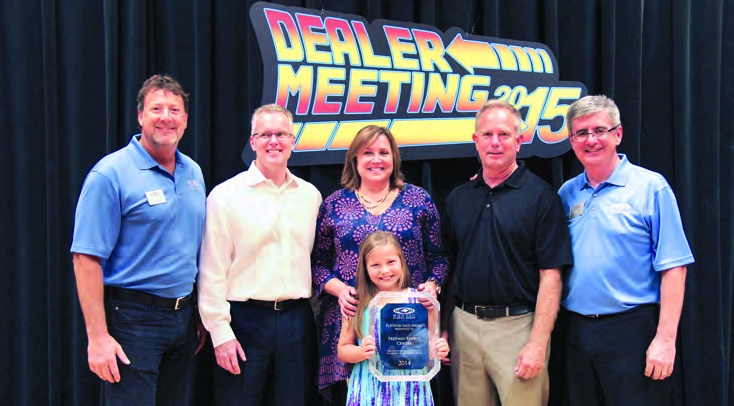
One small scene puts those relationships in view. At Nautic’s annual dealer meeting in South Bend in 2014, Freeway Sports Center received recognition as a national sales leader for several product lines. Gates joined the award presentation. The photograph shows a chief executive standing alongside people from the dealer business.
The meeting’s theme was “Back to the Future.” Dealers had gathered for business sessions, sales seminars, a product review and awards. There is something agreeably literal about that combination. A manufacturer can talk about the future all afternoon; eventually somebody wants to see what will be available to sell.
The dealer is a useful character in Gates’s story because the dealer belongs to two worlds at once. The factory has a production schedule. The buyer has a plan for a weekend. Between those schedules sits an independent business trying to make both parties happy. The award photograph catches the sociable side of an arrangement whose economics depend on considerably more than sociability.
In July 2014, Nautic also announced changes to its organization. Mike O’Connell became chief operating officer. Andy Lindstrom and Mike Kamaloski were promoted to national sales managers for North America, while Bob Wachs moved into dealer development. Product managers were to work closely with engineering. Here, relationships had reporting lines and responsibilities attached to them.
That is a revealing companion to the photograph. Awards recognize a relationship in public. Organizational decisions determine how the relationship will be served on an ordinary Tuesday. A commercial promise needs someone responsible for the product, someone responsible for the customer and a way for the two to speak. Otherwise the customer becomes the organization’s most persistent internal messenger.
Across borders, with a product to deliver
Before the boats, there was Capital Safety. In August 2010, Gates was identified as managing director of its Asia business when the company announced accredited training-provider status from Singapore’s Ministry of Manpower. The announcement described a hands-on training center in Singapore. His work there combined equipment with the services needed to use it.
Later came the EMEA presidency, covering Europe, the Middle East and Africa. Gates had also held business and marketing roles at Toro. Taken together, those assignments help explain why his professional history crosses both products and geography. Selling manufactured equipment involves more than knowing the catalog. Distribution, support and the circumstances of the buyer all matter.
International management adds another practical question to the familiar ones: which decisions should travel, and which need to be made close to the customer? A product can carry a common brand across borders while the commercial arrangements around it differ. That is an observation about the work itself, rather than a claim that one executive possesses a universal recipe.
Gates’s education offers a smaller, quieter pairing. He earned a bachelor’s degree in marketing and a master’s degree in organizational management at Concordia University, St. Paul. One discipline asks how a business reaches its market. The other asks how people organize the work. His subsequent assignments repeatedly bring those questions into the same room.
- 2010Capital Safety Asia
Managing director - 2014Nautic Global Group
Chief executive - 2017Pure Safety
CEO and president - 2019Structural Concepts
CEO and president - TodayKLH Capital
Partner
Buying businesses, then making them belong
Pure Safety announced acquisitions of Guardian Fall Protection and Web Devices in August 2017, with Gates serving as CEO and president. The businesses were to retain their existing brands through a transition period expected to run into early 2018. The opening move brought established companies into a larger organization without immediately discarding the identities customers already knew.
Acquisition changes ownership at a particular moment. The work of operating the combined business continues afterward. Customers still need to know what they can buy, who will support it and whether the familiar name will mean the same thing tomorrow. Those questions make integration a commercial assignment as well as a financial one.
By June 2018, the group had added Checkmate in the United Kingdom and acquired Ty-Flot. The Ty-Flot transaction brought dropped-object prevention products and a portfolio of 126 granted or pending patents. Gates described an intention to assemble complementary businesses. The product categories give the expansion a specific shape: a wider offering built from several existing organizations.
Later that year, the company selected Houston for its headquarters and a global training center. It also announced renovation of a 54,000-square-foot manufacturing site in South Houston, where 165 workers would make equipment. Gates connected the location choice to customer industries and domestic manufacturing.
The sequence is useful because it moves from the transaction to the place where work happens. A combined company needs a location, facilities and people. Acquisitions can enlarge a catalog rapidly. Production and customer support must catch up with the new promise. Gates’s part in this period belongs to that demanding interval between owning more businesses and making a broader business work.
The next chapter of an established company
In October 2019, Gates became CEO and president of Structural Concepts, the Michigan manufacturer of temperature-controlled food and beverage displays. He succeeded Dave Geerts, who had led the company for 25 years and would remain on its board. The transition brought Gates into a business whose products occupy an everyday commercial setting: the place where food is presented for sale.
“I’m pleased to join a company with a passion for setting standards,” Gates said at the time. A display case is an unusually instructive product for someone interested in commercial performance. It is equipment, but it is also part of the customer’s sales floor. Its usefulness belongs to another business’s daily operation.
The ownership story had begun before his arrival. Structural Concepts had been sold to Mason Wells in 2018, after founder James Doss and senior management owners sought a buyer. The sellers placed weight on shared values and continued investment. In 2019, the business was reported to employ 550 people and generate more than $100 million in annual sales.
Those figures describe the company at that point; they are not a scorecard for Gates’s tenure. They establish the scale and maturity of the organization he joined. Succession in an established manufacturer includes the accumulated expectations of employees and customers. A new chief executive inherits a business already in motion, with a history that cannot be revised by changing the opening slide.
The shift from boats to display cases may look improbable on a list of job titles. At the level of work, it is easier to follow. Both involve manufactured products, customer requirements and the problem of coordinating commercial ambition with what an organization can deliver. The executive’s task is to learn the particulars without forgetting the obligations.
The operator at the investment table
At KLH, Gates works with portfolio companies on growth strategy and execution. His remit includes sales, pricing, marketing, geographic expansion, product management and acquisitions. The list is broad, but its center is recognizable from his earlier work: how a company translates its plans into commercial results.
His public LinkedIn profile also describes board and advisory work for private equity owned and privately held businesses. A recommendation from former colleague Nate Damro credits him with focusing leaders on cost control and sales growth, and describes a demanding approach to results. That is a colleague’s assessment, a useful glimpse of working style rather than a substitute for a performance record.
The attraction of an operating background at an investment firm is easy to understand. A growth plan has consequences for the people who must carry it out. More sales may require different production arrangements. A new market may require a new route to customers. A pricing decision may change what a sales team has to explain. Experience running companies gives those consequences a place in the conversation.
Gates’s career is most engaging when read at that level. It has boats and factory floors, dealers and display cases, acquisitions and leadership handovers. Its connecting thread is the obligation that survives each change of title: somebody has agreed to buy something, and the business has to make good on the agreement. A promise is easy to put in a presentation. Keeping it requires an organization.