In April 1990, Richard G. Newman helped employees buy the businesses they worked for. Five entities became an independent company called AECOM. It was a consequential piece of engineering, although the structure being assembled was a business. The people inside it would have an ownership stake in what came next.
AECOM eventually reached the New York Stock Exchange. Newman eventually handed over its chief executive’s job. Then, after his years on its board had ended, he helped build another infrastructure enterprise. The later business, Global Infrastructure Solutions Inc., returned to employee ownership with a privately held structure. Across those chapters, the recurring interest is how a company can grow while keeping its people invested in the outcome.
Engineering firms are usually introduced through their projects. Newman’s career invites a look at the arrangements behind them: who owns the practice, who succeeds its leader, and what survives when several businesses join together. A bridge needs a sound structure. So does the collection of people entrusted to design it.
Five businesses, one purchase
The founding event had a corporate parent: Ashland. Newman was president of Ashland Technology before AECOM’s launch, and he led the employee and management purchase of the original businesses. AECOM became independent in April 1990, combining five entities with histories that preceded the new name.
That distinction matters to the story. Newman was bringing established professional businesses into a new arrangement. Their expertise already existed. So did their working relationships. The new enterprise gave them a shared future, with employees participating in ownership. A founding date can sound like a beginning from nothing; this one marked a change in who held the business together.
AECOM’s name would become more familiar than many of its constituent firms. Over time, more than 50 companies joined it. In 2007 it became publicly traded. The distance between the employee buyout and the public listing was 17 years, enough time for the original transaction to become a much larger institutional story.
Before the acronym
Newman’s education began with the discipline his later businesses would organize. He earned a civil engineering degree at Bucknell University in 1956 and a master’s degree at Columbia University in 1960. He also completed the executive management program at UCLA Anderson. Technical training and management training sit alongside each other in that record.
His professional affiliations included the American Society of Civil Engineers and the National Society of Professional Engineers. His earlier business roles included chairman and chief executive of Genge, an early publicly traded architecture and engineering company. AECOM therefore followed experience with both engineering practices and corporate ownership.
At Daniel, Mann, Johnson & Mendenhall, better known as DMJM, Newman held vice presidential roles from 1977 to 1985. He became president and chief operating officer in October 1985, serving until December 1988. He then became president of Ashland Technology. Those dates give the 1990 buyout a useful prehistory: the founding leader had spent years inside the businesses before helping take them independent.
The job titles describe a gradual change of scale. An engineering education led into the management of a multidisciplinary practice, then into leadership of its parent. When the opportunity for independence arrived, Newman already occupied the place where the individual practices and the larger organization met.
A company learns to outlast its chief
By September 2005, AECOM described a business employing 22,000 people worldwide, with expected annual revenue of approximately $2.5 billion for that fiscal year. Its operating companies worked in transportation, facilities and environmental markets. The enterprise formed in 1990 now required a succession as well as a growth strategy.
John M. Dionisio became chief executive and president effective October 1, 2005. Newman stayed as chairman. Other appointments accompanied the handover: Raymond Holdsworth became vice chairman for corporate development, while Jim Royer became chief operating officer. Responsibility moved among executives who already knew the organization.
Dionisio’s connection to the business was lengthy. He had joined Frederic R. Harris, a predecessor company, in 1971. His succession connected another professional history to the institution Newman had helped assemble. An expanding company could carry several such histories at once; its leadership was drawn from them.
Newman handed the chairmanship to Dionisio effective October 1, 2011, becoming chairman emeritus. His board service continued until 2015. The chief executive transition and the later board transition were separated by years, allowing the founder’s formal responsibilities to change in stages. Even departure, in this career, had a schedule.
The chair his colleagues bought
Between those two handovers came a recognition with an unusually useful destination. In June 2010, UCLA announced the Richard G. Newman AECOM Endowed Chair in Civil Engineering. Members of AECOM’s executive team had provided the $1.5 million gift. His colleagues had put his name on a position devoted to educating engineers.
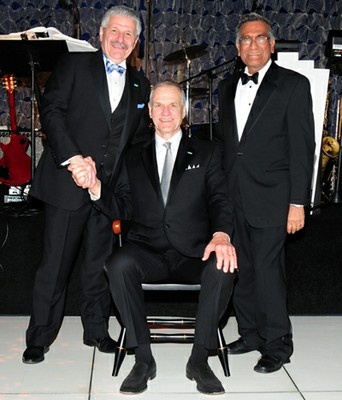
“I am both humbled and honored by this recognition,” Newman said.
The endowed position was designed to support faculty research, teaching and public service, with research projects creating training opportunities for students and fellows. It also established a continuing connection between AECOM and UCLA Engineering. Newman’s own education at UCLA had been in executive management; the position bearing his name would sit in civil engineering.
The gift placed professional development beside the acquisitions and executive appointments in his career. Its beneficiaries would include people preparing to enter the field. The same colleagues who knew his work as an executive chose an academic appointment as their tribute, giving the recognition a practical life beyond the occasion.
His institutional connections extended beyond AECOM and the university. Newman served on the boards of Sempra Energy and Southwest Water, and on boards affiliated with Capital Group. He also chaired Capital Group’s Private Client Services Board. These were separate responsibilities from running an engineering enterprise, placing him in the governance of utilities and investment organizations. The network around his career reached beyond the companies he founded, into other businesses with their own obligations to customers and shareholders.
Another company, familiar questions
Newman’s next company brought him back into collaboration with experienced industry colleagues, including Dionisio and Jeff Kissel. GISI’s history dates its establishment to 2016. Newman served as its chief executive from 2017 to April 2020 and as executive chairman from 2017 to March 2024. In 2017, its first construction-services merger brought together GISI and the leadership of the Structure Tone Organization.
The idea addressed an awkward moment in the life of a successful firm. Owners may want capital, a succession arrangement or access to larger opportunities. They may also want their company’s culture to survive the transaction. Selling a practice involves more than the valuation of its shares; people have spent careers making its name mean something.
GISI’s approach combines private ownership, employee participation and collaboration between businesses. It says partner companies can retain and develop their leadership and cultures while gaining access to capital and a wider professional network. This gives the ownership discussion a specific operational purpose: helping established firms grow without requiring them to discard the practices that brought them there.
Who gets to own the work?
The question connecting AECOM’s buyout with Newman’s later chapter
The structure also extends beyond the day a company joins. GISI offers broad employee ownership and permits retiring employee shareholders to keep their shares. Dividends depend on declaration, and annual repurchase limits apply. Those details belong in the account because ownership is an ongoing arrangement with conditions, responsibilities and choices.
Newman’s current remit includes equity plans, strategy, mergers and relationships across the architecture, engineering and construction industry. His work remains close to the mechanics of joining businesses. The attention to partner cultures suggests a consistent professional concern: growth should make use of what a firm has learned.
Dick, Rick, and the next handover
There are two Richard G. Newmans in the GISI leadership story. The founder of AECOM is Dick. His son, Richard G. Newman Jr., is Rick. Keeping the names straight reveals something more interesting than a shared surname: they took different professional routes before working within the same enterprise.
Rick studied at Stanford and MIT and built his career at Lowe, eventually becoming chief executive of its real estate business. He described wanting to establish his own path after his education. He joined GISI as president in April 2018 and became chief executive in April 2020, bringing experience acquired outside his father’s engineering company.
Effective March 28, 2024, Rick became GISI’s chairman as well as chief executive. Dick continued as a director and executive vice chairman. GISI now lists the elder Newman as chairman emeritus and executive vice-chairman. The titles distinguish continuing involvement from the responsibility for running the enterprise.
For Newman, this was another transfer of authority inside a company he had helped create. AECOM’s chief executive succession had gone to Dionisio; GISI’s went to Rick. The organizations and relationships differed, but both episodes added another stage to a career already concerned with how businesses carry on.
The employee purchase in 1990 remains a useful place to begin. It put ownership directly into the founding story of AECOM. Decades later, Newman was still working on equity plans and the relationships around mergers. His career’s recurring project has been the company itself: something people can join, help build, hold a stake in, and eventually leave in other hands.