An old contract can be a remarkably persistent colleague. It outlasts reorganizations, sits through strategy presentations and eventually asks for money. In August 2026, Troy Rudd had to explain a $337 million pre-tax loss on an AECOM construction management project awarded in 2019. By then, he had spent six years as chief executive, recasting the company around professional services and a more selective approach to risk.
The explanation carried an awkward symmetry. Rudd said the project's terms would fail the company's current risk processes. Lower subcontractor productivity had pushed completion back and raised the estimated cost of finishing. AECOM expected substantial completion in its second fiscal quarter of 2027; resolving its claims could take years. The future had acquired better rules. The past still had a contract.
For Rudd, now AECOM's chairman as well as CEO, this is the practical territory of leadership: deciding which promises an engineering business should make, how to price them and how to keep them. His career gives him an unusual vantage point. Before taking charge of the people who design infrastructure, he spent years working through the finances that make an infrastructure business possible.
A route through the accounts
Rudd's education includes a Bachelor of Science from the University of British Columbia and a Master of Science in Taxation from Golden Gate University. Taxation is an understated credential for someone whose company works across transportation, water, energy and buildings. It does, however, introduce a person to a useful principle: small provisions can have substantial consequences.
Before AECOM, he was a KPMG partner. He joined AECOM in 2009 and accumulated responsibilities across corporate finance, treasury and operations. By 2014, his work included serving as chief operating officer for Design Consulting Services in the Americas and chief financial officer for the global design consulting business. This was a route into management through both the balance sheet and the business itself.
He became AECOM's CFO in October 2015. The responsibilities around his rise included mergers and acquisitions, investor relations, financial reporting, risk and controls, and the expansion of design and shared services centers. Those jobs put him close to the machinery behind a sprawling professional organization: where expertise sits, how work moves and which obligations travel with it.
His CEO appointment was announced in June 2020, initially with an October start. The transition was brought forward to August 15. Lara Poloni became president on the same date, having led AECOM's Europe, Middle East and Africa business. Rudd's promotion therefore arrived with an experienced operating partner. A business selling collective expertise was being led by people who had already spent years inside it.
- 2009Joins AECOM
- 2015Chief financial officer
- 2020Chief executive officer
- 2025Adds chairmanship
Making a large firm behave like one
In November 2020, Rudd launched Think and Act Globally. The name was suitably portable for a multinational. Its operating intention was more concrete: simplify the organization, clarify accountability and bring expertise from across the company to individual projects. A client hiring one office should be able to benefit from knowledge accumulated elsewhere in the firm.
The strategy also addressed digital delivery, reuse of core design elements and more flexible working arrangements. These are unglamorous subjects compared with the finished bridge or station. They determine whether a firm can repeat good work efficiently, however. A beautiful rendering never has to explain why two teams solved the same problem separately.
The reshaping of the portfolio continued. In January 2021, AECOM completed the sale of its civil construction business to affiliates of Oroco Capital. Following the sale of its power construction business, the company said it had exited substantially all of its self-perform, at-risk construction operations. Rudd was narrowing the business around the services he wanted it to sell.
The distinction matters when considering the later project loss. A construction business is a collection of particular contracts, each with its own terms and timetable. Changing the overall portfolio does not instantly settle every older obligation. For a former CFO, the gap between announcing a new business model and finishing the old work is especially consequential.
Giving carbon a place in the design
In 2021, Rudd described an effort to make sustainability part of everyday project decisions. AECOM's ScopeX initiative sought substantial reductions in embodied and operational carbon through design. His explanation had a refreshingly ordinary concern at its center: a new practice needs language that people will actually use when speaking to clients.
He explained that naming the initiative gave employees a way to discuss it with clients. The observation offers a glimpse of his management approach in public: give an ambition a recognizable form, then try to make it part of routine work. It is easier to discuss an engineering trade-off when it has escaped the corporate presentation and entered the project meeting.
His affiliations extend that interest beyond AECOM. He serves on the Sustainable Markets Initiative board and the executive board of SMU's Lyle School of Engineering. In a FINTECH.TV interview, he also discussed biodiversity accounting and AI. The recurring subject is how technical knowledge can change decisions about the physical world before those decisions become expensive to reverse.
“We named it so our people are talking to clients about it.”
Troy Rudd on ScopeX, 2021
The next recruit is an algorithm
AI has become a prominent part of Rudd's next chapter. AECOM's 2024 discussion of its digital strategy included Oscar, its in-house generative AI tool, with uses such as improving bids and freeing time for other work. By 2025, the company was describing a broader effort to embed AI in engineering delivery. The ambition had moved from assistance toward the work product itself.
The acquisition of Norwegian AI company Consigli added another connection: founder Janne Aas-Jakobsen became AECOM's head of AI engineering. In March 2026, she and Rudd were listed together for a Dallas keynote on AI and infrastructure delivery. The shared platform placed an infrastructure executive and an AI builder around the same practical question: what can engineers deliver when their tools change?
There is an economic question beneath that technical one. A professional services firm has to turn better tools into value a client recognizes. Faster work may help expand what a budget can buy, improve delivery or support a different commercial arrangement. Rudd's public case for investing in AI connects the technology to client relationships and technical knowledge already inside the business.
In April 2026, AECOM and SMU announced a partnership centered on doctoral fellowships at the Lyle School of Engineering. PhD and Doctor of Engineering candidates would work with faculty and AECOM technical leaders on infrastructure problems with commercial applications. For Rudd, whose own academic route ran through science and taxation, the next generation of expertise would include advanced research in AI.
Two numbers, one uncomfortable quarter
The record before the August setback explains the ambition. AECOM finished fiscal 2025 with adjusted earnings per share of $5.26, up 16%, and $685 million in free cash flow. Its full-year adjusted EBITDA margin was 16.8%. These measures describe a business that had improved its earning power, even as the work of changing its portfolio continued.
In November 2025, AECOM set a target for a segment adjusted operating margin and adjusted EBITDA margin exit rate above 20% by fiscal 2028. It also targeted at least 15% compound annual growth in adjusted earnings per share from fiscal 2026 through 2029. Advisory services and proprietary AI were central to the plan. These were stated ambitions, with years of delivery still ahead.
Early 2026 brought further progress. First-quarter backlog was about $26 billion. Second-quarter adjusted earnings per share reached $1.59. Then the third quarter brought the construction management charge and lower full-year expectations. “We are disappointed by the loss we took this quarter,” Rudd said. In an executive vocabulary often crowded with momentum, disappointment was the word the occasion required.
Even that quarter had another story running alongside it: backlog increased 13%, and the company reported a book-to-burn ratio of 1.6. New awards were arriving faster than existing work was being delivered. Demand and execution were giving different answers. A full order book could show opportunity while a single difficult job demonstrated the cost of fulfilling it.
Execution risk and incoming demand can move in different directions. These figures measure different things and are not a financial offset.
What the next promise must earn
Rudd added the chairmanship in 2025. His responsibility now spans the day-to-day direction of the firm and leadership of its board. In September 2026, another transition followed: Manav Kumar was named chief legal officer, succeeding David Gan, who would become a senior advisor ahead of retirement in 2027. The organization behind the strategy continued to change.
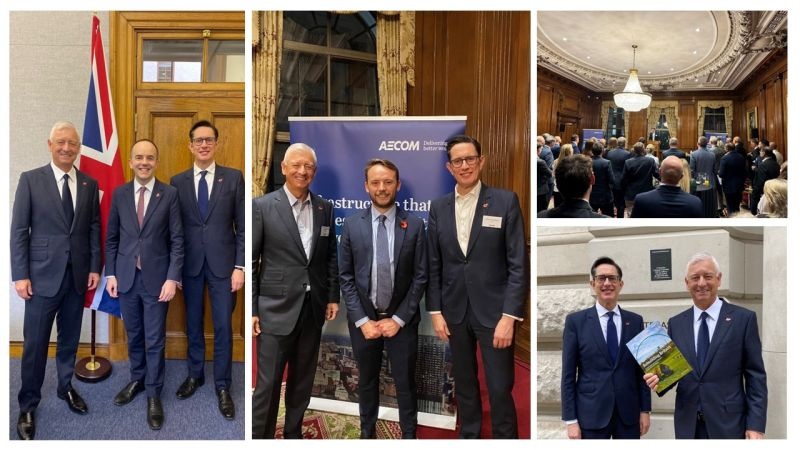
A photograph from a London infrastructure report launch shows another part of Rudd's working life: alongside colleagues and guests, discussing how Britain can deliver infrastructure and draw in private investment. It is a useful counterpoint to the financial tables. Infrastructure leadership also involves persuading institutions with different budgets, responsibilities and calendars to move toward a common project.
The thread through his career is the effort to organize expertise so that it can be sold and delivered reliably. Finance, operating structure, carbon design and AI each offer a different way to approach that task. The people doing the engineering remain essential; the business around them determines how widely their knowledge can travel and what risks accompany it.
Rudd's next results will have to carry several promises at once: better technology, stronger advisory services, higher margins and more disciplined risk. The 2019 contract is a costly reminder of how long a decision can remain alive. For the former finance chief, the measure of the next chapter will be whether the new promises leave a more manageable inheritance.