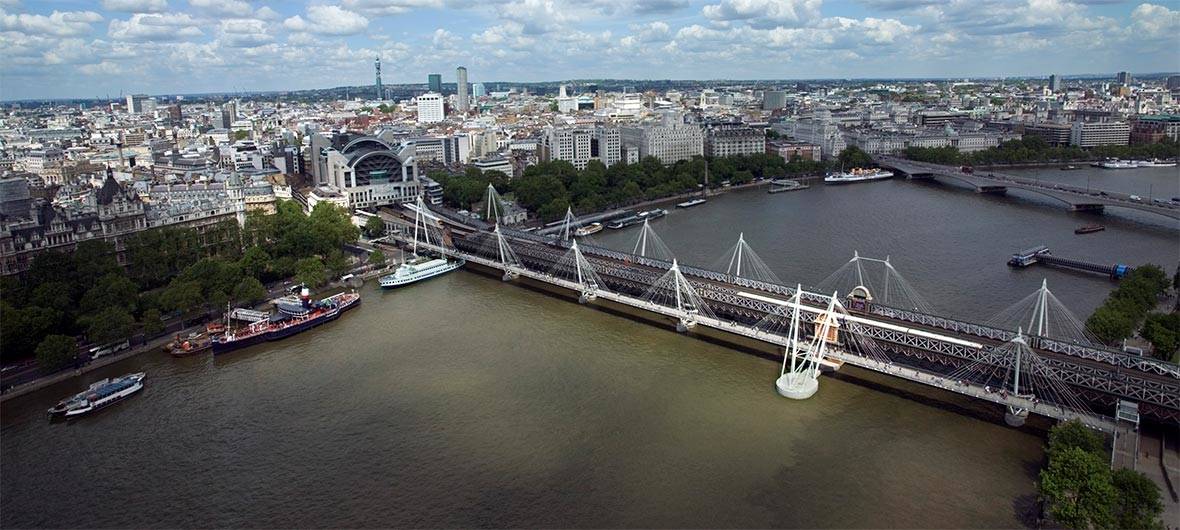
Beneath London, a tunnel must negotiate things that do not negotiate back: clay, chalk, buried utilities and the foundations of a city already occupying the space above it. AECOM’s assignment on the Thames Tideway Tunnel was to provide design services for the 12-kilometer central section. Seen from a bridge, the engineering is almost entirely invisible. That is a useful introduction to the company.
- The work: engineering, environmental advice and management for complicated infrastructure.
- The buyer: agencies, utilities and private owners with assets to deliver.
- The catch: technical expertise cannot cancel an expensive contractual promise.
Twelve kilometers under the postcard
Tideway’s central section runs through several geological formations, beneath existing underground infrastructure and near Tube lines. Streets above must keep functioning. The task therefore includes understanding how one intervention affects another. A beautiful drawing is useful only if the ground, the neighboring assets and the construction sequence will accommodate it.
AECOM works across transportation, water, buildings, energy and environmental services. It can help an owner examine a proposal, plan and design an asset, secure environmental approvals, and manage delivery. Its service list includes ground engineering, architecture, cost management, remediation and geospatial analysis. The appeal is the ability to bring related disciplines into the same conversation before their assumptions collide on site.
Water makes that breadth tangible. A utility might need drinking-water treatment, wastewater reuse, flood protection or help with emerging contaminants such as PFAS. These are different assignments, but they share an awkward feature: choices made in one part of a system can create costs somewhere else. AECOM sells access to specialists who can investigate those connections.
The company that bought the whole toolbox
The business began independently in 1990, assembled from five entities. Richard Newman helped lead the employee and management buyback from Ashland. This was a company built by bringing established practices together. More than 50 companies subsequently joined AECOM; it listed on the New York Stock Exchange in 2007.
Then came a much larger wager. In July 2014, AECOM announced an agreement to acquire URS in a transaction with approximately $6 billion in enterprise value, including assumed debt. The pitch was an integrated delivery platform with added construction, power, oil and gas, and government capabilities. More of the customer’s problem could fit inside one organization.
That history helps explain its competitive position. An owner can consider Jacobs, WSP, Arup, AtkinsRéalis or Stantec, depending on the assignment. AECOM’s proposition is the breadth of expertise it can assemble and coordinate. For buyers, the useful comparison is the proposed team, its relevant experience and its authority to solve problems across contracts.
The number inside the number
AECOM reported about $16.14 billion in fiscal 2025 revenue. Roughly $8.6 billion was pass-through revenue, including subcontractor and other direct project costs. Subtract it and approximately $7.54 billion remains. The distinction matters: money traveling through a project account tells a different story from revenue associated with the company’s own services.
Rounded figures. After pass-through revenue is not profit.
Its commercial engine is project and program work for institutional buyers. Contract terms determine how effort becomes income and how overruns become liabilities. A fee for advice and a promise to deliver construction at an agreed price can involve very different exposures. Anyone buying these services should understand which arrangement is actually being proposed.
A contract has a long memory
By 2020, AECOM had completed the $2.405 billion sale of Management Services to affiliates of American Securities and Lindsay Goldberg, subject to adjustments. It also moved to exit self-perform, at-risk construction businesses. The portfolio was shifting toward professional services with lower risk. In November 2025, it announced a review of strategic alternatives for Construction Management, including a possible sale.
Then, in August 2026, came a $337 million pre-tax charge on a construction management project awarded in 2019. Management pointed to subcontractor productivity, delay and a higher estimated completion cost. It said the contract would not pass today’s risk processes. This is the financial trap in long projects: changing the rules for new work leaves old obligations alive.
“lower subcontractor productivity is driving a delayed completion and a higher estimated cost to complete”Troy Rudd / August 2026 results
The reported failure was in delivery productivity; its financial consequences depended on the contractual exposure. That distinction is worth keeping. Better screening can improve the next decision. It cannot rewrite a signed agreement.
Rivals, until the project needs both
In September 2026, Transport Infrastructure Ireland appointed an AECOM-Jacobs joint venture as MetroLink’s program delivery partner. The planned system connects North County Dublin, the airport and the city center through 16 new stations. The team’s work includes procurement, governance, risk management and coordinating multiple contracts. Here, a competitor becomes part of the delivery machinery.
In October, an AECOM-led venture won the program management consultancy for Ontario’s Highway 413, an approximately 59-kilometer corridor. These assignments show the customer problem clearly. Infrastructure owners need technical work and an organization capable of connecting its many moving parts.
Its environmental ambitions extend into the business itself. AECOM’s 2026 sustainability report says total emissions fell 29% against a 2018 baseline. That is a company footprint measure, separate from the carbon consequences of the infrastructure it advises on. For a client, the practical questions remain specific: which design changes reduce emissions, and which investments keep an asset useful as climate risks change?
Start with the handoff
There is a smaller, copyable idea here: assign responsibility where disciplines meet. Ask who owns the schedule, who approves a change and who pays when one team’s delay reaches another. AECOM’s program management offering formalizes that work through budgets, controls, contracting strategies and stakeholder management.
Communication also needs engineering. Its PlanEngage platform turns technical material into interactive online reports and collects structured feedback. That addresses a familiar planning obstacle: the giant PDF that technically informs everyone while practically inviting very few people into the discussion.
The model depends on a funded client, a clear brief, usable information and authority to coordinate delivery. Without those conditions, assembling more specialists adds meetings. AECOM’s experience suggests a precise question for any ambitious project: when the handoff goes wrong, whose problem does it become?