The memorable object in Petra’s story is a hole: twenty feet long, bored through Sioux quartzite, announced in December 2021. The company said its robot advanced at an average of one inch per minute without a cutting tool touching the rock. A cable could pass through the space it made. For a utility trying to bury infrastructure in difficult terrain, that was the point of the exercise.
THE STORY IN THREE POINTS
- Heat did the cutting. Petra used thermal spallation to fracture hard rock.
- The design became a toolkit. Six interchangeable modules tackled different construction tasks and ground conditions.
- The company wound down in 2024. Some of its equipment and know-how continued elsewhere.
Petra is worth understanding because its history contains two different kinds of adaptation. First, the engineers changed how they attacked rock. Then the company changed what it thought a contractor needed. Both decisions produced something physical. Neither kept Petra in business indefinitely.
01 / A very expensive place to put a wire
Founded in 2018 as ArcByt, Petra was led by co-founders Kim Abrams and Shivani Torres. Abrams connected its purpose to the devastation of California’s Paradise fire: get vulnerable utilities underground, and make doing so affordable enough to happen more often. She had previously co-founded robotic digitization company Ripcord and worked at NASA. Her new subject was decidedly less tidy than a document.
The intended buyers were utilities, municipalities, engineering firms and construction contractors. Their projects could involve electricity, communications, water or sewage. These customers needed infrastructure installed beneath the surface with manageable cost and disruption. In bedrock, the excavation itself could become a formidable part of the bill.
That focus gave Petra a particular place in the market. Its early announcement described utility bores from 20 to 60 inches in diameter. The Boring Company’s vehicle tunnels belonged to a different scale and application. Petra was trying to create the passage for a pipe or a cable, rather than a route for commuters.
“What we're trying to do is to lower the cost so dramatically that it's a no-brainer to underground.”
Kim Abrams · Watt It Takes
02 / The first idea ran too hot
Petra initially tried a high-powered plasma torch. The approach proved impractical. The company’s own ARPA-E teaming description later said it had determined plasma was unsuitable for use at scale. Tesla co-founder Ian Wright, recruited as CTO, helped improve the drilling technology. Giving up a method was part of getting a machine to work.
The subsequent method used thermal spallation. Heat applied at the rock face causes fragments to break away, exposing another surface to attack. Petra’s later Jet Bore description specified that the process did not melt the rock. The distinction is useful: the objective was removable pieces, not a puddle underground.
Contactless excavation offered a way around cutting-tool wear in strong, abrasive rock. Petra also designed for retrieval: the boring unit could reverse through its carrier pipe for maintenance. In a small utility tunnel, recovering the working end is a practical concern. A clever tool has less value if maintaining it requires another excavation.
Reported bore length
Reported average advance
A demonstration result in a particular rock - not a forecast for every job.
The quartzite bore established a specific piece of evidence. It did not, by itself, establish the cost of an entire installation or the reliability of a long production run. The difference between those questions would become central to Petra’s next design.
03 / The ground refused to pick one personality
After the hard-rock announcement, construction companies brought Petra stories about other difficult ground. In its account of the platform launch, Petra said it decided in early 2022 to expand beyond rock. A tool intended for one material might meet something quite different halfway through a job. Soil, unfortunately, does not read the equipment specification.
In September 2022, Petra acquired Zilper Trenchless. Zilper brought experience in flowing sand, cobbles and high-water-table environments. Its co-founders, Daniel and Roberto Zillante, became Petra’s COO and CTO. The acquisition joined hard-rock development with a team that knew difficult soft ground.
Zilper’s record included a reported 16-inch metal casing installed beneath a river through flowing sands with less than five feet of cover. That example helps explain the appeal. Hardness is only one way for geology to make life awkward; unstable material and water create their own demands.
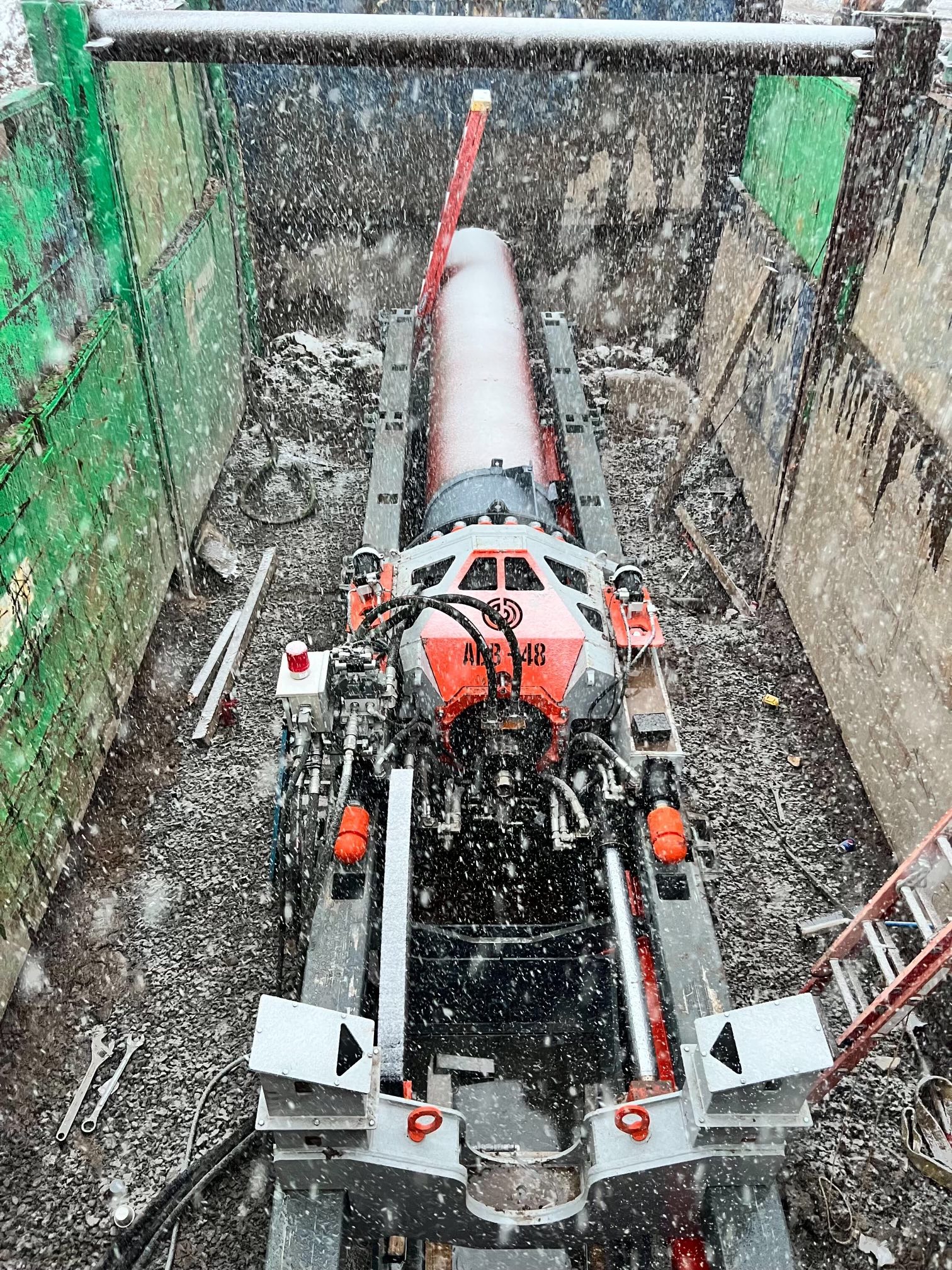
Launched in April 2023, the Petra Platform combined six modes on one machine. The operating idea was to exchange the module as geology or the installation task changed. The launch announcement claimed a swap took about 15 minutes. The ground would still be uncertain, but the machine could carry more than one answer.
Choose a condition to see the intended tool.
A non-contact cutterhead uses thermal spallation to excavate strong, abrasive rock.
The other modes: piloting sets a path; pilot pullback enlarges a pilot bore while drawing in the service pipe. This schematic explains the design, not site suitability.
04 / A hole is a service
Petra’s business combined research, equipment manufacturing and construction services. A contractor could use the company as a specialist subcontractor for difficult underground work. That relationship makes field performance part of product development: the people completing the installation can expose a machine’s weaknesses rather more convincingly than a presentation.
The conventional alternatives included horizontal directional drilling, microtunneling, auger boring, pipe jacking and open excavation. Petra’s proposed advantage was flexibility across conditions and tasks, alongside its non-contact rock tool. Its offering included rehabilitation as well as new installation. A pipe-bursting module could break an existing pipe while drawing a replacement into its place.
The company reported that earlier platform prototypes had completed 28 crossing jobs in Latin America by the April 2023 launch. That is a measure of project experience, not a count of paying customers. It also announced a New York deployment, giving the modular argument a field setting rather than leaving it entirely in a diagram.
Commercial ambitions were broader still. A 2022 partnership with Tekfen Construction and Tekfen Ventures targeted opportunities across Europe, the Middle East and Africa. The announced first phase called for a 100-foot North American hard-rock pilot, with Tekfen supplying project specifications to inform development. Construction expertise was part of the proposed exchange.
The money deserves equally careful reading. Petra announced a $30 million Series A led by DCVC in December 2021, bringing disclosed funding to $33 million at that time. Its early price ambitions were roughly $200 per linear foot in soft soil and $600 in hard rock. Those were stated targets, rather than a verified menu of completed-job prices.
05 / Electric in the pit, conditional everywhere else
Petra’s 2023 engineering account described electric-powered hydraulic pumps supplied by diesel generators, batteries or mobile substations. It characterized the pit operation as emissionless, while explicitly tying overall greenness to the power source. The detail is more helpful than a broad environmental label: moving combustion away from the pit does not make diesel disappear.
The modules also had different intended conditions. Auger boring addressed stable ground; Assisted Dynamic Boring combined jacking and ramming for difficult or unstable conditions; Jet Boring addressed intact hard rock. In late 2023, industry coverage still described Jet Boring as in development, with longer granite test bores underway. “All-geology” expressed the platform’s scope, rather than proof that one mode could handle every site.
The lesson a project owner can copy is to ask for evidence that matches the installation: material, diameter, length, groundwater and access. The lesson a hardware designer can copy is more direct. Put the capability that may need changing into a replaceable module. Petra’s architecture made that response explicit.
06 / The machines outlived the company
The Petra Platform won the 2023 ISTT No-Dig Award in the New Technology category. By October 2024, Petra’s story had taken a different turn. The San Francisco Business Times reported that it had shut down after failing to raise new funding. Technical recognition and access to capital had become separate outcomes.
EarthGrid acquired used equipment and shared patents in 2024, according to a later SEC-filed biography. Another part of the equipment story appears in Phoenix Boring’s founding account. Roberto Zillante says he bought the two Multi-Platform ADB48 machines in the United States with his personal savings after Petra’s wind-down.
Phoenix says Zillante then completed a challenging 500-foot gas-pipeline project for PG&E in California. That job helped attract investors; with their support, he acquired further relevant intellectual property and hard assets. This is Phoenix’s account of its own beginnings, and the PG&E project belongs to that later chapter.
There is something unusually concrete about the ending. Petra’s ideas survived in machines that could be bought, maintained and put into another excavation. The company’s history leaves a useful question for anyone building infrastructure technology: after the demonstration, what does the next job require? In this case, at least part of the answer was already sitting in the yard.