A freezer is an excellent skeptic. It cannot be persuaded by a climate pledge, a handsome investor presentation, or a forecast of tomorrow’s sunshine. It needs power tonight. That unglamorous fact helps explain Mainspring Energy, a company whose unusual generator has found customers in places where electricity is less a convenience than a condition of doing business.
- The machine: local electricity from a software-controlled linear generator.
- The buyers: utilities, data centers, warehouses, and industrial operators.
- The wager: change fuels over time without replacing the generating equipment.
Lineage, the cold-storage operator, offers a useful entry point. In September 2024 it signed an agreement for 33 Mainspring generators across five Texas facilities, scheduled for installation in 2025. Earlier, it had announced a facility producing all its consumed energy onsite with rooftop solar and linear generators. Refrigeration gave the technology a demanding audition.
Electricity, in a straight line
Most people picture a generator as something spinning. Mainspring’s machine moves back and forth. A low-temperature reaction of compressed air and fuel pushes oscillators carrying magnets through copper coils. Air springs return them for another cycle. Power electronics and software control the motion, adjusting operation to the fuel and the load.
The engineering proposition is flexibility. A customer can use available gaseous fuels today and change the mix later. The machine can also increase or decrease output as demand shifts, providing power alongside solar or operating independently of the grid. Mainspring sells equipment that gives an energy manager more choices after installation.
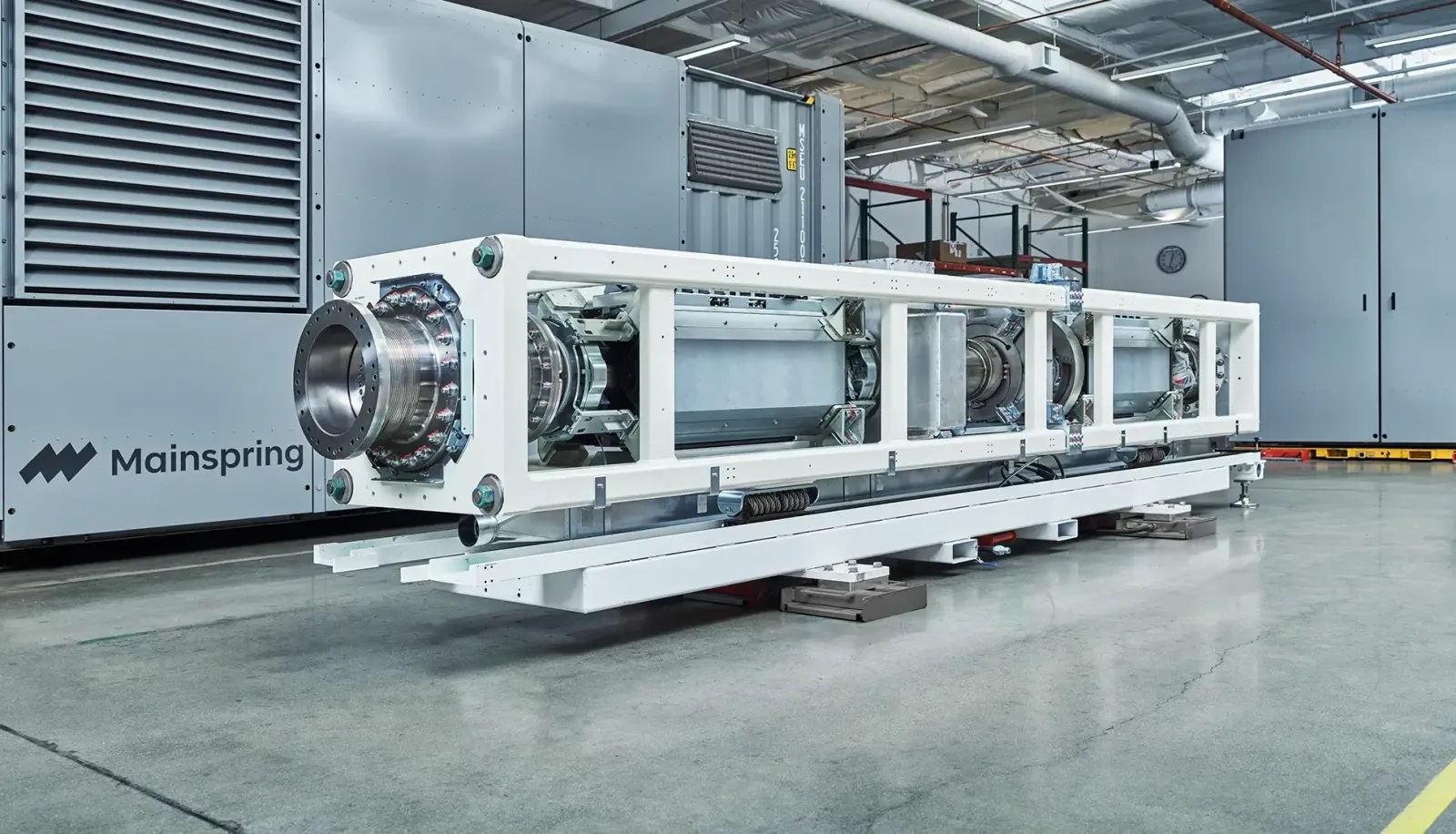
That places it between familiar procurement choices: gas engines and turbines, fuel cells, and combinations of renewable generation and storage. Each solves a different version of the power problem. Mainspring argues for combining controllable output, low local emissions, and fuel switching. Batteries remain useful partners; a fuel-fed generator can keep producing while fuel remains available.
Software adjusts the cycle as fuel and demand change.
The machine worked. The paperwork took longer.
Shannon Miller, Adam Simpson, and Matt Svrcek co-founded the company in 2010, drawing on Stanford thermodynamics research. Customer deployments began in 2020. The public launch arrived in March 2021. A decade is a long interval in venture capital, but rather less surprising when the product must survive continuous operation outside a laboratory.
The early Colton grocery-store trial reveals the work between invention and adoption. Its report describes permitting and grid-connection obstacles, minor software issues during commissioning, and improvements aimed at reducing auxiliary power consumption. Performance held above 40% efficiency across the store’s load range. The evidence is prosaic in the best possible way: a machine doing its job.
The rules required their own development effort. In a 2023 interview, Miller described incentives written for fuel cells before regulators knew about linear generators. Securing similar treatment took more than nine years. Technical novelty had created a commercial disadvantage that technical performance alone could not remove.
“Sometimes changing these laws can take more time than the technology development!”Shannon Miller, 2023 interview
The second order tells the story
For a new equipment company, an early customer is encouraging. A returning customer is more revealing. California Bioenergy, or CalBio, began deploying Mainspring generators in 2022 at dairy-biogas facilities. In February 2026 it announced the purchase of eight additional units, with combined capacity across five sites expected to reach 5.3 MW by year-end.
Here the fuel story becomes tangible. Dairy digesters produce biogas; processing operations require electricity. Local generation can connect those two needs. CalBio’s expansion is an announced target, rather than proof that every planned installation is already running. Still, purchasing more equipment after operating earlier systems supplies a useful signal.
The same distinction matters when reading Mainspring’s scale claims. Its current website lists more than a gigawatt in late-stage development and operation combined. Development belongs in the picture, but it is not delivered electricity. A buyer evaluating reliability should ask about comparable operating sites and service experience, as well as the order book.
A power plant needs a balance sheet
Mainspring’s business extends beyond manufacturing. It offers direct purchases, financed solutions, project delivery, and maintenance, supported by partners and resellers. Its 2021 launch described energy-services agreements under which customers paid nothing upfront. The accompanying $150 million NextEra agreement covered equipment purchases and project finance. It was not an equity round.
The equity rounds were substantial enough. A $95 million Series D in 2021 was followed by a $290 million Series E final close in 2022. General Catalyst led a $258 million Series F in April 2025, joined by investors including Amazon’s Climate Pledge Fund. That announcement put cumulative financing above $800 million.
Series E shows its final close, including the first close.
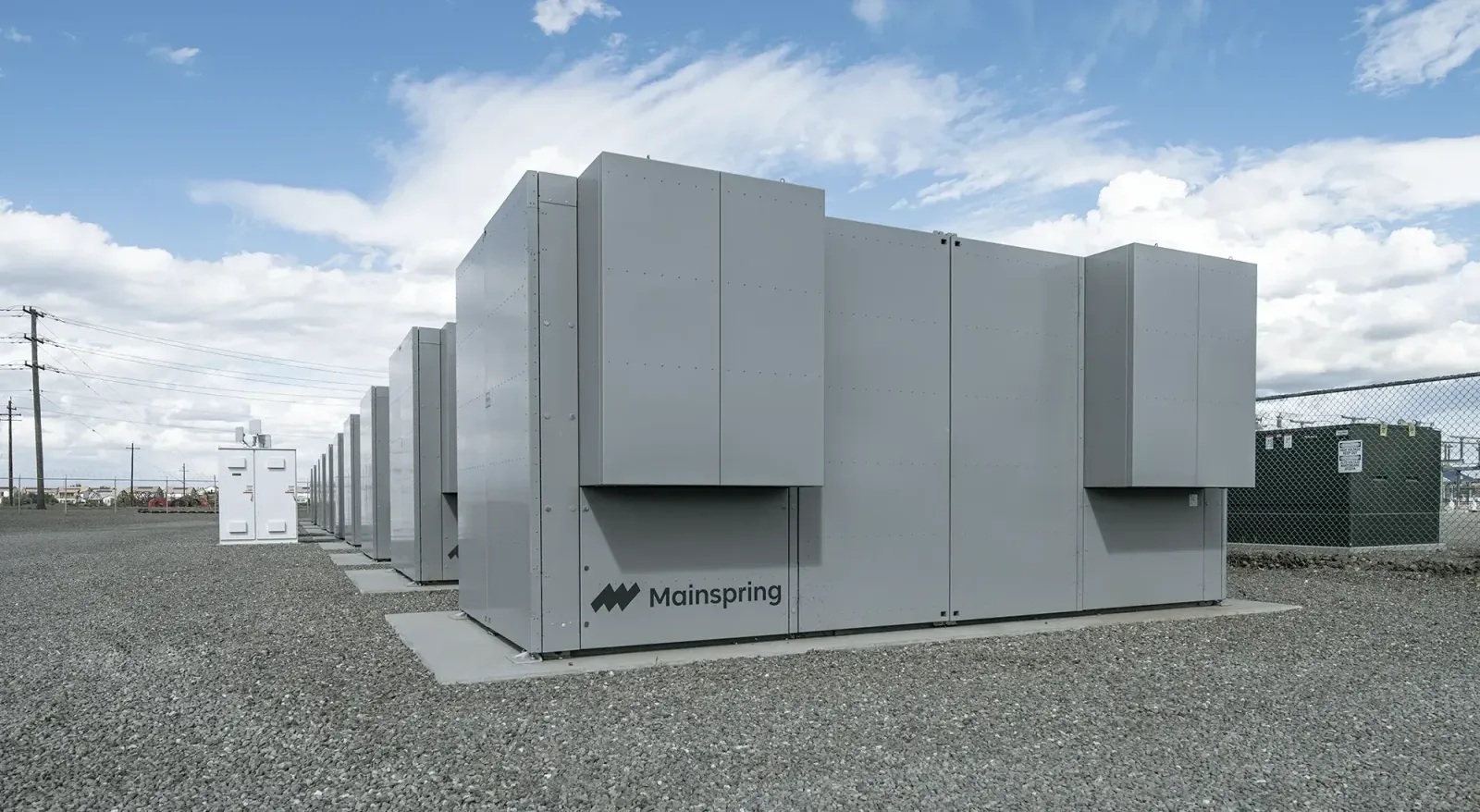
Small units become larger installations through a shared electrical architecture.
Customer economics deserve separate arithmetic. A May 2024 demonstration report modeled electricity costs of 9-12 cents per kilowatt-hour under its assumptions. That historical range is not a current quotation. Delivered fuel prices, operating hours, installation, maintenance, and financing determine whether a particular project saves money. The attractive number on a slide needs a site beneath it.
Fuel flexibility still needs fuel
There is also a distinction between low air pollution and low carbon. Mainspring reports near-zero nitrogen-oxide emissions, useful where air permitting is demanding. Natural gas still produces carbon dioxide. Cleaner-fuel ambitions depend on the source, availability, and production of those fuels. A machine capable of using hydrogen cannot conjure a hydrogen supply.
Resilience requires the same practical discipline. The Air Force’s March 2026 pilot announcement at Travis Air Force Base proposed testing multiple fuels, including natural gas and hydrogen. That is a test of a promising capability. At a commercial site, alternate fuel connections, storage, controls, permits, and maintenance would still need a coherent plan.
The founder hired for the next problem
In June 2026 Miller recruited former Cummins chief Tom Linebarger as CEO and became president. They had worked together for fourteen months after he joined the board. The move put an experienced power-industry operator in charge as Mainspring pursued larger utility and data-center opportunities.
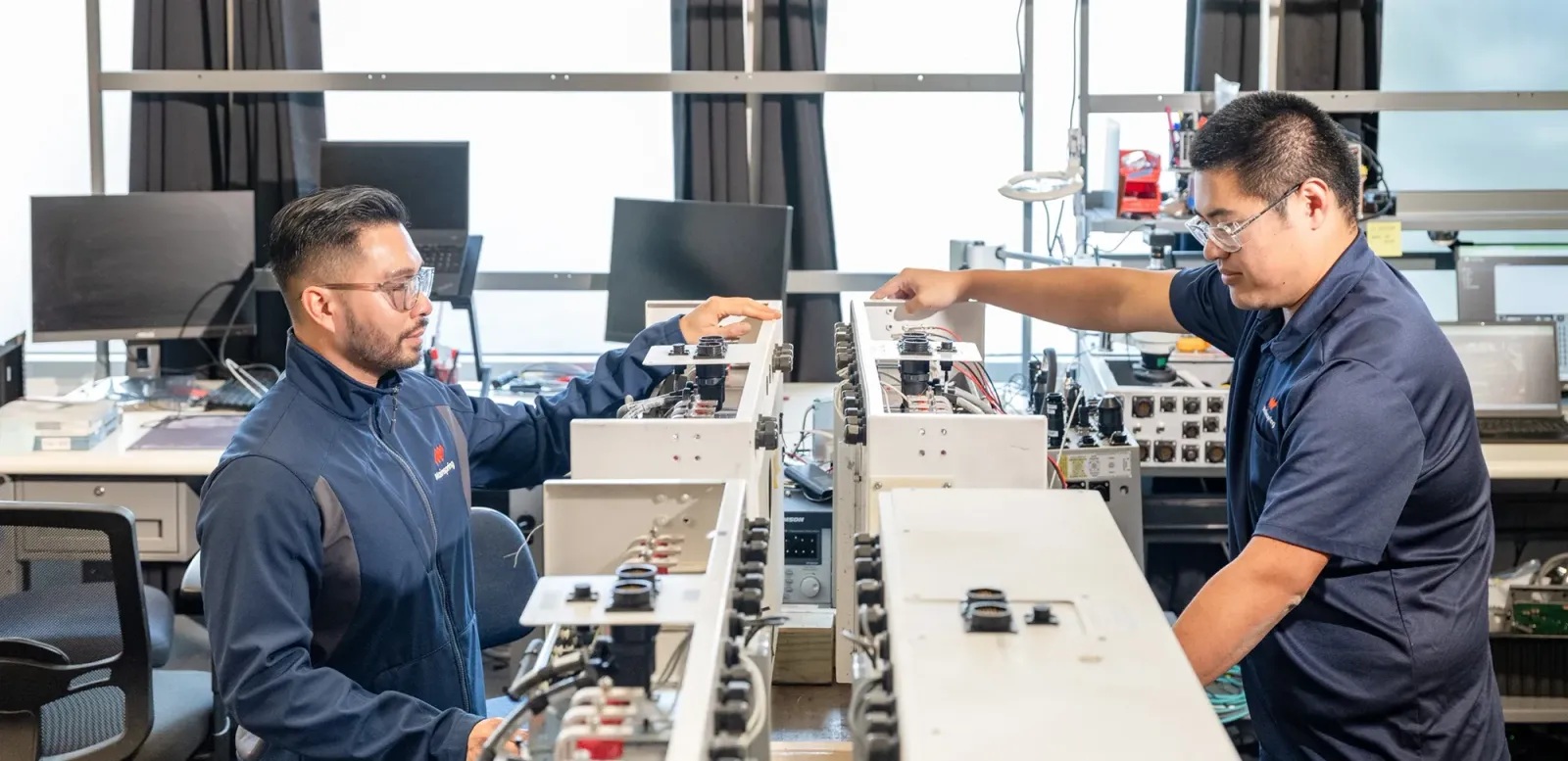
The lesson other businesses can borrow is straightforward: find a costly, measurable problem; prove the product under working conditions; make the next purchase easier. Mainspring’s generator is unusual. Its customers’ requirements are wonderfully ordinary. Keep the freezer cold. Keep the facility operating. Leave room for tomorrow’s fuel.