There is a photograph in Michael Vellano's family that does a remarkable amount of work. It shows his Italian-immigrant great-grandfather laying a water main in Schenectady, New York, in 1925. The picture is old enough to belong to another industrial age. The problem in it is entirely current: a city needs water, and somebody must know how to put the system beneath everybody's feet.
Vellano grew up inside that inheritance. His family supplied waterworks equipment, trench shoring, hydrants, frames and covers. His father and uncles brought newer repair methods into the trade. Long before he had a title, Mike counted T-bolts and picked scraps of paper off the warehouse floor. His father once offered him a dollar for each piece. The boy returned with a grocery bag, imagining a small fortune. He received five dollars and instructions to buy a soda.
It is a better founder story than the customary garage. There is inventory, mild labor-law ambiguity and an early lesson in unit economics. More importantly, there is repetition. Water infrastructure entered Vellano's life not as a market category but as the family grammar.
01 / Learning the whole pipe
The useful move was sideways
From 2001 through 2009, Vellano rose from local branch manager to vice president at Vellano Brothers in the Albany area. He helped streamline operations, develop accounts and increase sales. By his 30th birthday, the family company was essentially the only serious entry on his résumé. Familiarity can become an advantage, but only after you discover where it ends.
So he moved his family to Texas. The point was not reinvention for its own sake. He wanted operating experience at a regional lining company, on the contracting side of the business. He later became vice president of sales and marketing for a large privately held trenchless contractor, overseeing sales, product development and strategic alliances. He already knew how the parts reached customers. In Texas, he learned what happened when crews, schedules, equipment and damaged pipes met underground.
That sentence explains much of what came next. Vellano did not organize innovation as a parade of inventions. He saw it as a loop. A material alone rarely solves a large culvert or failing sewer. The useful system includes people, process and technology. Crews encounter the inconvenient truth first: strange geometry, active flows, corrosion, limited access. Their adaptations travel back to the laboratory. The lab turns improvisation into a repeatable method. The method returns to the field.
02 / Assembling Vortex
A portfolio, not a miracle product
The future Vortex began with a mechanical pipe-seal technology called Pipe-Robo-Tec. In 2014, Vellano developed QLS, a system for structurally repairing large-diameter pipe, alongside turnkey bypass capability. The following year, he founded Vortex in Houston and consolidated a set of growing operations. The first office had 15 employees.
Vortex was designed around a simple customer frustration. Municipalities, engineers and facility managers did not merely need a clever liner or robot. They needed someone to assess a problem, select a suitable method, supply the materials, train people and, where required, install the solution. One roof could hold pipe and manhole lining systems, mortars, epoxies, resins, robotics, monitoring, contracting services and field support.
The company acquired Quadex in 2015, adding geopolymer, manhole-rehabilitation products, coatings, resins and equipment. It added rights and relationships around sewer robotics and drain-cleaning tools. Over the following decade, it bought contractors, technology companies, manufacturers and regional specialists in the United States and Europe. The result was less a string of trophies than a connected operating system.
This is where Vellano's sales background became unexpectedly useful. Many acquisition targets began as customers, vendors or industry partners. The relationship created a kind of slow diligence. He could see how people behaved, whether the technology worked and where Vortex might add value before anybody hired a banker or opened a data room.
The Vortex acquisition loop
His public filter is admirably free of financial incense. Does the business have good personnel? Does it bring a useful technology? Does it support the work Vortex already performs? Can the combined company grow it? If Vortex cannot make the acquired business better, the deal is harder to justify.
The people do not disappear behind the purchase price. Vellano has pointed to executives who joined through transactions and later ran larger parts of Vortex. In April 2025, he promoted two employees who had been there from day one into roles overseeing process, integration and Southwest operations. Growth, in this model, creates ladders as well as logos.
03 / Capital without costume jewelry
Private equity entered the trench
Vortex's appetite eventually required outside capital. Platform Partners backed the company in 2017. In September 2023, Quad-C Management invested, with Vellano continuing as co-founder and CEO. Terms were not disclosed. The transition mattered because it preserved the operating thesis while supplying another runway for expansion.
The 2024 acquisition of Applied Felts' Americas operations brought liner manufacturing and distribution, including MaxLiner and FerraTex Solutions, deeper into the group. Premier Pipe USA followed that August. Tri-State Utilities and Pipe Vision arrived in December. By its tenth-anniversary year, Vortex's own history showed an organization still adding geographic reach and technical depth; in 2026 it announced further moves in potable water and Midwest municipal-pipe services.
The pattern is worth stealing. Vellano does not separate organic growth from acquisitions as rival religions. Crews are added. Existing products travel into new service businesses. Acquired chemistry meets commercial expertise. A partner's capability becomes a platform's capability. Buying and building are simply two tools in the same box.
04 / Learning to leave the fire brigade
The founder became less necessary on purpose
Vellano describes his leadership with more self-diagnosis than theater. He knows what he is not good at. His longtime CFO became a partner in filling those gaps. He favors concise explanations and admits that, as Vortex grew, he had to become more attentive to the detail behind an issue. Peer learning through YPO helped him listen and gain perspective.
The younger operator wanted to run toward every burning building. Scale taught him that other people could handle particular fires better. Humility, in this telling, is practical resource allocation. A founder who remains the answer to every question has built a queue, not a company.
His favored cultural phrase is “We win big together.” Corporate mottos often arrive lacquered and leave untouched. At Vortex, the interesting evidence is structural: leaders from acquired businesses receive larger jobs; field crews influence product development; long-serving employees move into integration and regional command. The slogan has plumbing.
There is public recognition too. Houston Business Journal named Vellano to its 40 Under 40 class in 2019. That year, an independent panel selected him as a Gulf Coast finalist for EY's Entrepreneur Of The Year award. He redirected the credit toward the entrepreneurial leaders he had assembled. It was on-brand, certainly, but also consistent with the organization he was trying to build.
05 / The view above ground
Infrastructure is a public art of avoiding drama
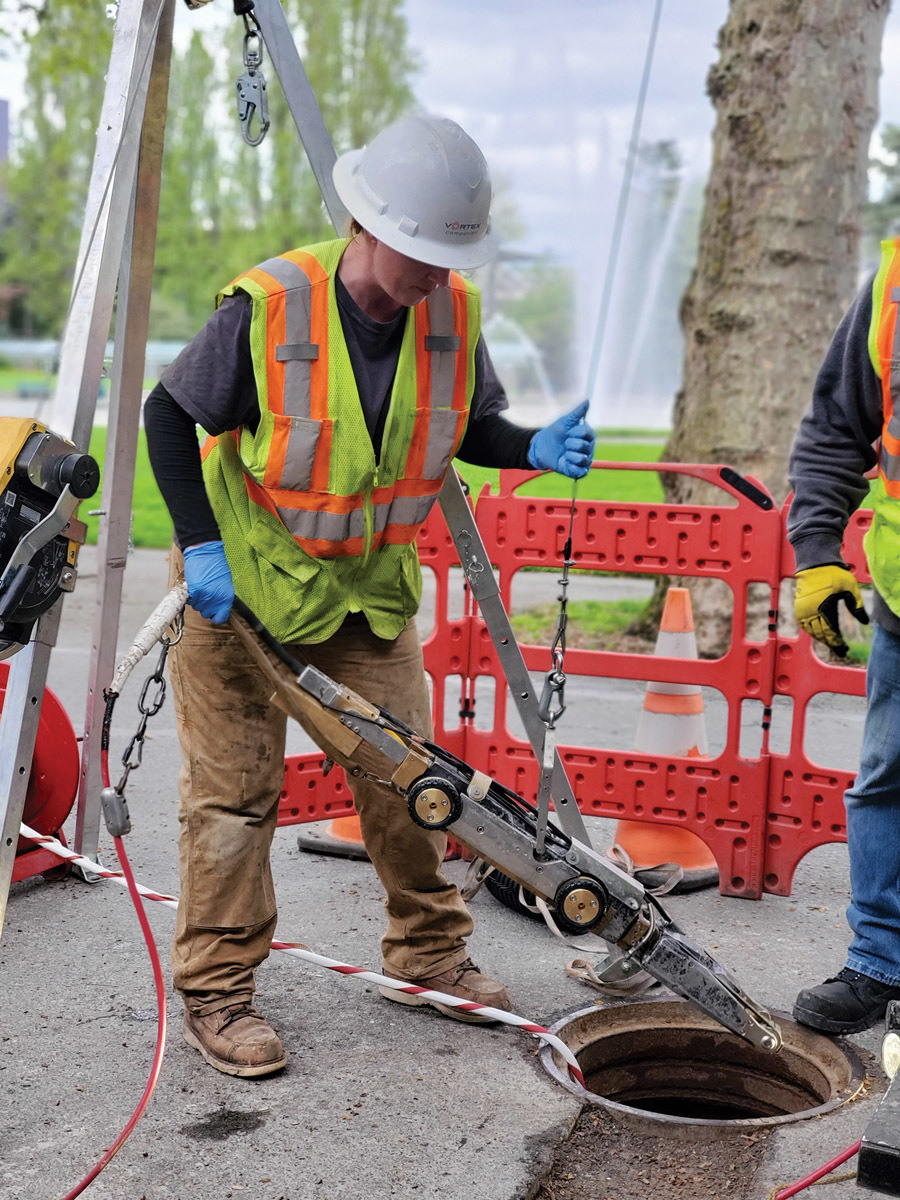
Trenchless repair is easy to overlook because its victory condition is uneventfulness. The road remains passable. The hospital entrance stays open. The city does not need to excavate an entire corridor to restore a pipe. Inside the old asset, a liner, coating, seal or structural material creates another service life.
Vellano once compared the process to angioplasty in a sewer application. The metaphor is vivid, but the business lesson is plainer: constraints create categories. Cities cannot casually stop moving. Industrial facilities dislike shutting down. Old infrastructure does not wait for a convenient fiscal year. A less disruptive repair method becomes valuable because it respects everything happening above it.
His ambitions extend beyond contracts. Vortex has partnered with World Vision on clean-water infrastructure for communities in Honduras, and Vellano's family supports theater, arts and youth programs in Houston. Vellano Investments, founded in 2019, backs lower-middle-market growth companies and has described interests in nonprofit, real-estate and education ventures.
Yet the personal details keep him out of bronze. He cooked in a restaurant during college and bagged groceries. He prefers Tex-Mex to barbecue, particularly cheese enchiladas with a margarita. Given a month away, he would go anywhere in Italy, a brisk answer tied to ancestry and, by his own cheerful admission, wine.
The century-long family photograph remains the neatest ending. Vellano's great-grandfather helped lay a Schenectady water main. The family later repaired the same line. Four generations do not eliminate the old problem; they improve the way people approach it. In Vellano's version, the street stays calmer, the technology gets smarter, and the crew beneath our feet receives a little more of the credit.