The best trenchless repair has a peculiar quality: from street level, almost nothing appears to be happening. Traffic moves. A light-rail train keeps its schedule. The bakery opens. Somewhere below, an old sewer is being cleaned, measured, patched and given a new structural life from the inside. Vortex Companies has turned that disappearing act into a sizable industrial business.
The Houston company works on the buried circulatory system of cities and plants - water mains, wastewater lines, storm drains, culverts, manholes, tunnels and process piping. Conventional replacement often means excavation, detours, noise and restoration bills. Vortex instead offers a catalog of ways to enter through limited access points, stabilize or line the old structure, and prove the finished repair. It sells the ingredients and machines to other contractors, and it also sends its own crews to do the work.
A new pipe inside the old one
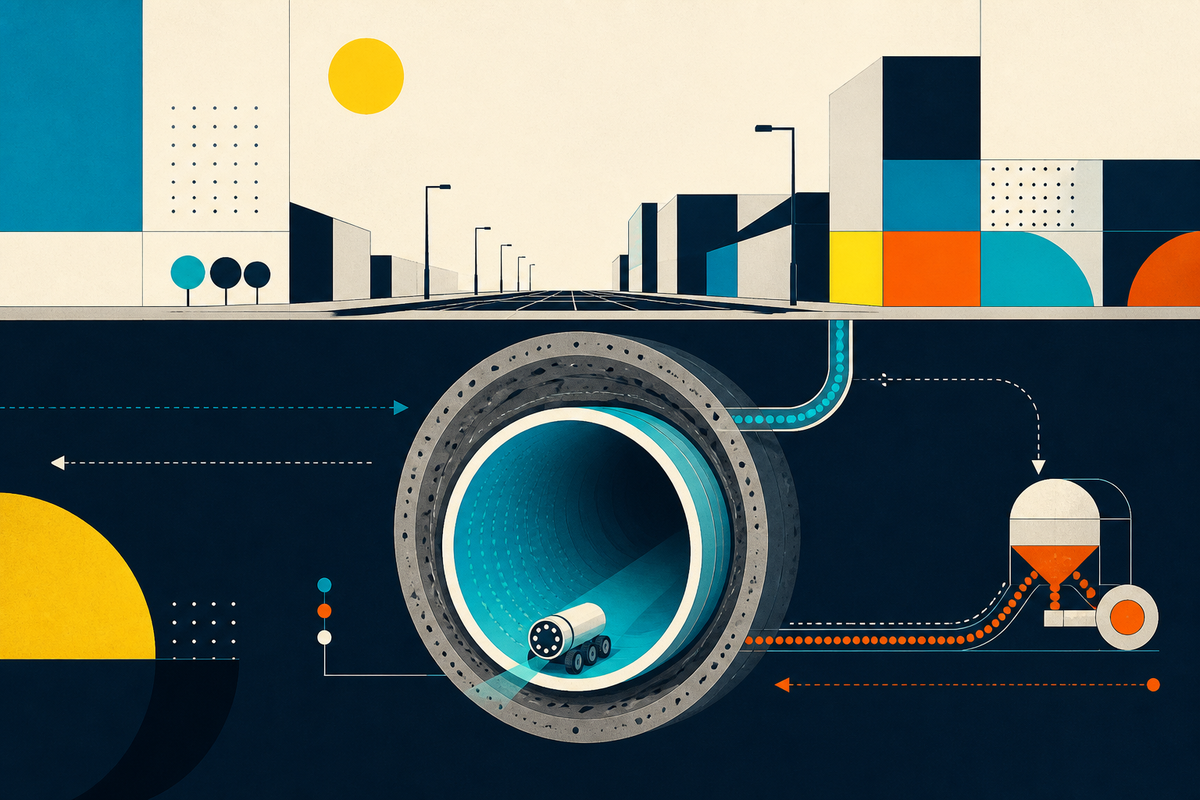
Cured-in-place pipe, or CIPP, is the easiest place to see the proposition. A flexible liner saturated with resin is inserted into a damaged host pipe, pressed against its walls and cured with hot water, steam, ultraviolet or LED light. Once hardened, it becomes a pipe within the pipe. Other failures call for spray-applied geopolymer mortar, epoxy, chemical grout, a localized point repair, slip lining or pipe bursting, which fractures an unsalvageable pipe while pulling a replacement into its path.
The technique is only one link in a fussy chain. Crews first need condition data from CCTV inspection. Flow may require bypass pumping. Roots, scale and protruding connections have to be cut away. Engineers match the repair to the diameter, shape, corrosion and loads. A liner must be impregnated evenly, installed at the correct pressure and completely cured. Laterals must be reopened. The owner needs records. Missing one step can compromise all the others.
The no-dig stack
Vortex's wager is that customers would rather buy that chain with fewer seams. Its coatings and materials operation formulates geopolymers, hybrid cements, resins, grouts and polymerics. United Felts and MaxLiner provide liner systems. The equipment side builds application rigs, inversion drums, UV curing units and custom robotic trucks. VeriCure uses fiber-optic distributed temperature sensing to monitor a liner through the curing process. Training ranges from material application to the company's wonderfully specific Tap Cutting Institute.
The product is not merely a liner or a robot. It is continuity above ground while renewal happens below it.The Vortex value proposition, in plain English
The one-roof strategy
Mike Vellano co-founded Vortex in 2015 with four employees and one location. The founding idea was a one-stop shop for trenchless renewal, but the route to it has been a steady sequence of acquisitions. Quadex brought repair materials and the GeoKrete lining system. Stag Technologies deepened coatings. North American Pipeline Services, Trenchless Pipe Repairs and other regional operators expanded field capacity. Fleer-Tech added European reach. Acquisitions of monitoring technology moved data into the stack.
The most consequential combination came with Applied Felts in 2024, which included MaxLiner and FerraTex operations in the Americas. Liner manufacturing could now sit beside resins, installation gear and services. Recent deals have filled more of the map: Sancon in the West, McAllister in the United Kingdom and Ireland, Foraction in Quebec, Mainlining America on potable-water work along the East Coast, and Municipal Pipe Tool across six Midwestern states.
Private capital has helped move the consolidation. Houston-based Platform Partners backed Vortex before selling the company to Quad-C Management in September 2023. The price and valuation were not disclosed; Audax Private Debt provided financing for the transaction. Vellano stayed on as chief executive. Vortex is still private, and acquisition announcements reveal more about its direction than conventional quarterly filings would.
This model has a productive tension. A contractor can buy Vortex materials, liners, robots and training. A municipal owner can hire a Vortex service division for a turnkey project. At times the supplier and the installer occupy adjacent lanes. The company answers that concern with breadth, local operating teams and field support: it can equip a customer, partner through a design, or take responsibility for execution. The field crews also give product engineers an unusually direct feedback loop.
Revenue therefore arrives in several shapes. Consumable liners, resin and repair materials can recur as contractors win jobs. Equipment sales place larger, less frequent machines in the field, followed by parts, maintenance and instruction. Contracting revenue is tied to projects and the operational risk of delivering them. The portfolio makes Vortex more than a marketplace linking buyers and specialists: it owns factories, intellectual property, inventory and fleets. It also explains why acquisitions are useful. Buying a respected regional contractor adds crews and customer relationships; buying a manufacturer adds a product that can travel through the whole network. In theory, each new node gives the rest of the platform something else to sell or use. In practice, the value appears only when estimating, procurement, safety and technical teams can collaborate without slowing a local operation that customers already trust.
The customer buys less disruption
Municipal utilities are the obvious customer, but the operating environments vary widely. Vortex's published work includes sewers, stormwater systems, water-treatment structures, airport and transportation assets, petrochemical and manufacturing facilities, hospitals, hotels, beverage plants and the plumbing stacks inside multi-tenant buildings. Contractors buy consumable materials and equipment; owners buy renewed assets; both buy technical confidence.
The common problem is rarely just a crack. It is a crack below a railway, a corroded manhole under a crowded intersection, or a process line inside a plant that cannot casually stop. Surface obstruction, environmental permits and limited public budgets turn access into part of the engineering. Trenchless methods can shrink the construction footprint and reduce restoration work. They do not eliminate complexity - they relocate it into inspection, chemistry, installation control and planning.
A 2022 project in Vortex's hometown makes the case neatly. About 5,700 linear feet of badly deteriorated sanitary sewer ran below Fulton Street, a busy Houston corridor carrying METRORail. Vortex used the Quadex Lining System and spray-applied GeoKrete to restore round and irregular sections. An internal bypass kept wastewater moving. Traffic, businesses, schools and rail operations continued while the work proceeded underneath. The job received Trenchless Technology's Project of the Year award for rehabilitation.
The phone number 855-WHY-DIG1 is more than memorable marketing. It compresses the customer's decision into three syllables.
Chemistry, hardware and judgment
Vortex sits in a market that includes integrated national providers such as Aegion, PURIS and Azuria, large specialist contractors, material manufacturers and hundreds of regional operators. Traditional excavation remains the alternative when a pipe is collapsed, poorly aligned or otherwise unsuitable for rehabilitation. No-dig is a toolkit, not a religion, and the hard part is choosing the right method before the trucks arrive.
That is where Vortex's range can matter. A company that understands structural mortar, liners, robotic preparation, curing equipment and installation has more ways to fit a repair to an asset. Its manufacturing footprint also offers control over formulations and delivery. Training and equipment service address the unglamorous reality that sophisticated tools are only useful when a crew can operate and maintain them. The difference from a catalog distributor is applied know-how; the difference from a contractor is repeatable product.
Its culture language is characteristically big: Think Big, Win Together, Do It Right, Be Safe and Be Driven. Beneath the capitals is a practical integration problem. Vortex is asking businesses with long local histories to share systems, standards and commercial goals across more than 50 locations. The careers operation emphasizes promotion from the field, veteran recruiting and a zero-incident safety ambition. Those are not decorative concerns when employees enter confined spaces and work around high-pressure cleaning, chemicals and live flows.
Where the platform goes next
The recent expansion points toward potable water, broader geographic service coverage and a tighter equipment ecosystem. Mainlining America extends end-to-end water-main capability. Municipal Pipe Tool gives Vortex trusted municipal relationships in the Midwest. A 2026 distribution agreement with MiniCam puts Dancutter robotic cutters and Sewertronics LED UV curing systems into MaxLiner's sales, service and training network.
The market tailwind is familiar: aging public assets, constrained crews, crowded rights of way and political resistance to disruptive construction. Yet growth will depend on execution rather than the size of the repair backlog. Vortex must integrate acquisitions without flattening local expertise, maintain quality across products and projects, and manage the boundary between supporting contractors and competing for contracts. In trenchless work, a broad promise eventually narrows to one installed foot at a time.
What makes the company interesting is not that it makes cities invisible. It makes a hidden layer of the city more manageable. Its chemistry hardens in darkness; its robots travel where people should not; its sensors turn heat into proof; its crews try to leave the surface looking uneventful. For an infrastructure company, uneventful can be a remarkably valuable outcome.