In 1978, Rodney McMullen took a part-time job at a Kroger in Lexington, Kentucky. He needed money for college. The work was the sort that keeps a supermarket functioning while attracting very little applause: stocking shelves, bagging groceries, moving through departments, learning where things belonged. Decades later, he would describe working everywhere from dairy to the deli. Before he had responsibility for the balance sheet, he had responsibility for the groceries.
By January 2014, he was chief executive. A year later, he was chairman too. His route through the company had taken him from a Kentucky store to financial work in North Carolina, then to corporate headquarters in Cincinnati. It was a career with an unusually long receipt. The company that helped pay for his education became the institution he would spend his working life trying to enlarge and remake.
The ending unsettles the familiar story of the hourly worker who reaches the executive suite. McMullen resigned in March 2025 after a board investigation into personal conduct. His proposed combination with Albertsons had already been halted. The upward line acquired two abrupt breaks. To understand the career, both the patient climb and the limits belong in the picture.
A college job with a very long afterlife
McMullen was born in Pineville, Kentucky, and grew up on a farm. He attended Grant County High School while living outside Williamstown. His background gave him proximity to food long before he worked for a food retailer, although a farm childhood should never be mistaken for a complete explanation of a business career. The more concrete connection was education: he became the first in his family to earn a college degree.
At the University of Kentucky, he studied accounting and finance, then earned a master’s in accounting. His undergraduate and graduate degrees date to 1981 and 1982. The subject matter was practical preparation for a business in which enormous volumes of small purchases must add up correctly. A supermarket can look abundant from the aisle and unforgiving from the ledger. Both views would become part of his job.
After college came Kroger’s division office in Charlotte. He moved to Cincinnati as a financial analyst in 1986. Chief financial officer followed in 1995; vice chairman in 2003; president and chief operating officer in 2009. These were different kinds of responsibility, accumulated inside the same organization. He learned the company’s financial machinery before taking charge of its daily operations.
When David Dillon prepared to hand over the chief executive’s job, he described McMullen as a participant in every major Kroger decision over the preceding 25 years. The succession announcement arrived in September 2013, with the transfer set for the following January. This was a handover to someone already deeply involved in the business, carrying decades of decisions into the new office.
- 1978Part-time stock clerk
- 1995Chief financial officer
- 2009President & COO
- 2014Chief executive
- 2025Leaves Kroger
A bigger company, with familiar names
Kroger had grown through combinations long before McMullen became CEO. The 1999 Fred Meyer merger happened during his time as chief financial officer. Harris Teeter joined in 2014, followed by Roundy’s in 2015. A shopper could enter a store with a familiar regional name while the ownership behind the sign became part of a much larger enterprise.
That arrangement made Kroger a particularly interesting company to lead. Its reach extended through banners including Ralphs, Fred Meyer and Harris Teeter. Corporate scale and local recognition occupied the same building. The person buying dinner might care deeply about the store and scarcely at all about the organization chart. McMullen’s work sat behind that gap, connecting investment decisions to a shopping trip that still needed to feel straightforward.
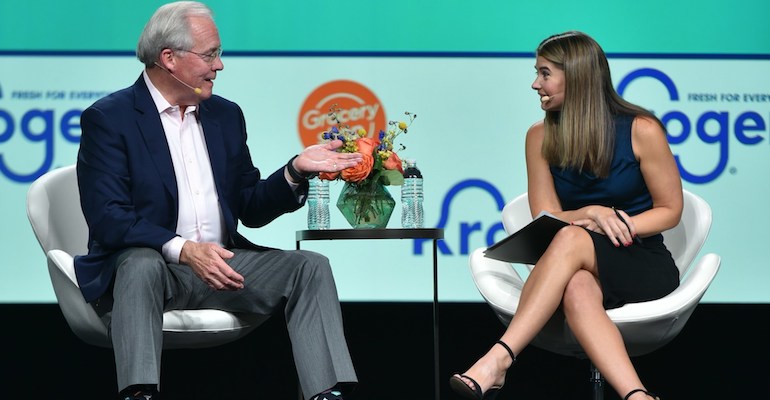
His own trajectory also gave substance to the company’s promotion story. At Groceryshop in 2021, he pointed to the share of store leaders who had started as hourly employees: 70 percent. Education assistance and advancement were part of the case he made for working there. His example was unusually visible, but the broader argument depended on opportunities further down the hierarchy, where most careers would actually unfold.
The accountant discovers good cheese
For all the discussion of scale, McMullen could bring the conversation back to something smaller and more edible. In a 2022 interview, he explained that his understanding of cheese had changed after the people at Murray’s introduced him to varieties he had not grown up eating. It is a pleasing admission from a grocery executive: years in the business, and the cheese counter could still teach him something.
The anecdote carried a commercial point. He was discussing how customers could manage their budgets while keeping the products they enjoyed. A household might save on one item and spend more on another. The customer with an eye on the total could still have strong feelings about dinner. His own education in cheese gave a human scale to an otherwise rather bloodless conversation about spending patterns.
On the June 2022 earnings call, he described that split in shopping behavior. Some customers continued buying premium offerings, including Private Selection and Murray’s Cheese. Others, feeling food and fuel costs more sharply, were looking for savings. The same store had to serve both. In that account, the shopper was neither uniformly extravagant nor uniformly frugal. There were choices within the basket, and the retailer had to understand the differences.
“Come for a job, discover a career.”
The Kroger saying McMullen invoked in his 2022 Senate testimony
When the stockroom became a software problem
McMullen’s tenure also pushed the business beyond the physical shopping trip. Restock Kroger, announced in 2017, linked customer data, personalization, digital shopping, store space, private brands and pricing. It included partnerships, talent development and changes to how the company earned money. The ambition was broad because the problem was broad: a familiar supermarket was being asked to accommodate unfamiliar ways of buying food.
In May 2018, Kroger announced its exclusive United States partnership with Ocado. The British company brought technology for online ordering, automated fulfillment and home delivery. Kroger increased its investment in Ocado, taking its holding above six percent. The announcement envisaged identifying as many as 20 warehouse sites over the agreement’s first three years. These were plans for a different physical system behind the digital storefront.
“We are actively creating a seamless digital experience for our customers,” McMullen said at the announcement. The language was polished, but the logistical challenge was concrete. A shopper who chooses delivery still expects the right products to arrive. Moving the order onto a screen shifts work into picking, packing and transport. Someone, somewhere, still has to handle the groceries.
By Groceryshop in September 2021, McMullen was describing a business that could meet customers in stores and online, with different speeds of service. Kroger had introduced Delivery Now with Instacart, offering delivery in as little as 30 minutes. Automation and outside partnerships sat alongside the existing stores. His first job had involved putting products where customers could find them. The newer task included getting those products to customers who never entered the building.
The deal that asked too much
The proposed Albertsons combination brought the question of scale into sharper focus. Announced in 2022, the $24.6 billion transaction would have joined two major supermarket businesses. McMullen and Albertsons chief executive Vivek Sankaran made the case for combining them. Kroger’s argument emphasized the ability to compete with retailers such as Walmart and Amazon and invest more in prices, stores and workers.
McMullen took that case to a Senate antitrust subcommittee in November 2022. He opened his written testimony with his own history at Kroger, recalling the part-time job and the college years. The personal story supplied a form of credibility: he had experienced the institution at several levels. Then came the promises attached to the proposed deal, including $500 million toward lowering prices and $1.3 billion for the customer experience.
The disagreement turned on what a larger company would mean for the people using it. Kroger presented scale as a way to compete and invest. The Federal Trade Commission argued that removing competition between the chains threatened customers and union workers. Those arguments could not be settled by the warmth of an origin story. A compelling career and a permissible merger are different questions, each requiring its own answer.
On December 10, 2024, a federal district court in Oregon granted the FTC’s request for a preliminary injunction. The acquisition did not proceed. For McMullen, the decision interrupted a strategy built around the advantages of a larger enterprise. For the company, it left a deal pursued over years without the combined business that was supposed to justify the effort. The promised future had met a boundary.
The value of the proposed transaction
Announced2024
Halted
Forty-six years, then a different kind of reckoning
On March 3, 2025, Kroger announced McMullen’s resignation as chairman and chief executive following an investigation into personal conduct that the board found inconsistent with its business ethics policy. The company said the conduct was unrelated to its business and did not involve Kroger associates. Ron Sargent became chairman and interim CEO. The announcement brought McMullen’s long career inside the company to an abrupt close.
The leadership transition continued. In February 2026, Kroger appointed Greg Foran as chief executive, succeeding Sargent. McMullen’s name, however, remained connected to the unfinished consequences of the Albertsons transaction. By October 2026, the companies’ dispute over responsibility for the failed deal had reached trial in Delaware. His departure from the executive suite had not removed him from the story of its decisions.
Reporting on October 20 placed McMullen among the expected witnesses. The dispute concerned whether Kroger had fulfilled its obligations in pursuing the combination; Albertsons was seeking billions of dollars. Expected testimony is still an expectation, and the parties’ positions remain contested. What is already clear is that the merger outlasted his tenure as a problem to be resolved.
Look back to Lexington and the scale of the journey is striking enough without polishing it. A student took a grocery job, learned the work, studied the numbers and rose through one company for decades. He eventually made decisions about how millions of people would buy dinner. His career leaves an uncomfortable pairing: evidence of how far an employee could advance, and reminders of the limits that apply even after reaching the top.
Read, watch, explore
- Kroger online
- Rodney McMullen on LinkedIn
- University of Kentucky conversation
- His 2021 LinkedIn essay
- Watch: Talks at GS with Rodney McMullen
- The 2013 succession announcement
- The 2018 Ocado announcement
- Groceryshop conversation, 2021
- The cheese conversation, 2022
- Read the 2022 Senate testimony
- The December 2024 injunction
- Kroger’s March 2025 announcement
- October 2026: expected testimony