Jack Sinclair has a small, rather endearing preference. His favorite Sprouts own-brand product is Ricotta & Asiago Filled Gnocchi. After decades spent deciding what customers might want for dinner, the chief executive has a specific answer of his own. His career history tells you where he has worked. A packet of gnocchi at least suggests what might interest him on the way home.
Sinclair has spent decades deciding what belongs on supermarket shelves. His route runs from British grocery chains to Walmart, a discount retailer and, finally, Phoenix-based Sprouts Farmers Market. Along the way, the scale of his responsibilities grew enormously. The interesting turn came when he began asking how much of conventional grocery retail a company could leave behind.
At Sprouts, the question became physical. Could a smaller building carry a distinctive enough assortment to justify its place beside much larger competitors? Could a chain grow by being more particular about whom it served? These are unusually concrete questions for a business story. They involve floor plans, deliveries, shelves and the recurring business of persuading someone to come back next week.
A grocer learns the scale of things
Sinclair earned a bachelor’s degree in economics and marketing at the University of Strathclyde in Glasgow. He stocked shelves while studying, a useful conjunction of theory and tins. His early career included Tesco. He later spent 14 years at Safeway PLC in London, working across operations, merchandising and marketing for a business with more than 450 supermarket and convenience locations.
In December 2007, he joined Walmart to lead its U.S. grocery division. He remained until April 2015. The operation covered more than 4,000 stores. Fresh food and local assortment were part of his work there, giving him experience with a problem that would follow him: how to make a large retail system respond to the particulars of a place.
The next stop was 99 Cents Only Stores. He became chief merchandising officer in July 2015 and CEO in February 2018. A discount chain brings a pointed version of the retailer’s daily examination: does the customer see enough value to buy? Sinclair arrived at Sprouts in June 2019 with experience at both enormous scale and a tightly priced format.
His appointment took effect on June 24, and included a seat on the board. Sprouts chairman Joseph Fortunato and his fellow directors had selected an experienced operator for a company with an established identity. Sinclair was joining a business whose appeal already depended on being recognizably different. The job required judgment about which habits from previous employers would travel well.
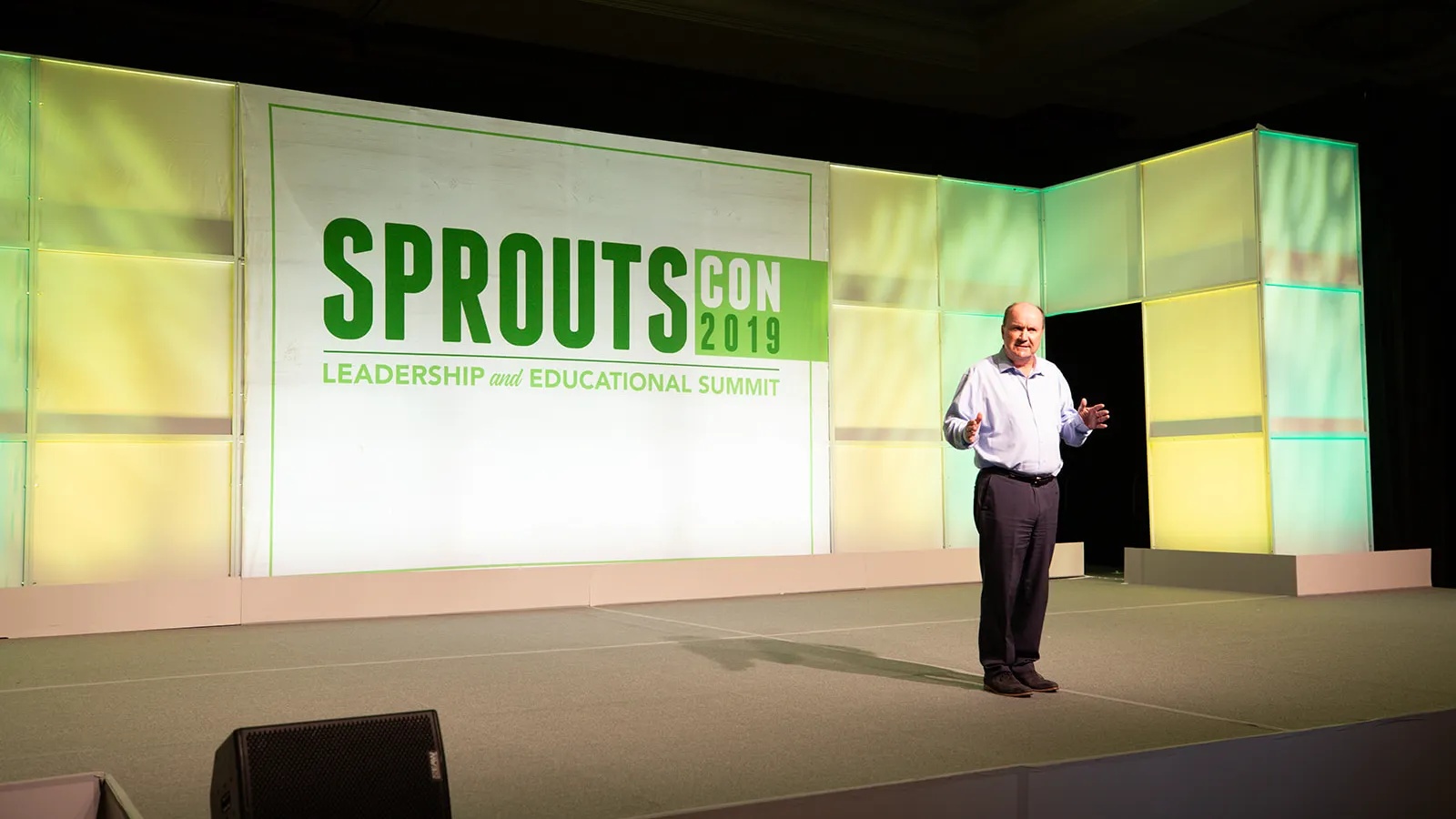
The second shopping trip has to earn its keep
A shopper can buy ordinary groceries in many places. A specialist asks for something extra: another stop, another parking space, another portion of the afternoon. That makes a specialist’s assortment a practical argument. The shelves have to offer a reason for the detour. A memorable product can make that argument more efficiently than a large sign announcing that the store is special.
By 2020, Sinclair was describing a return to Sprouts’ origins, with more attention on products and less on expensive features. His phrase was “making the product the hero”. The operating plan combined changes to merchandise, marketing and the geography of expansion. Locating stores nearer distribution centers was part of the same thinking. A distinctive shop still needs a dependable delivery.
The shift also meant withdrawing promotions the company considered ineffective and unprofitable. That carried an immediate cost. In May 2023, Sinclair described a strategy change that had initially cost about a quarter of transactions in the second quarter of 2020. By the first quarter of 2023, comparable sales were up 3.1%, and he said traffic trends were improving.
Those numbers describe the discomfort built into a decision to narrow an audience. Transactions can disappear before the intended customer arrives more often. The early loss and later improvement belong in the same account. Leaving them together gives a clearer picture of Sinclair’s wager than treating a strategy presentation as if it were already a result.
“making the product the hero”
Jack Sinclair · December 2020
Less building, plenty to browse
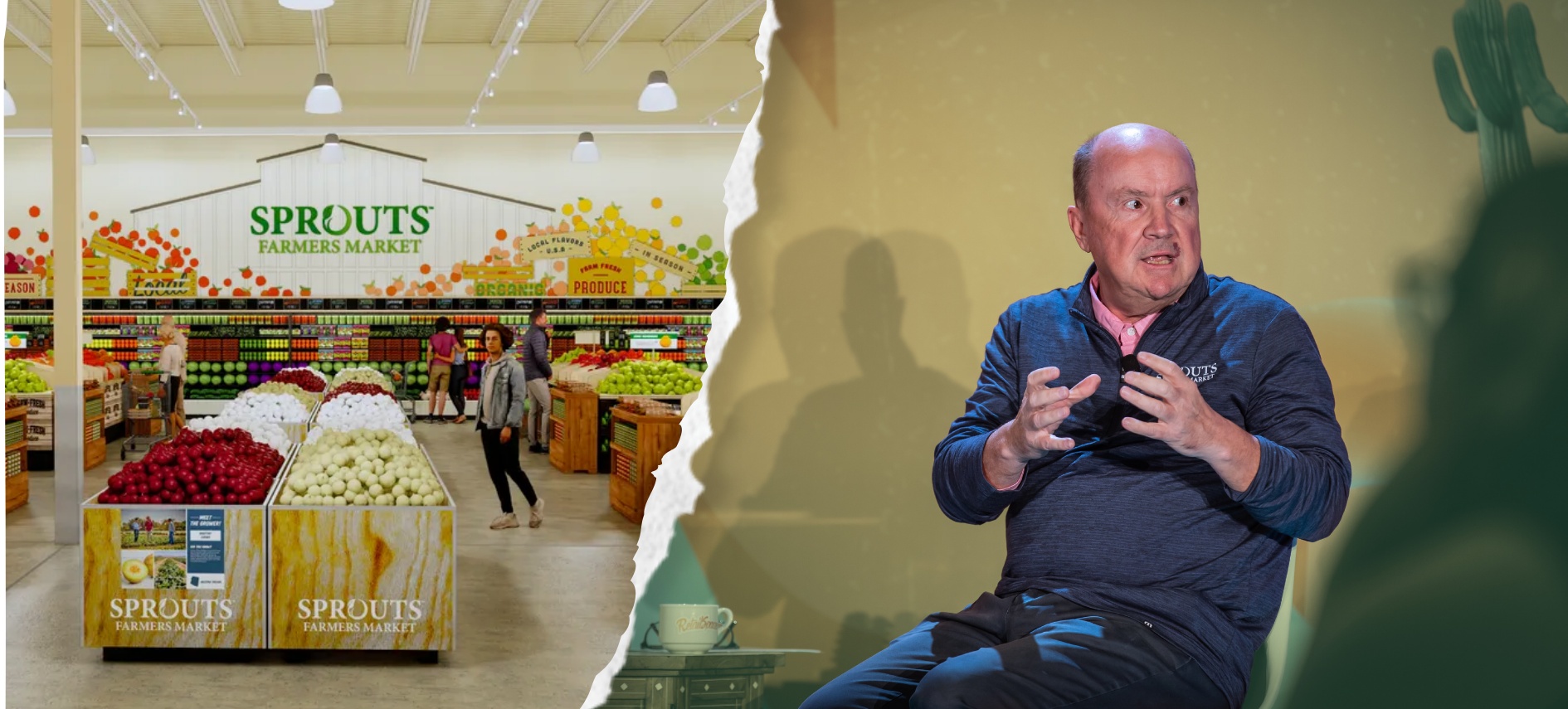
Sprouts’ older store prototype occupied about 30,000 square feet; by 2021, the newer one was closer to 23,000. That is roughly 23% less space. The company connected the smaller format with reducing emissions per store. It also described investments in lighting, refrigeration and energy management, the mostly unseen systems that keep a grocery building working.
A smaller footprint is an unusually legible executive decision. You can draw it. You can measure it. You can also get it wrong: remove the part customers value and the saving becomes expensive. Sinclair’s task was to preserve the experience of discovery while reducing the amount of building needed around it. The distinction matters because floor space alone cannot tell you whether a store feels abundant.
Explaining the format at NRF in 2025, he called Sprouts “a complementary retailer as opposed to a competitive retailer”. He welcomed proximity to other stores and described a lower-profile layout that lets customers see around the shop. The logic is neighborly in appearance and commercially exacting underneath: a nearby supermarket can attract people to the area, but Sprouts must still give them a reason to cross its threshold.
This is where Sinclair’s career becomes more interesting than a list of promotions. Someone who has managed thousands of grocery stores is now defending the usefulness of a particular kind of smaller one. Experience supplies comparisons. It also creates assumptions that need examining. His Sprouts approach suggests a willingness to make those assumptions earn their place alongside everything else.
Room to be particular.
in the newer prototype
The work behind the interesting shelf
A product-led business has a less photogenic supporting cast. There are distribution routes, buying decisions, stock levels and the difficulty of getting a promising item into the right place at the right time. Sinclair’s emphasis on the assortment makes those jobs consequential. A product cannot surprise a customer while sitting in the wrong warehouse.
His public discussions of technology reflect that practical emphasis. In his RetailSpaces conversation, he put attention on using data for replenishment, supply chains and marketing. The same conversation included a joke about the mutual bewilderment of his Scottish speech and his Arkansas colleagues. He can discuss an operating system without sounding as though he has mistaken it for a personality.
In 2023, Arizona State University’s W. P. Carey School of Business selected him as its Executive of the Year, the award’s 40th annual recipient. The school recognized his leadership of Sprouts and the relationship between commercial performance and environmental and community initiatives. It was a local acknowledgment of a career that had carried him a considerable distance from Glasgow.
Another appointment widened the setting. Sinclair joined the Federal Reserve Bank of San Francisco’s Head Office board in January 2025, after serving on its Los Angeles branch board from 2021. In 2026, he is listed as a Class B director, representing the public. A grocery executive brings a particular vantage point to that table: prices, employment and purchasing decisions show up in stores every day.
Growth arrives with a more awkward question
By the end of 2024, Sprouts had 440 stores across 24 states. Annual sales reached $7.7 billion, up 13%, while comparable-store sales rose 7.6%. Online sales exceeded $1 billion and represented 14% of the business. Sprouts Brand products accounted for 23% of sales. The smaller-store idea was developing alongside an increasingly substantial business.
The following year brought sales of $8.8 billion, a 14% increase, and comparable-store growth of 7.3%. Sprouts opened 37 stores and ended 2025 with 477 locations. These are company results, produced by buyers, store teams, distribution workers and executives together. Sinclair’s role was to lead the choices that gave that work a direction.
By the second quarter of 2026, the picture had become more demanding. Sales rose 5% to $2.3 billion, helped by a larger store base, but comparable-store sales declined 1%. There were 490 stores in 25 states at June 28. Sinclair described a cautious consumer environment and emphasized deeper customer engagement. Expansion and the performance of existing stores were telling different stories.
That distinction is the useful test of his approach. New locations can add revenue while older ones lose a little momentum. A concept may still have room on the map and need more work in the aisle. The current challenge asks whether Sprouts can keep its particular appeal while making the value of a visit clear enough for customers to return more often.
New doors. Repeat visits.
A handover, with another chair waiting
On September 1, 2026, Sprouts announced that Nick Konat, its president and chief operating officer, would become CEO on January 4, 2027. Sinclair is due to become executive chairman that day. Joe Fortunato will become lead independent director. As of October 21, Sinclair remains chief executive; the next chapter has a date, rather than a completed handover.
Konat joined in 2022 and has worked closely with Sinclair on the strategy. The succession follows a board search and planning process. Choosing an executive who helped shape the operation gives the transition a clear element of continuity. The work ahead includes expansion, customer engagement and the ordinary discipline of making a distinctive offer consistently available.
For Sinclair, it changes the way he will contribute to a business he has led since 2019. The relevant legacy will be found in decisions that other people can continue to execute: a store format, an assortment, a way of judging where to grow. The chairman’s title will provide another vantage point from which to watch those decisions meet the customer.
Asked at RetailSpaces what keeps him awake, Sinclair offered “I try to sleep well.” He also recalled his mother’s observation: “People have to eat.” There is an appealing economy to that advice. It gives a grocery executive a durable starting point and leaves almost every interesting detail unresolved. What will people choose? Where will they find it? And will they come back for the gnocchi?