The most important aisle in GDN AR’s supermarket may be 35,000 square meters away. In Escobar, north of Buenos Aires, a distribution center holds the practical thesis behind the company’s latest reinvention: if a retailer can move a purchase order to a shelf in eight days instead of roughly 25, customers should encounter fewer holes where detergent, paper goods or shampoo ought to be. The warehouse is not glamorous. Empty shelves are not glamorous either. Both are where a retail brand keeps or breaks its promise.
GDN AR is the Argentine arm of Grupo de Narváez, the privately held retail group controlled by businessman Francisco de Narváez. The modern company took shape in November 2020, when the group acquired Walmart’s Argentine business. The inherited operation had been in the country since 1995. GDN received stores, people, systems and habits accumulated over a quarter-century, then set out to make them local.
That work produced the pink-and-black world of ChangoMâs: Hiper ChangoMâs for the big shop, ChangoMâs and Super ChangoMâs for supermarket trips, Punto Mayorista for bulk buying and MâsOnline for the digital cart. Pharmacy counters became Mâs Farma. Vehicle workshops became Mâs Autocenter. In August 2026, the portfolio moved closer to the sidewalk with Mâs Go, a proximity format carrying more than 2,000 basic products at its first Buenos Aires locations.
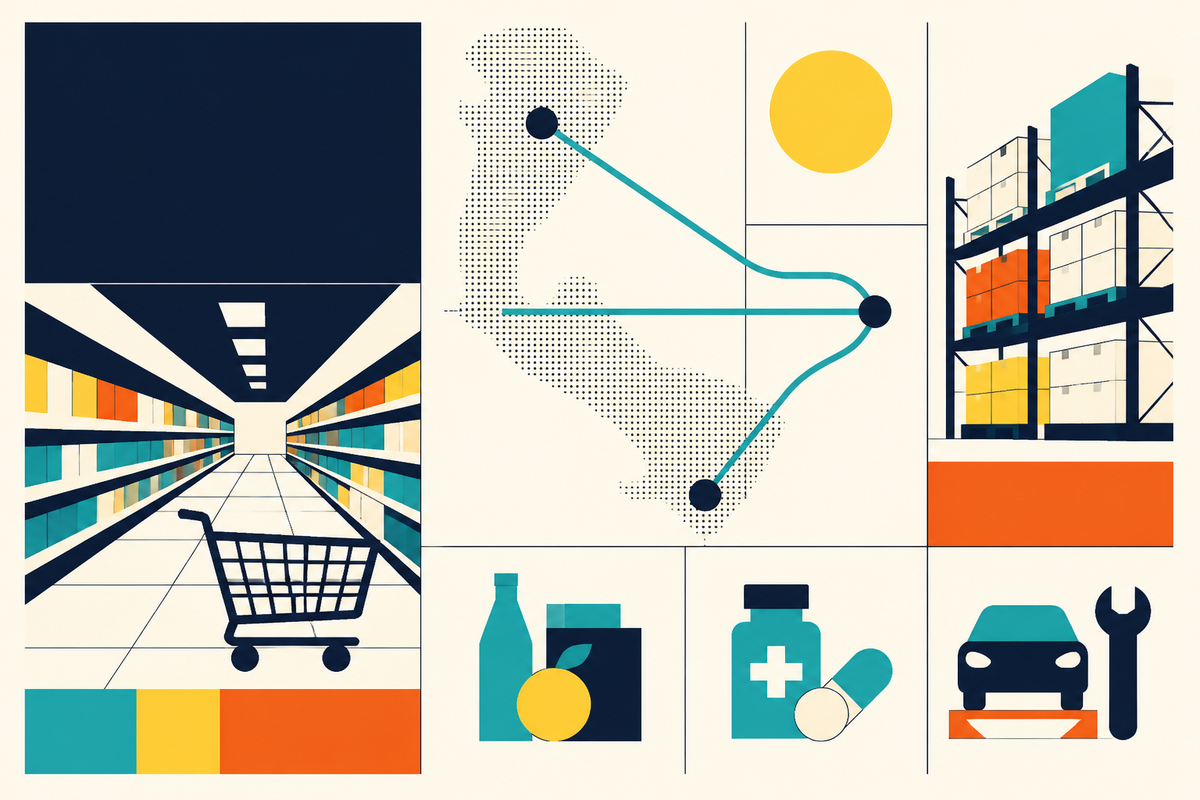
A rebrand with a loading dock
The easy version of the 2020 story is cosmetic: Walmart left, ChangoMâs arrived. The useful version is operational. A global company’s Argentina exit created a rare test. Could a local owner keep the scale advantages of a national chain while giving formats, suppliers and communities more local relevance?
GDN announced a US$120 million investment plan for its first three years. Store conversions were only the visible layer. The program also addressed information technology, new private-label identities, ecommerce and the supplier base. This distinction matters because a sign can change overnight; the machinery beneath it cannot.
The company’s public numbers require a small piece of retail arithmetic. GDN AR describes 93 supermarkets across the country. GDN Group counts 170 Argentine locations when it adds 34 Mâs Farma pharmacies and 43 Mâs Autocenter service points. Both can be true: one number counts the store network; the larger figure counts the service units living within it. The group also reported 1.4 million active frequent customers in Argentina at the end of 2025, responsible for 56 percent of sales.
Why eight days matters
In 2025, new CEO Guillermo Calcagno made logistics an early priority. GDN invested AR$24 billion in the Escobar center, a 35,000-square-meter complex with the same number of rack positions. TASA Logística operates the building. It was designed to receive products from 140 suppliers across 2,000 references, with separate areas for receiving, storage, picking and dispatch.
The center shifts GDN toward a hybrid model. Suppliers can consolidate deliveries rather than sending every product directly through an inherited system, while stores can replenish faster and with better traceability. The customer never needs to know what a rack position is. They understand whether the coffee they came for is there. In grocery retail, infrastructure becomes customer experience one missing item at a time.
suppliers
distribution
shelf
The practical problem is unusually Argentine. Inflation, exchange-rate swings and uneven consumption make forecasting difficult. Retailers negotiate constantly with suppliers while customers watch prices closely and substitute brands without ceremony. Faster replenishment cannot remove volatility, but it can reduce the time the business spends reacting to an old picture of demand.
One parking lot, several businesses
GDN’s answer to competition is not a single novel product. It is the accumulated convenience of a network. A household can buy groceries online or in a store, fill a prescription and leave a car for an alignment. When Mâs Farma and Mâs Autocenter were formally launched in 2022, the company reported 36 pharmacies and 43 automotive centers. The car-care operation offered more than 60 services, from brakes and suspension to tires, lubrication and electronic scanning.
The pharmacy is similarly attached to a trip people already make. It serves private customers and members of participating health plans, with medicines, pharmacist guidance, dermocosmetics and personal care. The automotive centers can work on a vehicle while its owner shops. Neither idea is unprecedented. The distinction is distribution: GDN can place these services across a large national footprint and fold their benefits into an existing customer relationship.
The conventional alternative
A grocery trip, a separate pharmacy visit, an independent garage and several unrelated accounts.
GDN AR’s proposition
Several errands attached to one retail network, one promotion calendar and a familiar set of locations.
The company still competes on the fundamentals: price, freshness, assortment, location and promotion. Carrefour, Coto, Cencosud’s chains, La Anónima, Día and regional grocers all fight for the Argentine basket. Mercado Libre shapes expectations online. Farmacity and local pharmacies compete for health spending; workshops compete for the car. GDN’s defense is to make these categories reinforce one another without letting complexity slow the core grocery trip.
The brands hiding on the shelf
Private label is where the retailer stops being merely a reseller. GDN’s 2023 sustainability report counted 606 own-brand products across 90 categories, including the Check, Aliada and Soul Care families. The assortment runs from dry and frozen food to cleaning and beauty. Private labels give the company more control over price architecture and product specification while offering customers an alternative to national brands.
They also expose the company to a harder trust test. A retailer’s name, directly or indirectly, stands behind what is inside the package. GDN operates three production centers for baked goods, meat and sliced products. In 2025, those facilities renewed international FSSC 22000 V6.0 and BRC V9.0 food-safety certifications. Certification is not colorful shelf theater. It is the paperwork, auditing and process discipline that allows value pricing to coexist with a credible quality claim.
Packaging has become another operating surface. GDN said 80 percent of its private-label packaging was recyclable or reusable in 2023. Its broader sustainability framework uses three verbs - build communities, transform operations and create opportunities - to organize work on energy, waste, suppliers and inclusion. The language is corporate; the test is tangible: lower energy use, correctly handled waste, more accessible packaging and suppliers that can stay in business.
Local is a supply-chain decision
GDN’s most distinctive community programs tend to use the shelf as infrastructure. TraMâs brought basic garments made by the Uniendo Redes textile cooperative in La Matanza into ChangoMâs stores. An earlier program, De la Quinta a tu Mesa, connected family fruit-and-vegetable producers with seven branches. The company said the products could be priced below comparable chain offerings, while small producers received help meeting the standards of modern retail.
There is a useful lesson here for any marketplace: access is not created merely by inviting small suppliers in. Someone must translate packaging, consistency, volume and commercial requirements into a route they can actually travel. GDN’s store network supplies demand; its teams supply the less visible onboarding.
Other partnerships work on attention rather than inventory. The Mâs Monumental naming agreement put the brand on River Plate’s stadium through April 2029. With Fundación River Plate, GDN supported more than 185 Valores a la Cancha workshops for children and adolescents. Mâs arte en todas partes placed reproductions from the Museo Nacional de Bellas Artes collection inside supermarkets, winning an Eikon award in 2023. A grocery floor became an unlikely gallery, which is precisely why the project was memorable.
Small stores, large experiment
Mâs Go is the latest expression of the multiformat thesis. The first announced locations in Villa del Parque, Monte Castro and Belgrano trade hypermarket breadth for proximity and time. With more than 2,000 everyday products, familiar promotions and bank discounts, the format aims to cover the urgent basket without asking shoppers to navigate an aircraft-hangar-sized store.
This puts GDN in a different competitive rhythm. Large stores win planned stock-up trips. Proximity stores win forgotten milk, tonight’s dinner and the ten-minute gap before work. Ecommerce wins when carrying the basket is the burden. A retailer that can serve all three missions has more chances to be useful, but it must avoid duplicating inventory and confusing its proposition. Format variety only works when the supply chain knows what each box is for.
That is where GDN AR fits in the market: a large national value retailer trying to behave less like a single chain and more like a portfolio. Its advantage is reach - stores in 22 provinces, millions of annual tickets and a physical network already embedded in local routines. Its constraint is the same scale. Every improvement must survive old systems, long distances and the daily price sensitivity of Argentine households.
The company’s transformation is unfinished, which makes it worth watching. The visible story is a family of names with a circumflex over the â. The deeper one runs from a cooperative’s sewing room to a private-label package, through a warehouse rack and onto a neighborhood shelf. That route is not a slogan. It is the business.