Greg Foran began his working life filling supermarket shelves in Hamilton, New Zealand. His mother saw an advertisement for a Woolworths management trainee and encouraged him to apply. He got the job. At 20, he was running a store. The ambition was modest enough to fit inside a single building; the career that followed would prove considerably harder to contain.
In February 2026, Foran became chief executive of Kroger. Between that first supermarket and Cincinnati lay Woolworths, Walmart’s Chinese and American businesses, and Air New Zealand. Groceries, electronics, discount stores, aeroplanes: a curious shopping basket of responsibilities. Through it runs a recurring question about how much a leader can learn by getting close to the work.
There is something pleasingly concrete about a shelf. It either contains the thing a customer wants or it does not. A corporate explanation can be elaborate. The gap where the product ought to be remains impressively concise.
An education with customers attached
Foran was born in New Zealand in 1961 and grew up in Hastings and Hamilton. His parents were teachers. He did not attend university, although his later education included a management diploma and advanced management programs at Harvard and the University of Virginia. His early professional education came with stock to move and customers to serve.
At Woolworths, the work widened beyond a supermarket. He held general management roles at Dick Smith Electronics and Big W, then became director of supermarkets, liquor and petrol. Those businesses required attention to different products and buying habits. A customer choosing an electronic device has different questions from someone buying dinner, even if both would appreciate finding an employee who can answer them.
By October 2011, he had joined Walmart. In March 2012 he became president and CEO of Walmart China. A move to lead the Asia region followed in May 2014; that August, he took charge of Walmart U.S. The sequence was quick. The responsibilities were large enough to make a leisurely orientation unlikely.
The unglamorous business of getting better
Walmart’s announcement of his U.S. appointment emphasized fresh food, general merchandise and e-commerce. Doug McMillon, the company’s chief executive, had worked with Foran already. He was choosing someone whose experience crossed both products and countries. Foran’s own public promise was pointed: “We must be fierce advocates for our customers.”
By the following February, his earnings-call account of the job was full of the vocabulary of store management: inventory, returns, shrink, markdowns and wages. These were the things occupying his early months. They are also the things a retailer can spend an astonishing amount of time discussing while a customer simply wonders why the queue is moving so slowly.
Walmart announced changes to pay, training and scheduling during this period. Its U.S. hourly wage floor would rise to $9 in April 2015, with existing associates earning at least $10 by the following February. Foran described both hourly rates and the number of hours worked as important to employees. Better execution had a cost, and people were part of the investment.
Fresh food became a particular focus. Stock rotation, product changes, cleaner stores and better inventory controls all formed part of the improvement effort. The grocery department supplied a practical foundation for a broader retail strategy. Customers returning for food could encounter the rest of the shop; customers disappointed by food had less reason to do so.
“We must be fierce advocates for our customers.”Greg Foran, on taking the Walmart U.S. role, 2014
When Walmart announced his departure in October 2019, McMillon credited investments in employee pay, customer prices, training and technology. He also pointed to the use of physical stores as an advantage in digital shopping. Kroger would later summarize Foran’s U.S. record as 20 consecutive quarters of positive comparable-sales growth. The achievement belonged to a vast organization, but it gave the executive leading it a measurable record.
The correspondence course
One episode from Walmart makes his interest in employees unusually tangible. Foran personally replied to about 2,700 messages from store managers, a story recounted in his Between Two Beers interview. Asking a question at that scale is easy enough. Answering the people who take it seriously requires rather more time.
The episode helps explain the appeal of his operating style. People running stores hold information that becomes less vivid as it travels upward. An executive can receive a perfectly tidy report about an untidy experience. Personal correspondence gives the person nearest the problem a shorter route to the person with authority to change it.
It also establishes an expectation. Once a chief executive invites candour, the response matters. Silence would teach its own lesson. A reply makes the invitation harder to dismiss as another management exercise that briefly occupied everyone’s inbox.
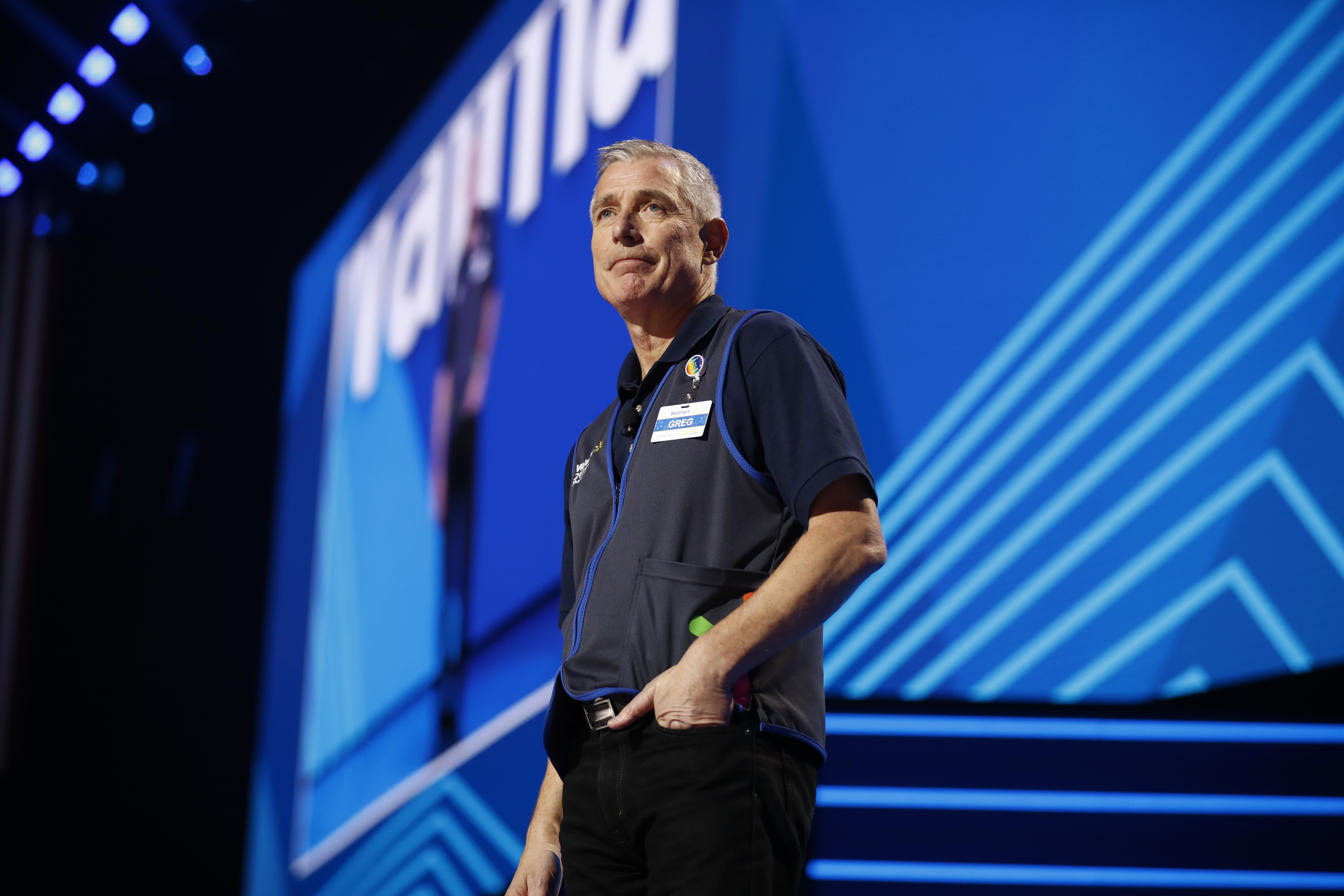
Foran’s version of store discipline also left room for improvisation. At Walmart’s 2018 U.S. associates meeting, he showed a video about the making of The Greatest Showman while discussing creativity. “The magic is being able to add your creative flair to something,” he said. He encouraged employees to find ways of improving a customer’s visit beyond the instructions in a training video.
There is a useful tension there. A retail chain depends on repeatable standards, yet a customer’s request may be wonderfully specific. Training gets an employee to the moment. Judgment determines what happens next. A musical was an entertaining way to make room for that distinction in an arena full of shopkeepers.
An American map, drawn store by store
By June 2019, Foran told Walmart associates he had visited every U.S. state, most more than once. Before living in America, he had known the country largely through its tourist destinations. Working there had given him a different geography, built around towns, neighborhoods and the stores serving them.
His prepared remarks put personal relationships at the center of trust. He brought Jennifer Garner into the conversation onstage to discuss her work with children and communities. The setting was a shareholder and associate event, but the subject was smaller than a national sales total: the connection between people who meet and deal with one another.
That interest offers a useful way of reading his career. The businesses grow enormous. The encounters that make them work remain local. A customer cannot experience 4,600 stores at once. They experience the one they entered, with the people working that shift.
A departure gate in the middle of the story
Foran’s next move carried him home. Air New Zealand announced his appointment in October 2019, and he started in February 2020. He had been responsible for Walmart U.S., a business the airline’s announcement described as serving more than 160 million customers a week. He was now taking responsibility for a national carrier with an altogether different operating system.
The airline years brought difficult union negotiations, fleet investment and persistent supply-chain problems. Engine issues affecting Boeing and Airbus aircraft became a daily operational constraint. In announcing his planned departure in March 2025, chair Dame Therese Walsh singled out his work managing those disruptions and their consequences for customers.
His successor, Nikhil Ravishankar, took over in October 2025. A month before that handover, the airline gathered several generations of its leaders at a new Auckland hangar. Former executives included Christopher Luxon, by then New Zealand’s prime minister. The building offered a visible reminder that one leader’s decisions become another leader’s working conditions.
“In aviation, legacy matters,” Foran said at the gathering. The hangar had its beginnings during Luxon’s airline leadership. Foran acknowledged the decisions made before his own tenure. An executive biography likes clean chapters; a large organization has contractors, commitments and equipment that cheerfully ignore the chapter breaks.
Back to groceries, with the result still open
Kroger appointed Foran CEO on February 9, 2026, succeeding interim chief Ron Sargent. He also joined the board. His new company served more than 11 million customers daily across its stores and digital business. There would be plenty of opportunities to see whether the shelves matched the promises.
In his shareholder letter, Foran described visiting stores, distribution centers and manufacturing facilities. He watched what shoppers put into carts and what they left behind. His plans linked operating savings to customer value and included improvements to Kroger’s own brands. The stated ambition was recognizable: better shopping, supported by more disciplined work behind it.
Expansion joined that agenda. In July, Kroger announced an agreement to buy Giant Eagle for $1.65 billion. The transaction remained subject to regulatory approval; the announcement was a proposed acquisition, with completion expected in 2027. Growing the map would bring its own demands on execution.
Identical sales, excluding fuel
Adjusted eCommerce sales
September’s results supplied a mixed early reading. Kroger reported identical sales excluding fuel up 0.2%, while adjusted eCommerce sales grew 20%. It lowered its full-year identical-sales guidance. Foran said improving sales momentum remained a priority. The digital figure was encouraging; the overall sales picture still demanded work.
October brought a harder announcement: plans to eliminate 3,000 corporate jobs over three years as Kroger increased its use of artificial intelligence. Foran’s employee memo described changing work and the need to reduce duplication. Those decisions add a human obligation to the operating agenda. Employees will experience the consequences more directly than any chart can convey.
His career offers evidence of what he has done before. Kroger will produce evidence of what he can do here. For the former shelf stacker, the final examination remains familiar: a customer arrives with a list, a budget and somewhere else they could shop. The answer has to be waiting in the aisle.