David A. Jones Sr. had spent decades acquiring things when he took on the job of helping Louisville keep something. Along Floyds Fork, on the city’s eastern and southeastern edges, he and his son Dan helped gather parcels of land into a connected public park system. There would be room for paths, trees, playgrounds and people who had no particular appointment to keep. The businessman became the treasurer. The object of the exercise was a place anyone could enter.
It was a fitting assignment for someone whose first advantages had included a library and a neighborhood park. Jones became known far beyond Kentucky as Humana’s co-founder and longtime chairman. But the distance between his childhood in west Louisville and his later influence can obscure a more interesting continuity: he kept returning to the institutions that let a city’s residents do more than their private circumstances might allow.
The library before the boardroom
Born in Louisville on August 7, 1931, David Allen Jones grew up during the Depression. One of the opening images in his autobiography is his mother pulling a wagon of books home from the Parkland Library. It is a useful corrective to the usual business biography, which tends to begin when somebody discovers money. Here, the cargo was reading material. Getting it home required a mile and a half of effort.
The neighborhood’s public spaces mattered too. Jones spent time in Victory Park, an experience he later connected directly to his enthusiasm for building parks. His early life also included Golden Gloves boxing. The combination is pleasingly inconvenient for anyone hoping to sort him into a single type: reader, athlete, ambitious student. He had uses for all three.
A Navy ROTC scholarship took him to the University of Louisville, where he studied accounting and graduated in 1954. Naval service followed, then a period teaching economics at Quinnipiac College in Connecticut. He earned his Yale law degree in 1960. The itinerary offered several opportunities to become a person from somewhere else. He returned to Louisville.
Two lawyers, one small beginning
Jones and Wendell Cherry were young lawyers when they started the business that became Humana in 1961. Each borrowed $1,000. It is an arresting number, although it should never be mistaken for the entire cost of launching the venture. The small personal stakes were a beginning, accompanied by other investors and borrowed money. A founding story becomes less useful when its arithmetic turns into a fairy tale.
What followed was a long partnership and a company willing to change direction. The corporate name became Humana in 1974. Jones’s working life eventually encompassed 44 years as chairman. That span makes the familiar image of the entrepreneur as a perpetually departing founder look rather provincial. He stayed to handle the consequences of growth.
He also resisted the notion that confidence had to wait for complete expertise. Looking back, he described an early advantage as “the confidence of total ignorance.” The phrase has the merit of sounding like something a former boxer could admit without blushing. It contains both the nerve to begin and a warning about how much there is to learn once the beginning is over.
That willingness to begin again became a recurring feature of his work. The company changed; his attachment to its hometown persisted. Humana became an important employer and a visible presence in downtown Louisville, linking the fortunes of a business to those of the place around it.
A retirement with another job attached
There is a clean date for Jones’s departure as chief executive: December 2, 1997. He continued as chairman until April 26, 2005, when the company’s board retirement policy required him to step down following his seventy-third birthday. Institutions do occasionally manage to put an appointment in the diary that even a founder must keep.
By then, another project was taking shape. Dan and his father began developing the Parklands of Floyds Fork in 2004. Dan led the nonprofit behind it; David took responsibility for helping find the money. Their ambitions belonged to a tradition Louisville already knew. Frederick Law Olmsted’s parks had helped shape the city. The question was what another generation might leave for the people who would come after it.
David’s part was practical. In 2011, he described recruiting five campaign co-chairs, who in turn recruited 45 steering committee members. Fundraising meant turning a broad civic wish into individual decisions. A park system needs landscape design, but first it needs people willing to sit down with other people and ask for money.
Eighty parcels do not become a park by themselves
The physical task was as demanding as the financial one. More than 80 separate, voluntary land transactions assembled the acreage. The development proceeded without government condemnation or eminent domain. Each agreement helped turn a collection of properties into somewhere a visitor could move continuously through. Connectivity, that tidy word on a plan, had to be negotiated into existence.
Public and private money both mattered. By the time the campaign passed its $120 million goal in 2013, reported contributions included $49.5 million from government and $70.8 million from private donors. David and Betty Jones’s family and a family foundation contributed about $15 million. More than 550 individuals, companies and foundations participated in the private campaign. Even a prominent donor needed company.
Those figures describe a particular stage of the fundraising, rather than a final accounting of every dollar the parks would ever require. Later, the development total exceeded $125 million. Broad Run Park, the fourth and final park, opened in 2016. The finished system connected nearly 4,000 acres along a roughly 20-mile corridor.
The choice of scale mattered. A single attractive green patch would have been easier to explain and easier to finish. Joining places together created a different possibility: a public landscape large enough to accommodate both activity and quiet, and to remain useful as the city around it changed.
A gift can have a very practical name
Jones’s educational philanthropy had a similar interest in what people could do next. At Transylvania University, he and Betty established and helped endow a faculty development fund in 1990. It supported the adults doing the teaching, with the expectation that their own study and research would come back into the classroom. He also served as a trustee and supported the university’s endowment.
At Berea College, the names tell a less solemn story. The David Jones Wild and Crazy Fund supports international travel programs beyond the scope of traditional funding. Anyone who has tried to get an unusual idea through a committee may appreciate having “Wild and Crazy” already printed on the account. His support also helped buy books on China and assisted international students through the David and Betty Jones International Scholarship.
These were different ways of enlarging someone’s world: a teacher pursuing research, a student going abroad, another student finding the means to attend. The young accounting graduate who had gone away to serve and study understood the value of leaving home. Returning did not require shrinking one’s interests to the city limits.
“Family first”
A leadership lesson from Jones’s memoir
There was still a football to throw
The public record can make a busy father disappear behind his offices. His children’s recollections restore some ordinary motion. Carol remembered throwing a football with him. Dan remembered wanting to be a receiver, with his father sending long passes that invited diving catches. Business influence is difficult to picture. A parent putting a ball into the air is considerably easier.
David and Betty had five children. Reading was part of the household, just as it had been in his own early life. Their children remembered books, games and the long familiarity of family friends. Those details belong beside the campaign totals. They give the money and the work a setting.
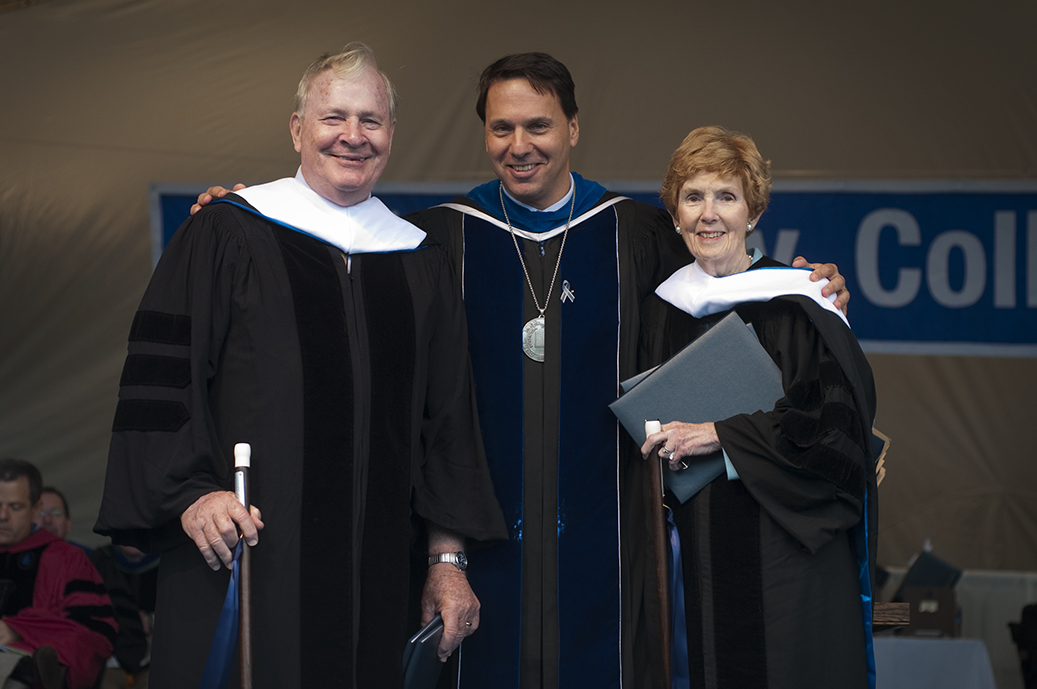
The photograph from Middlebury’s 2009 commencement catches the couple together in academic gowns, flanking President Ron Liebowitz. Both received honorary degrees. Jones also served the Middlebury Institute of International Studies between 2006 and 2017 in several governing roles. A ceremony is a public occasion; the picture still has the unmistakable pleasure of two people attending it together.
The last project went to his eldest son
Jones died on September 18, 2019, at 88, a month after Betty. One piece of work remained for the family: the account of his own life. He had worked with Louisville writer Bob Hill, gathering memories of the people and decisions behind the company. His eldest son, David A. Jones Jr., helped edit the manuscript and bring it to publication.
Always Moving Forward: A Memoir of Friends, Family and Building Humana appeared in October 2023. Its subtitle makes room for the people a corporate history might consign to acknowledgments. Jones wanted the story finished for friends and family. Commercial publication gave that private undertaking a larger audience.
In November 2023, Louisville put his likeness on a Hometown Heroes banner at the downtown YMCA, where he had played pickup basketball. His son suggested that Jones would have opposed the honor had he been there to do so. There is a small civic advantage to a posthumous tribute: its subject cannot successfully negotiate it away.
Another record had arrived the previous year. In December 2022, the Parklands reported that cumulative visitation had passed 25 million. The number counts visits, with all the repeat walkers, returning families and familiar routes that implies. Years after the fundraising meetings, people were still making use of the room David and Dan had helped Louisville keep. That is a rather good way for a business-minded person to remain part of a place.