A folding chair is an unpromising place to look for a life’s work. It has no machinery to admire, no secret formula, and almost no dignity when stacked. In 1955, Charlie Loudermilk borrowed $500, bought 300 of them, and rented them to an Atlanta auction for ten cents a chair per day. The chairs went out. The chairs came back. He could send them out again.
That small, repeatable transaction became Aaron Rents. Over the following decades, the inventory changed to furniture, appliances, and electronics, and a local business became a chain operating in the United States and Canada. Loudermilk’s interests expanded, too: election campaigns, public transportation, college buildings, a theater, a park. An enterprise that began by finding people somewhere to sit eventually gave him a place at many of Atlanta’s consequential tables.
He was a conservative Republican who helped elect Andrew Young, a Black Democrat, mayor. He was a businessman who chose his company’s name for its position in the telephone directory. He was also a boy from a working-class neighborhood who returned, with money, to the movie theater outside which he had sold bottled Coca-Cola. The distances in this story are sometimes enormous. Occasionally, they are just across the street.
A restaurant, a loan, and 300 chairs
Robert Charles Loudermilk Sr. was born in Atlanta on July 12, 1927. His father worked as a Georgia Power lineman. His mother, Addie, ran a restaurant and insisted that her sons would go to college. Much later, when civic leaders assembled to celebrate her son, he continued to put her at the center of the explanation. Ambition had arrived at home before it appeared on a business card.
He served in the Navy, attended Georgia Tech, and graduated from the University of North Carolina at Chapel Hill in 1950 with a commerce degree. Atlanta drew him back through his mother’s restaurant. She had the opportunity to take over a 200-seat establishment and wanted him home to help. The restaurant supplied both employment and an education in what people needed for an occasion.
Chairs made sense in that world. So did tables, china, silver, and party equipment. The first business did not require persuading customers that an unfamiliar object was desirable. They already needed the objects. Loudermilk offered a way to use them without buying and storing them. For a young operator, that distinction opened a remarkably broad field.
Even the name was practical. Aaron Rents put the business near the beginning of the phone book, where customers looking for rentals could encounter it early. In an age before search rankings became an industry, alphabetical order provided a useful competitive advantage. Loudermilk had found a marketing department that required neither meetings nor a salary.
The household behind the payment plan
The expansion into furniture gave the company a larger purpose and a different customer. People moving for work needed furnished rooms. Households needed appliances. Some customers could not obtain conventional credit; others wanted flexibility. The business developed around those circumstances, eventually combining rental with a route to ownership.
By his retirement, the range included sofas, televisions, computers, and home appliances. The company’s formal language was sales and lease ownership. That wording mattered to Loudermilk because he saw a business organized around how a customer acquired something, as much as around the thing itself. A refrigerator was familiar. The payment arrangement was where he sought room to compete.
The modest opening inventory can obscure the length of the undertaking. Aaron’s went public in 1982. Loudermilk handed over the chief executive’s job in 2008, then retired as chairman in September 2012 after 57 years with the business. At the announcement of his retirement, the company employed more than 11,000 people. A ten-cent rental had become a substantial organization, with all the coordination that implies.
“I think the number one thing is people skills.”
Charlie Loudermilk, 2006
His answer to a question about surviving in business for half a century began with people. That is an instructive answer from someone whose origin story is usually told through objects and money. A stack of chairs explains the first transaction. It cannot explain decades of store operations, managers, customers, and successors. Loudermilk himself gave the team a prominent share of the credit.
A Republican backs Andrew Young
In 1981, Loudermilk supported Andrew Young’s successful campaign for mayor of Atlanta and served as a campaign co-chairman. Their political descriptions made the partnership conspicuous: a white conservative businessman and a Black civil rights leader with liberal Democratic politics. They did not have to agree about everything to make a decision about their city.
The choice brought resistance from people within Loudermilk’s own business circle. Supporting Young was a commitment with a social cost, rather than an easy expression of goodwill after the result was known. His friendship with Young became one of the enduring relationships of his public life. He later helped fund a statue honoring the former mayor.
Atlanta’s habit of negotiation between business leaders and Black political leadership acquired a familiar name, the Atlanta Way. Loudermilk took part in its practical work. He also chaired the MARTA board in the mid-1980s. These were positions where the future of a city came down to decisions, money, and whether people who distrusted one another could still reach an agreement.
His political optimism could be disarmingly personal. Recalling a meeting about Billy Payne’s effort to bring the Olympics to Atlanta, he described taking his cue from Young’s support. The account reveals how much confidence could travel through a friendship. A vast public ambition needed institutional backing, but somebody still had to decide to take the proposal seriously.
A million dollars for a good argument
In 2011, Loudermilk pledged $1 million to endow the Atlanta Press Club’s election debates. The series took his name and Young’s. A friendship that crossed party lines became attached to a forum where candidates could disagree in public and voters could hear them do it.
The distinction between financing a campaign and financing a debate is useful. One helps a preferred candidate win. The other helps create a setting in which candidates answer questions. Loudermilk did both during his life. The debate endowment gave a durable institutional form to his interest in politics, while the shared name preserved the relationship behind the gift.
By October 2026, the Loudermilk-Young Debate Series remained active, with statewide election debates on the schedule and support from the Robert Charles Loudermilk Sr. Foundation among its funding. Loudermilk died on August 3, 2022, aged 95. His name still appears where candidates are expected to show up and explain themselves. As memorials go, an ongoing argument has considerable life in it.
- 1955Aaron Rents begins in Atlanta.
- 1981Supports Young’s successful mayoral campaign.
- 1982Aaron Rents goes public.
- 2011Pledges $1 million for election debates.
- 2012Retires after 57 years; becomes chairman emeritus.
The boy outside the theater
Loudermilk’s geography remained personal. As a child, he and a friend traveled from their neighborhood near Howell Mill Road to Buckhead to sell Coca-Cola to moviegoers. Decades later, he purchased and restored the Buckhead Theatre. The place where he had once looked for customers became a building he could help preserve.
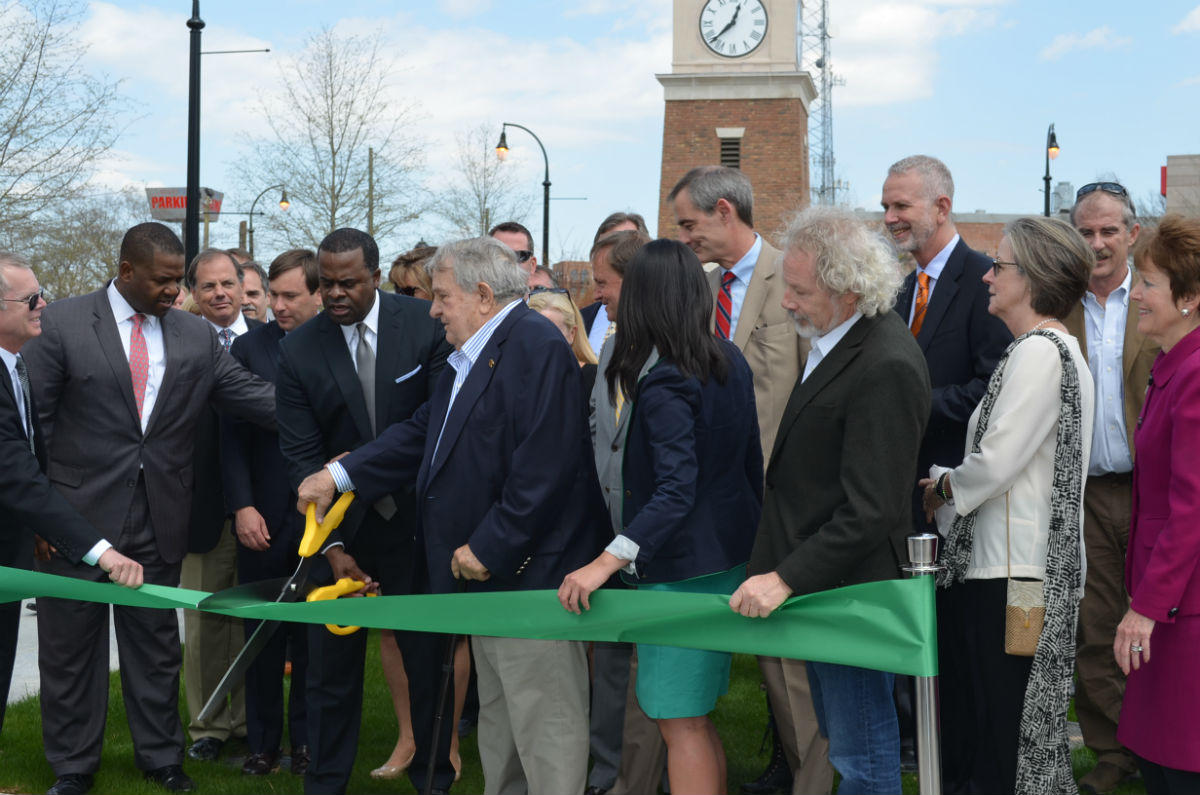
Across the street, a triangular park carries his name. Its 2015 reopening brought together city officials, neighbors, and Loudermilk himself. A statue of him faces the theater. There is something pleasingly specific about that arrangement: the civic benefactor in bronze looking toward a place the young salesman knew at pavement level.
His friend John Portman added another layer in 2017 with a twelve-foot stainless-steel sculpture called Aspiration. Portman and Loudermilk attended its unveiling with family and friends. The architect’s gift made their long friendship part of the public landscape. Here, a relationship became something a passerby could walk around.
Chapel Hill had its own claims on his affection. He helped support the Loudermilk Center for Excellence and business-school executive education facilities, and contributed toward the statue of football player Charlie Justice. His gifts often favored buildings and places. The physical setting gave an institution something to work with; the people running it still had their job to do.
Charlie, without the ceremony
The honors accumulated: the Council for Quality Growth’s Four Pillar Award in 2011, recognition from his university, and a place in Georgia Trend’s influential leaders hall of fame. His friendships allowed less ceremonial treatment. Portman described a relationship in which the two enjoyed needling each other. Public esteem apparently did little to interrupt the teasing.
Once, Loudermilk invited Portman to hunt at his plantation. Portman did not want to kill anything. Afterward, Loudermilk sent him a letter beginning with a cheerfully insulting salutation: “Dear Candyass.” A friendship capable of producing a public sculpture could also accommodate a private joke at the recipient’s expense. Portman recounted the exchange while discussing an award for Loudermilk. The tribute came with its own small puncture.
At his memorial in September 2022, his daughter Lisa remembered that fun and work had been closely connected. His son Robin emphasized honesty and doing the right thing. Young delivered the eulogy. The people gathered around the story included family, a business successor, and the political friend whose career Loudermilk had helped advance.
That collection of people says something the opening loan cannot. The business gave Loudermilk resources; his decisions determined where they went. Back to his college. Into a debate series. Across party lines. Toward a theater and a small piece of public ground in the neighborhood he had known as a boy.
The chairs had always been intended to come back. Over a long life, Charlie Loudermilk kept finding reasons to do the same.