The red phone was supposed to be annoying. Paul English took care over that detail. It had a mechanical ringer, sat on his desk in Kayak’s open office, and connected the people building a travel website to the people struggling to use it. His colleagues could hear him rush to answer. When he was away, nearby engineers picked up.
Most companies would recognize this as an interruption. English had arranged it as an education. A complaint about a confusing screen could reach someone able to change that screen. He particularly liked angry callers: their irritation meant they cared enough to get in touch. Fix the problem, he found, and a critic might become an enthusiast.
The phone makes a useful introduction to English, now founder and CEO of Gumdrop. His career includes travel search, customer service, games, a startup studio and several nonprofits. Across that assortment, a recurring interest emerges: the distance between what an organization thinks people need and what people actually experience. He keeps finding ways to shorten it.

A computer in a crowded house
English grew up in West Roxbury, Boston, the sixth of seven children. His father worked as a pipefitter for Boston Gas; his mother was a substitute teacher and social worker. At Boston Latin School, music and computing competed for his attention. He played piano and trumpet and joined the computer club. The eventual entrepreneur began with sounds, screens and other people who knew how to make them do things.
A Commodore VIC-20 at home gave that curiosity somewhere to go. He read its manual and sought out programmers at computer meetings, before the web made technical companionship available on demand. His brother Ed, who adapted Frogger for the Atari platform, brought him into game sound design. Programming offered the pleasant discovery that something absorbing could also pay.
English made a game called Cupid and, with Ed’s help, licensed it to Games by Apollo. The company folded before the game reached the market. The promised licensing deal was $25,000; the lesson lasted longer than the buyer. On his startup list, English calls this early venture especially meaningful because it demonstrated that code could become cash.
He earned his undergraduate and master’s degrees in computer science at UMass Boston in 1987 and 1989. Work at the software company Interleaf followed. Before Kayak made him widely known, he had already built Boston Light Software, sold it to Intuit and worked inside a much larger organization. His later impatience with corporate habits came with some practical exposure to them.
The mop before the money
One of English’s favorite Boston Light stories involves a bathroom. The company occupied inexpensive warehouse space, and executives from Intuit were due to visit. English came in early to prepare a presentation. A colleague named Jim appeared with a bucket and mop, having noticed that the bathrooms needed cleaning.
Nobody had assigned him the job. English remembers being struck by the initiative and the regard for everyone else working there. While reviewing compensation that day, he awarded Jim additional stock. Within months, English says, that extra allocation was worth $1 million. A mop rarely enjoys such an impressive return on investment.
It is a revealing detail in a career usually introduced with acquisition prices. English noticed an unglamorous contribution and attached a material reward to it. His hiring essay, written in 2002, makes the expectation explicit: employees should produce excellent work and actively strengthen the team. Merely avoiding damage does not satisfy him.
The eventual value of the extra stock English says he awarded a colleague who brought in a mop.
A help line with a short commute
At Intuit, English absorbed a lesson from cofounder Scott Cook about consulting actual customers rather than theorizing on their behalf. Kayak, founded with Steve Hafner in 2004, gave him a place to apply it. The service helped travelers compare options across providers. English led the technology; Hafner brought travel-industry experience.
In Kayak’s early months, English answered customer messages himself. As demand grew, passing problems to engineers secondhand proved frustrating. They could disagree with his diagnosis without ever meeting the person having difficulty. Having programmers handle support put the complaint and the means to repair it in closer contact.
That decision attracted a predictable objection: engineers cost considerably more than outsourced support staff. English treated those conversations as part of product development. The work could produce a changed interface, a released fix and feedback from the same customer. The caller received help; the programmer discovered whether the solution survived contact with a real person.
GetHuman pursued a related irritation from the consumer’s side. It collected ways to reach people at companies whose automated telephone systems made that difficult. A travel search engine and a directory of customer-service shortcuts look like separate businesses. Both depend on noticing the effort an ordinary task requires.
Kayak went public in 2012, and Priceline completed its acquisition in 2013. English subsequently built Lola with familiar collaborators, including Bill O’Donnell and Paul Schwenk. Capital One acquired Lola in 2021. The businesses changed, while the interest in service and the habit of building with trusted colleagues carried forward.
- 1999Boston Light → Intuit
- 2004Kayak begins
- 2013Kayak → Priceline
- 2021Lola → Capital One
- 2026Gumdrop & The Meeting Book
Seven days, and a little humility
English’s recruiting rules have the urgency of someone worried that an interesting person might leave the room. His target is an offer within seven days of someone on the team first hearing about a candidate. Interviews, references and decisions must fit inside that window. Speed requires preparation, in his telling, rather than a license to skip it.
He looks for intelligence, adaptability, humor and evidence of accomplishment. Relevant experience can arrive from an unexpected direction: he has written about hiring an Olympic rowing medalist because the achievement suggested determination. He also wants people capable of discussing their limitations without an elaborate defensive ceremony.
His willingness to admit his own shortcomings helps explain the emphasis. On operations and paperwork, he cheerfully leaves room for colleagues to be better than he is. The recruiting ambition can extend beyond the applicant: if a reference turns out to be particularly impressive, English may try to recruit that person too. Providing a reference is, apparently, an opportunity to enter the interview process sideways.
“I wanted to transfer empathy directly to the engineers.”Paul English, on customer support at Kayak
The calendar becomes the product
Gumdrop brings English back to a familiar problem at a smaller scale: getting people into a useful conversation. His own July 2026 description of the job emphasizes making meeting preparation and follow-up simple. The company’s current website leads with group scheduling, coordinating participants through email and working with Google and Outlook calendars.
The distinction matters. Booking a slot, arriving with context and leaving with clear next steps are separate jobs. English has been thinking about the surrounding habits for years. His meeting guidance starts with two aims: reach good decisions quickly and improve relationships among the people present. An efficient gathering that leaves colleagues less willing to work together would fail half the assignment.
He favors small decision-making groups, an agenda circulated beforehand and action items with named owners. He recommends recording outcomes while everyone is still in the room, so the minutes are complete before people leave. He also asks meeting leaders to notice who gets interrupted and whose contribution never receives a hearing.
In May 2026, Wiley published The Meeting Book: How the Best Companies Meet Better. It draws on his experience and conversations with business leaders, examining practices at organizations including Amazon, Intuit and LinkedIn. Gumdrop and the book approach adjacent problems: the software handles coordination, while the person running the room still has decisions to make about attention and conduct.
Reach good decisions quickly.
Improve relationships in the room.
Boston, beyond the office
English’s nonprofit work has often required him to revise his opening idea. In Haiti, he initially considered building a high school. Looking more closely at the existing primary schools led him toward supporting those instead. Summits Education, founded in 2015, grew around financial stability for schools and investment in teachers. Research changed the proposed intervention.
Embrace Boston began with another question. After visiting a Martin Luther King Jr. memorial in San Francisco in 2017, English wondered about creating one in his home city. He wrote a proposal on the flight back, sought advice and joined forces with Reverend Liz Walker. Fourteen community meetings helped broaden the vision beyond a physical memorial toward ongoing work on racial and economic justice.
For Winter Walk, which he created with Ari Barbanell and Robyn Glaser in 2016, the invitation was direct: hear people’s experiences of homelessness, walk together and meet organizations doing the work. The format placed conversation before a request for help. It made room for participants to understand something before deciding how to contribute.
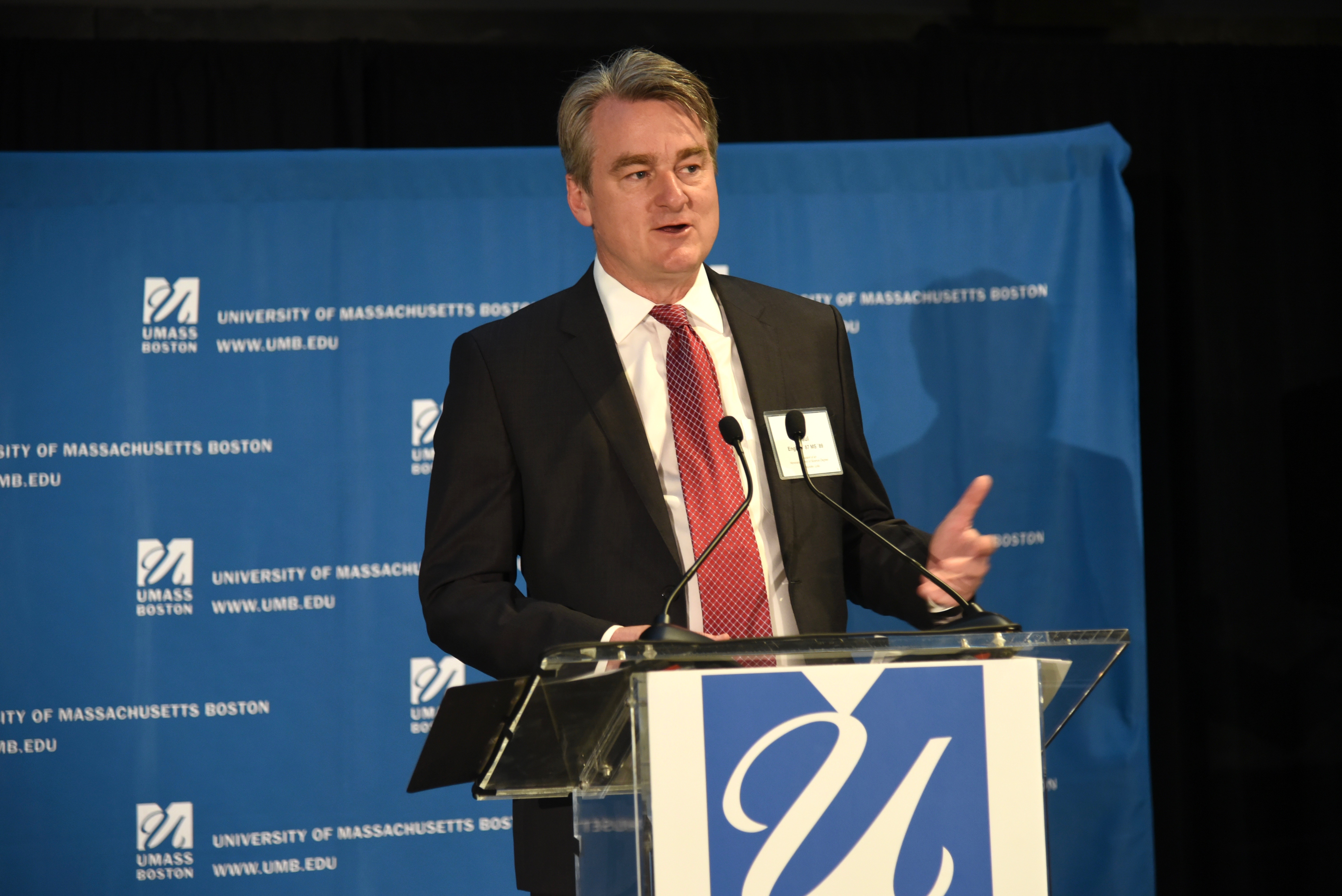
His education work has since returned him to UMass Boston. He committed $5 million to establish its applied AI institute and an associated scholarship fund. In March 2026, a further $1 million contribution launched a partnership supporting AI literacy in Boston Public Schools, with teacher development and student opportunities. Boston Public AI describes a mission of preparing graduates for work and education shaped by AI.
The first phone costs you the dishes
There is a domestic version of English’s interest in attention. In a 2022 account, he described hosting Tuesday Night Dinner since 2008 for siblings, a niece, a friend and his neighbor Nicholas. He tried to arrange business travel around it. Dinner might be quesadillas, pizza, burgers or waffles. The first person to touch a cellphone had to wash the dishes.
Sometimes the table observed a one-speaker rule, with pauses between turns. A leather-bound notebook recorded who came, what they ate and what they discussed. Those details give the gathering a texture that a calendar invitation cannot supply. Someone has to buy the food, make the time and listen.
English’s account of happiness includes long dinners, generosity and shared experiences. It also includes a wonderfully particular diversion: spending half an hour adjusting sugar granules on a Gumdrop logo. After the exits, the institutions and the book, he can still disappear into a small design problem. There is always another detail to fix, and, if Tuesday’s rules apply, a very good reason to leave the phone alone.