When the red neon sign came back on above Hotel Settles, people in Big Spring honked their car horns. The building had spent roughly thirty years dark and empty. On December 28, 2012, after six years of restoration, it opened again. G. Brint Ryan had helped give his hometown a familiar piece of its skyline back. For once, the return on an investment could be heard from the street.
Ryan makes his living with less conspicuous recoveries. His business examines taxes, searches for overpayments and helps companies keep capital they can use elsewhere. A refund rarely gets a rooftop sign. Yet the connection between the tax practice and the hotel is unusually close: both began with a willingness to look again at something other people considered settled.
The hotel makes a particularly good introduction to him because it complicates the usual founder story. Success took Ryan away from West Texas. Having the means to do something about a deteriorating landmark brought him back. There are cheaper ways to revisit your childhood than acquiring a fifteen-story building. Most require considerably fewer contractors.
The building he refused to write off
In 2006, Ryan bought the Settles from the city for $75,000. The eventual restoration cost about $30 million. Those figures belong to different stages of the project, but placing them side by side conveys the scale of the undertaking. Buying the problem was the inexpensive part. Making it useful again consumed years.
The building had opened in 1930, a product of the oil economy that shaped Big Spring. By the time Ryan took it on, collapse and neglect were part of its identity. Restoring it meant confronting damaged ceilings and decades of accumulated debris, along with local doubts about whether the effort could work. A landmark can become so familiar in its decline that people stop imagining it occupied.
Ryan’s explanation was rooted in family temperament. He described his grandfather as stubborn and recognized the same quality in himself. That persistence served a specific purpose here: restoring a place where people could meet, eat and stay. The reopened hotel had 65 guest rooms, gathering spaces, a restaurant and a bar. The point was to bring ordinary activity back inside an old shell.
The restoration itself cost about $30 million.
The English major who took accounting
Ryan was born in Big Spring in 1964, the oldest of four children. His early working life included a newspaper route for the Big Spring Herald and bagging groceries. These were jobs with immediate feedback: customers either paid or needed another reminder, and groceries did not bag themselves. His eventual profession would also reward attention to small transactions.
In 1982, he drove a tan 1979 Buick Regal to Denton and arrived at what was then North Texas State University with $300. He intended to study English. Accounting professors Horace Brock and Hershel Anderson helped redirect that interest toward tax. The change would eventually put his name on a business college, an outcome his original course plan had left out.
He completed bachelor’s and master’s degrees in accounting in 1988. The university offered more than a qualification: it exposed him to possibilities beyond the working life he knew in Big Spring. That distinction matters to the later gifts. He was supporting the institution where his sense of what a career could be had widened.
Ryan’s firm began in 1991 as Collis & Ryan. In 1993, he became majority owner, and the practice took the name Ryan & Company. The names changed again as the organization grew. In 1998 it surrendered its CPA-firm license and concentrated on tax consulting. Ryan himself is a Texas CPA; the company is not a CPA firm. That is a small distinction with a large bearing on what he built.
A taste for the difficult case
His attraction to the work is easy to understand when he describes the cases he enjoys. “I love the cases that no one wants,” he said in 2016. He also acknowledged that integrating acquisitions was a difficult part of leadership. Buying expertise and making teams work together are separate jobs; success at the first leaves plenty of work for the second.
There is something revealing in that combination. The appetite for an unpromising case suits a founder entering a specialized market. The problem of integrating people belongs to an executive whose organization has grown well beyond its original circle. Ryan has occupied both roles for decades. Expansion keeps presenting him with the less solitary kind of puzzle.
The firm’s work now spans federal, state, local and international business taxes, alongside software. His public responsibilities have included chairing the University of North Texas System Board of Regents and serving in Texas tax-policy advisory roles. The recurring territory is the point where businesses, rules and institutions meet. He has spent much of his career learning how decisions travel across those boundaries.
A resignation letter changed the rules
In 2008, team leader Kristi Bryant offered Ryan her resignation. She liked the company and its work, but saw its demands as incompatible with life outside the office. Ryan asked her to stay and help change the environment. He gave the person preparing to leave a role in deciding how others might want to remain.
A pilot later that year tested a results-only approach. Schedules and location became less important than agreed work getting done. Some managers resisted; the founder had to challenge assumptions his own firm had long rewarded. By the end of 2009, Ryan reported annual turnover down from 22.5 percent to 8 percent, alongside record revenue and profit. Those are historical company-reported results, rather than a promise that any workplace can repeat them.
The earlier culture had celebrated long hours. A 2013 account of the firm’s workplace changes described a fifty-hour weekly billable minimum and a leadership habit of treating hours as evidence of commitment. Moving away from that system required more than changing a handbook. It required managers to accept that a person could be accountable without being constantly visible.
This is an instructive episode in Ryan’s career because he had to revise something he had helped create. Persistence gets much of the credit in entrepreneurial stories. Here, listening was equally consequential. An employee’s decision to leave made a business problem concrete enough for its founder to act on.
Returning the favor, in Denton
On February 4, 2019, UNT announced a $30 million commitment from Ryan and his wife, Amanda. It set a university giving record at the time. The business college would carry his name. The commitment included at least six endowed chairs and support for academic initiatives over seven years, with areas ranging from taxation and entrepreneurship to logistics and cybersecurity.
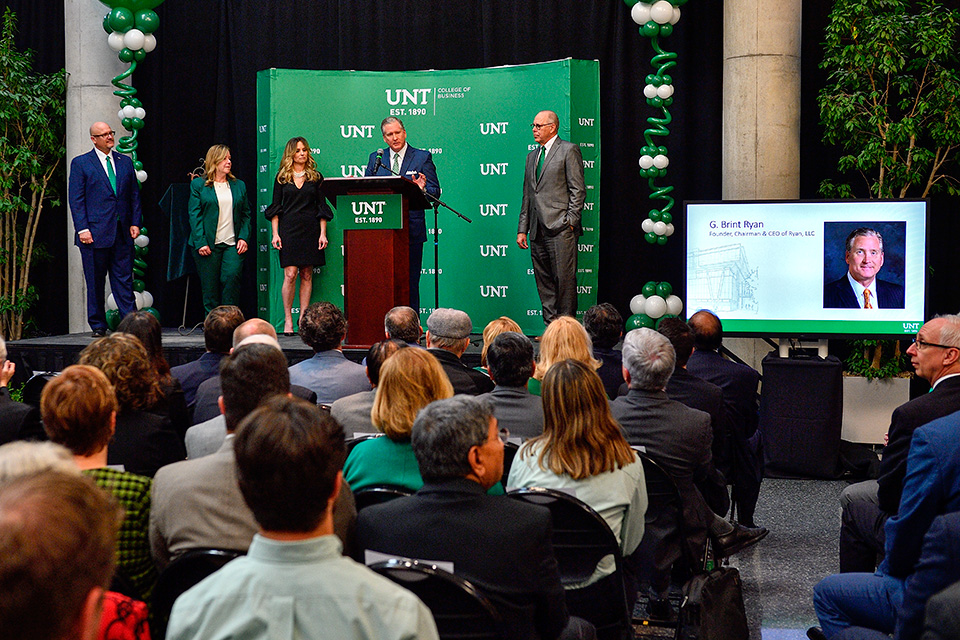
The practical design of the gift is worth lingering over. An endowed chair helps a university recruit and retain academic talent. Program funding gives that talent something to work with. The ambition was to improve the college’s capacity over time, through teaching and research, rather than make the naming ceremony the whole event. Ryan and Amanda were investing in an institution that would keep admitting students they would never meet.
A much earlier gift had already established that pattern. In 2006, Ryan donated $1 million to the UNT Foundation for a permanent accounting-department endowment. The later commitment expanded a relationship that had been developing for years. Education was becoming one of the places where business success could be turned into opportunities for someone else.
“The greatest risk of all is not taking one.”
G. Brint Ryan · 2022
The person outside the balance sheet
Ryan and Amanda have five daughters. His public tastes also offer a few welcome departures from tax: travel, cars and Tex-Mex. Asked about a dream car in 2022, he chose a Formula 1 machine on a track. Asked about food, his preferences were considerably easier to arrange. He named several Dallas-area Tex-Mex restaurants. Some aspirations require a racing team; others require a table.
His affection for music predates the business. At his high-school senior talent contest, he played rhythm guitar in a band whose set ended when a teacher cut the power. The episode supplies a pleasingly unruly footnote to the accounting degrees and board appointments. A career can become orderly on paper without having started that way.
The second look keeps getting bigger
Ryan remains founder, chairman and CEO, now based at the firm’s global headquarters in Plano. He announced the opening of the Legacy West headquarters in July 2025, emphasizing connection and collaboration. After a career that included loosening rules about where people work, he was marking the opening of a new place for them to come together.
The business has continued to expand. In January 2025, it completed the CAD $700 million purchase of Altus Group’s property-tax services business. In January 2026, it announced a commitment from Neuberger Berman to acquire a significant minority interest, alongside existing investors Onex Partners and Ares. Ryan and the existing leadership team were to continue running operations. The announcement described an investment in further growth, technology and people.
September 2026 brought the acquisition of Stockholm-based Svalner Atlas Advisors, adding capabilities across the Nordics and Benelux. On October 5, the firm announced the purchase of São Paulo-based Comtax, establishing its presence in Brazil. Comtax’s work includes tax determination, compliance and technology implementation. These deals extend the same central business into places where the local details are different, and where knowing those details is the service.
That is the larger shape of Ryan’s career: repeated attention to things that deserve another examination. A tax payment. A work schedule. An old hotel. A student’s prospects. The scale has changed, and each problem requires its own answer. Back in Big Spring, one answer still has red neon letters. When it first lit up again, people knew what to do. They honked.
Follow the story
Conversations, campus memories and the next chapter.
- Ryan · official biography
- LinkedIn · G. Brint Ryan
- UNT · the $30 million commitment
- North Texan · Journey of Transformation
- Smart Business · changing the work rules
- Texas Highways · Hotel Settles reopens
- D CEO · the 2022 conversation
- YouTube · Horatio Alger biography
- Ryan · October 2026 Brazil announcement