Before Deepak Jain asked a camera to recognize a customer, he tried putting the wallet inside a memory card. It was 2007 when he co-founded DeviceFidelity with his college friend Amitaabh Malhotra. Their business would help turn a mobile phone into something that could pay at a shop counter. The object doing the work was small enough to misplace between two fingers. The ambition required persuading two rather large industries, banking and telecommunications, to cooperate.
There is a pleasing disproportion in that picture. A tiny accessory, a substantial coordination problem. It introduces a recurring theme in Jain’s career: the customer should have less to do, even when arranging that convenience gives everyone behind the scenes considerably more work.
Today, Jain is the Plano, Texas-based founder and CEO of Wink. The company connects biometric identity with payments, allowing businesses to recognize customers through face, palm and voice technologies. Between the memory card and the camera sit a mobile wallet, a digital gifting business, acquisitions, patents and a continuing interest in how a person proves they have permission to spend.
A wallet small enough to disappear
DeviceFidelity arrived before paying with a phone became an unremarkable gesture. Its technology stored credentials on a plug-in microSD card and brought near-field communication, or NFC, to devices that lacked it. An accessory could supply a capability the phone itself did not yet possess. The wallet was becoming portable in a different sense: it could travel between devices.
Jain understood the importance of the handset people already owned. In 2011, discussing DeviceFidelity’s patent work, he pointed to customers changing phones and carrying more than one. A payment product had to accommodate those habits. Asking someone to admire a new technology was easier than asking them to reorganize their possessions around it.
The intellectual property followed the practical problem. His public patent list includes transactions using mobile-device covers, secured credentials and mobile wallets involving different enterprises. Those titles lack the sparkle of an advertising slogan. They describe the joints where the product has to hold together.
“Groundbreaking technology leads to market-dominating companies.”
Deepak Jain, 2010
That was Jain’s stated belief during the DeviceFidelity years. Inside the company, employees were judged and rewarded for the inventions they contributed. Innovation had an organizational consequence; it was something to recognize in someone’s work. The friendship with Malhotra became a working partnership, and the work produced both devices and a portfolio of ideas.
In November 2014, Kili Technology acquired DeviceFidelity. Jain and Malhotra continued managing the division. Kili was subsequently acquired by Square. The sequence matters because a founder’s biography can compress several corporate transactions into one tidy line. Here, the intermediate step shows the technology moving into a broader payments operation.
Credentials in the phone
Choice in the gift
Identity at checkout
Existing merchant devices
The gift with an escape route
Jain’s next consumer problem was more social. A gift card can be a generous present and a modest administrative burden. Someone has selected a retailer on your behalf. Perhaps they have selected correctly. Perhaps you now own forty dollars of obligation to a shop you never visit.
Swych gave recipients room to change that decision. A digital gift could be switched to a different merchant brand. Rather than treating the sender’s choice as permanent, the service let the recipient decide where the value would be useful. It brought flexibility to an object usually sold with a logo and a condition.
At FinovateFall in September 2016, Jain and co-founder Robert Sabella demonstrated the mobile gifting platform and its GiftBots. The bots made gifting available through familiar messaging environments, including Facebook, Skype and iMessage. Swych won Best of Show. The presentation brought together two conveniences: send from a place you already use, and receive something you can adapt.
The underlying interest was becoming recognizable. DeviceFidelity had worked around the limitations of a handset. Swych worked around the limitations of a gift. Both sought to make value more usable without demanding an entirely new set of habits from the person holding it.
Finablr took a majority stake in Swych in 2018, opening a route toward its international network. Jain later served as Finablr’s Global Head of Payments. Moneto, the mobile wallet business developed within DeviceFidelity, also became part of his exit history through its sale to Cachet Financial. Different products had brought him repeatedly to the question of distribution.
Following Jain from one venture to the next, the recipient becomes an interesting figure. In the gifting business, that person received more choice about where to spend. In the identity business, the customer is meant to repeat fewer tasks. The products address different situations, yet both begin by questioning the conditions attached to an otherwise straightforward exchange.
Back at the checkout, without the password
Jain founded Wink in 2021. By May 2022, the company had announced a $2.85 million pre-seed round, above its original $1 million goal. Cerracap and Carneros Bay led the financing. Its opening proposition combined face, voice and device recognition with payments and authentication, initially directed toward e-commerce.
A shopper often reaches the checkout only to meet another small examination. Remember a password. Locate a card. Enter its details. Prove you are the person entitled to use it. Wink sought to connect those questions through biometric identity, linking a verified person to the credentials needed for a transaction.
At FinovateSpring in 2023, Jain presented Wink’s multifactor biometric authentication. The company won Best of Show. His earlier gifting venture had also collected an audience award, giving this career an unusual recurring scene: a founder returning to a fintech stage with a different answer to an everyday annoyance.
The business was designed to reach customers through other businesses. Wink’s distribution model included direct enterprise sales, financial institutions, fintech platforms and licensing. That choice suits the problem. A consumer may welcome a shorter checkout, but the merchant and its technology partners decide what the checkout can actually do.
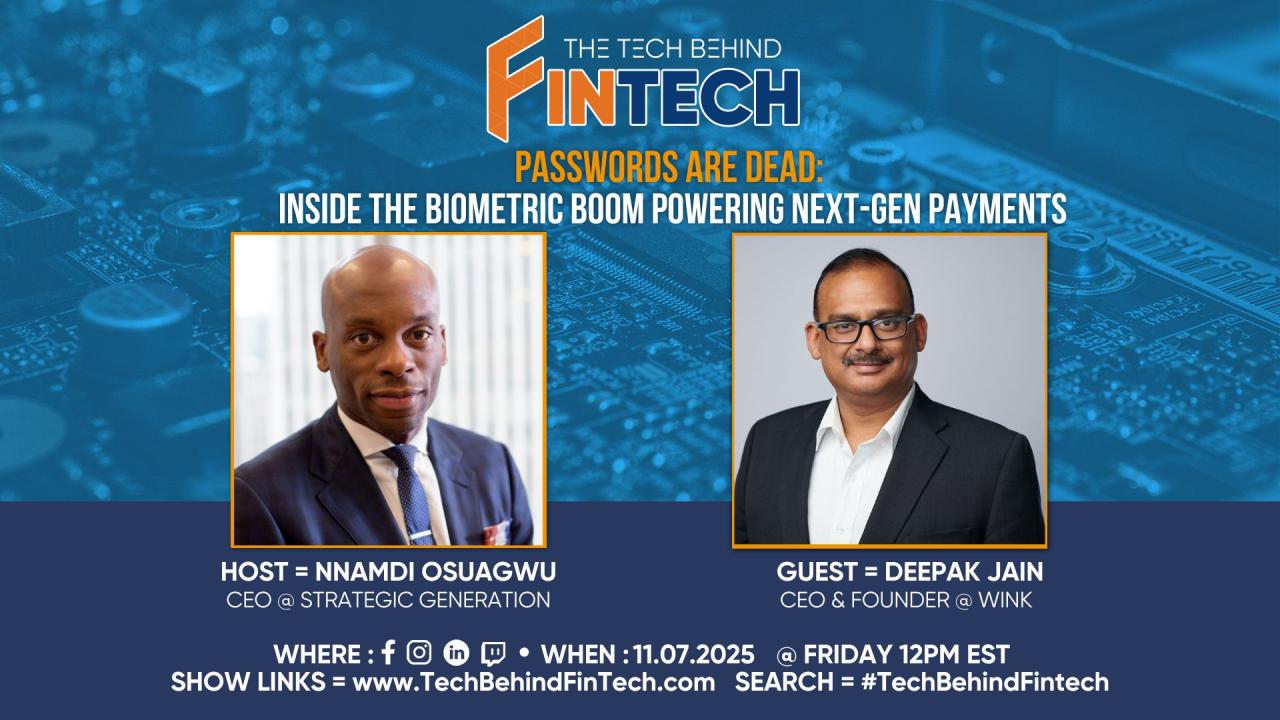
The customer’s freedom to choose still matters. In a 2024 discussion of Wink’s partnership with Bold Commerce, the two companies described checkout flows that could accommodate biometric authentication and alternatives when needed. Lighting, for example, can complicate face recognition. A shop has to complete the purchase even when the preferred experience encounters the ordinary world.
A camera needs somewhere to send the money
In April 2025, Wink merged with Phoenix Managed Networks. The combination joined biometric identity with an established payment technology and services business. Phoenix brought connections to payment participants in the United States and United Kingdom, along with infrastructure that had been serving the industry for more than fifteen years.
The merger announcement put that infrastructure at more than 10 million monthly transactions and 220,000 merchant connections. Those are figures describing the payment network’s reach. They do not establish how many shoppers were paying with a face or palm. For Jain, the strategic importance was the route to market: identity technology gained a place alongside systems already moving transactions.
Merchant connections in Phoenix’s payment infrastructure
Infrastructure reach; not a count of biometric customers.Jain’s accompanying letter connected the merger to several proposed experiences, including face and palm payment, fraud prevention and commerce inside connected cars. The range reveals how broadly he sees the identity problem. It also makes the commercial task more demanding. Each setting has its own equipment, partners and expectations about what a customer should do.
His response includes leaving the customer relationship with the business that owns it. In a September 2025 conversation, he described Wink supplying a trust framework while the merchant or financial institution controls the experience. The camera might do the recognition; the shop still needs to feel like the shop.
Biometric identity
Authorized payment and loyalty credentials
Existing commerce and payment systems
This is where his history with several kinds of payment products becomes relevant. The accessory, the wallet and the gifting app each had to fit into a larger commercial arrangement. Wink brings the same dependency into view again. A recognizable face starts an interaction; a network of companies must still cooperate to finish it. Jain has chosen a business in which invention keeps company with negotiation.
The shop counter is the real test
On January 7, 2026, Fiserv announced a collaboration bringing Wink’s technology into Clover. The announcement covered face and palm payments, linked identity and loyalty, and activation across Clover devices without hardware changes. Initial availability was aimed at quick-service restaurants, sports venues and retailers, with continued rollout planned through the year.
For a founder whose early business added payment functionality through phone accessories, the absence of a hardware replacement is a satisfying turn. The camera and the terminal can already be there. The work shifts toward software, integration and convincing a business that recognition earns its place at the counter.
Jain’s interests also extend to helping other founders. In January 2021, he joined the educational venture now known as Moonpreneur as an investor and advisor. The appointment drew on his experience building businesses and intellectual property. It placed him alongside younger entrepreneurial projects while he was approaching another founding year of his own.
“Once an idea is in my head, I want to make it happen.”
Deepak Jain, November 2025
That sentence offers a compact explanation for the repeat appearances. His companies have dealt with different objects, but a persistent concern runs through them: how much inconvenience people accept simply because it comes attached to spending money. The memory card, the gift and the camera are successive ways of approaching it.
The everyday test remains wonderfully unglamorous. Someone wants to buy something. Someone else wants to sell it. If Jain’s latest idea works as intended, they can spend less time negotiating with the checkout and get on with their day.