There is a specific kind of dread in the ninety seconds before a meeting. You are half-remembering who the person is, fully forgetting what you promised them last time, and skimming an email thread with your thumb while you say "so sorry, just one sec." Nobody markets this feeling. Gumdrop was built to delete it.
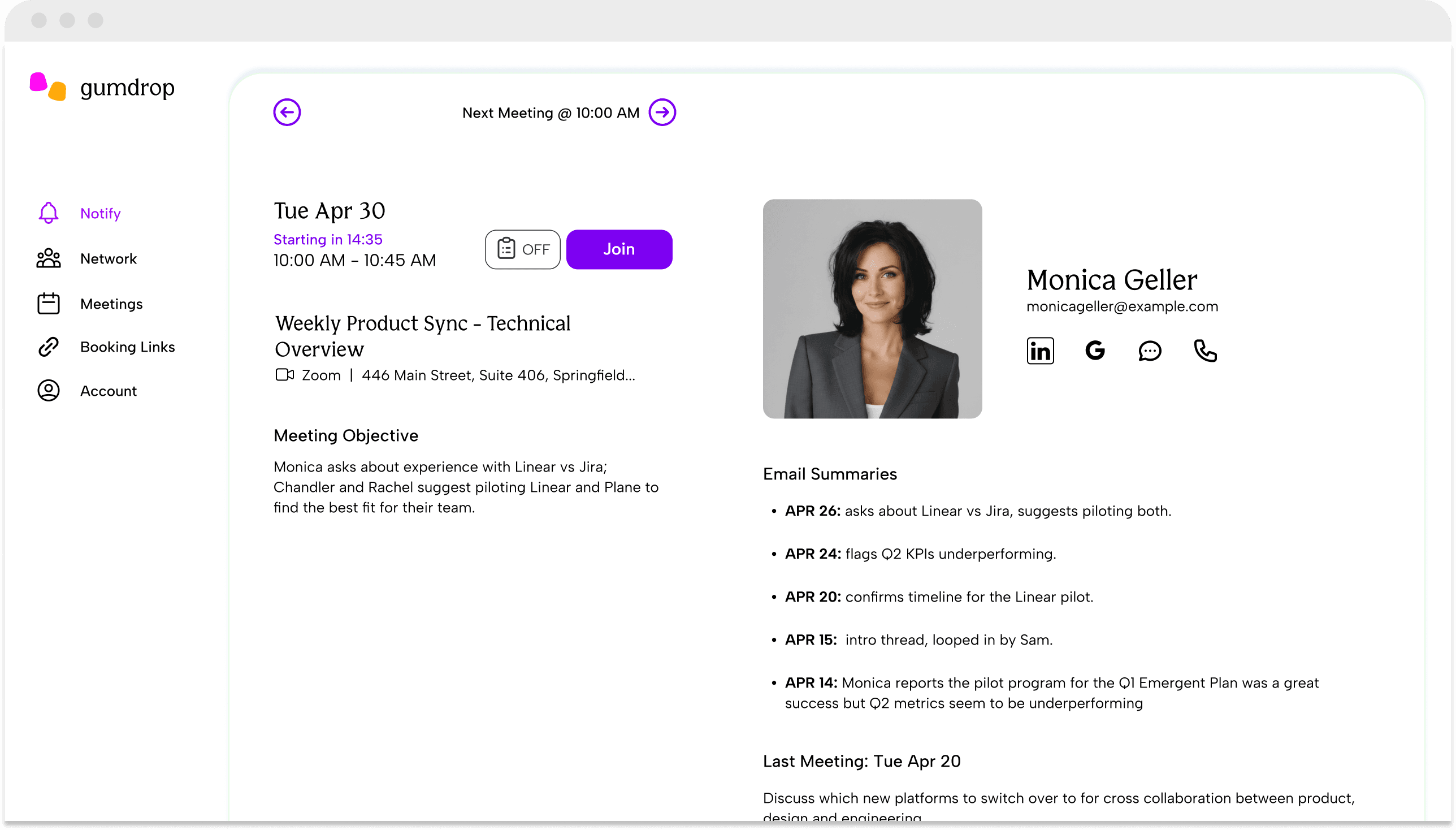
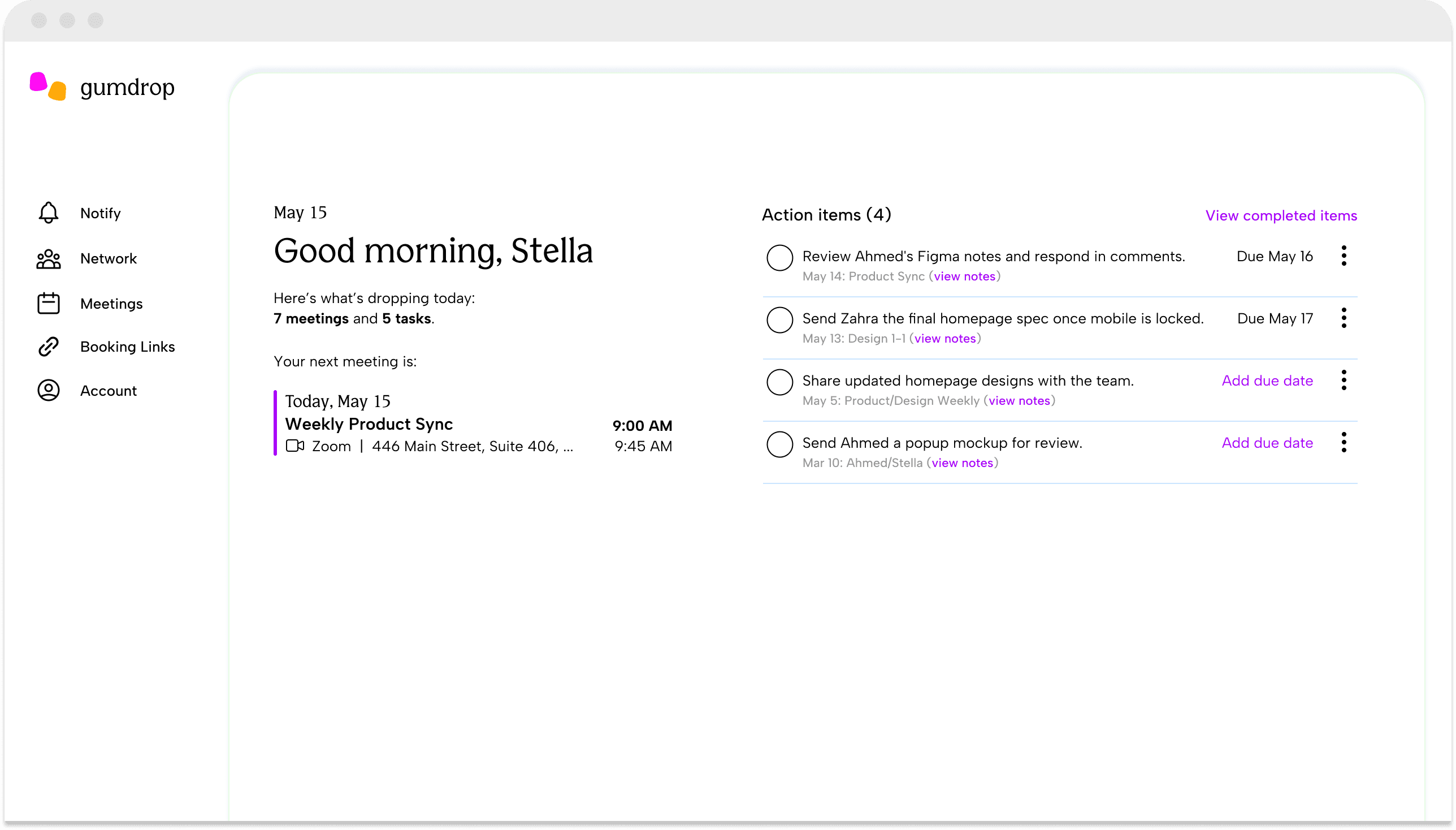
Gumdrop is an AI meeting assistant out of Boston. The premise is narrow on purpose: it preps you before a meeting and follows up after one. About five minutes before your calendar says "Call with Dana," a briefing arrives - a headshot so you recognize the face, a few lines pulled from your last conversation, the relevant recent emails, and the one thing you said you would do. When the meeting starts, an AI notetaker listens. When it ends, it hands you the commitments you made as a checklist instead of a wall of transcript.
That distinction - list, not transcript - is the whole personality of the product.
01Who is behind it
The founder is Paul English, who co-founded and served as CTO of Kayak. Kayak sold to Priceline in 2012 for $1.8 billion, and it is still one of the cleaner examples of software that made a chore - hunting for flights - stop feeling like a chore. English has spent the years since spinning up companies out of his Boston Venture Studio, including GetHuman, a service built to help people reach an actual human on customer-service phone lines. There is a through-line: he keeps picking a small, universally hated friction and trying to make it disappear.
Meetings are the latest one. English didn't just build software about them - he wrote a book. The Meeting Book, published in May 2026, studies how companies like Amazon, Airbnb and LinkedIn actually run their meetings. Gumdrop is, in effect, the software version of the argument. Content at the top of the funnel, product at the bottom, both pointed at the same complaint.
02What it actually does
Four things, tightly related. First, the pre-meeting briefing - the prep card described above, assembled from past meetings, recent email and your contact history. Second, the AI notetaker, which records and transcribes but is judged on whether it catches the commitment you made at minute 34 and forgot by minute 40. Third, scheduling: personal 1:1 booking links and group links that hunt for open time across several calendars, with one-click reschedule between Gumdrop users. Fourth, and the most quietly clever, email scheduling - you CC magic@gumdrop.ai on a thread and it works out a time with everyone, no app-switch required.
03Why it isn't just another notetaker
This is the crowded part of the market. Otter, Fireflies, Granola, Fathom, Read AI - the space is full of tools that join your call and produce a transcript. Gumdrop's move is to walk one step upstream and one step downstream from the recording. The transcript, in this framing, is table stakes. The value sits in the five minutes before (prep) and the follow-through after (did the thing you promised actually happen). It is a bet that the meeting itself was never really the problem.
There is also a trust angle, and it is doing real work in the pitch. An assistant that reads your calendar, your email and your contacts is either your best hire or your worst leak. Gumdrop leads with the boring, reassuring specifics: OAuth-only access, CASA Tier 2 certification, encryption, and a flat statement that it does not train on your data. In a year when plenty of AI quietly ingests everything it touches, "we read it, we don't sell it" is starting to read as a feature rather than fine print.
04Who it's for, and how it makes money
The target is anyone drowning in a calendar - founders, executives, salespeople, anyone whose day is a stack of back-to-back conversations with different people about different things. The business model is standard SaaS: a 30-day free trial with no credit card, paid individual plans, and a Team plan for organizations. It runs where meetings already live - Gmail, Google Calendar, Microsoft Outlook - with native iOS and Android apps, and a waitlist for iCloud and Teams. Third-party company databases list a team of roughly 17 people. Funding figures are not public.

05A footnote on the name
Search "Gumdrop" this year and you'll trip over a second story: OpenAI reportedly has a hardware project under the same codename - a screenless, pen-sized AI device. The two are unrelated. One is a rumor about a gadget. The other is software you can start a trial of this afternoon. Worth knowing before you go looking, because the internet currently believes both.
06The short history
English co-founds Kayak and serves as CTO, rebuilding how people search for travel.
Priceline acquires Kayak, cementing English's reputation for frictionless consumer software.
A studio to spin up new companies, later the home base for his AI ventures.
English publishes his study of how top companies run meetings - a companion to Gumdrop's mission.
Prep, notetaking, action items and scheduling ship across Gmail, Outlook, iOS and Android.
Whether Gumdrop wins is an open question - the meeting-AI shelf is loud, and being early to the prep-and-follow-up framing is not the same as owning it. But the underlying read is a familiar one from this founder: the biggest opportunities tend to hide inside the parts of the day everyone quietly agreed to put up with. Meetings have been on that list for a long time.
Follow Gumdrop
Official links, founder & press
Watch: search "Paul English Kayak founder" on YouTube for his fireside chats and TEDx talks, and "Gumdrop AI meeting assistant" for the product walkthrough. Direct demo links were not published at time of writing.