The $500 Bet That Turned "No Credit" Into a Two-Billion-Dollar Business
For 70 years Aaron's has made the same wager: that millions of Americans want a couch, a fridge or a big-screen TV today, and will pay weekly to own it - no credit score required.
In 1955, a 27-year-old named Charles Loudermilk borrowed $500, rented a small showroom on Atlanta's Peachtree Street, and started renting out folding chairs and office furniture. He was not selling anything. He was renting - betting that people would rather pay a little each month than a lot up front. Seventy years later that same instinct is a business doing roughly $2.1 billion a year, and it still answers the one question most of retail would rather avoid: what do you sell to the customer a lender just turned down?
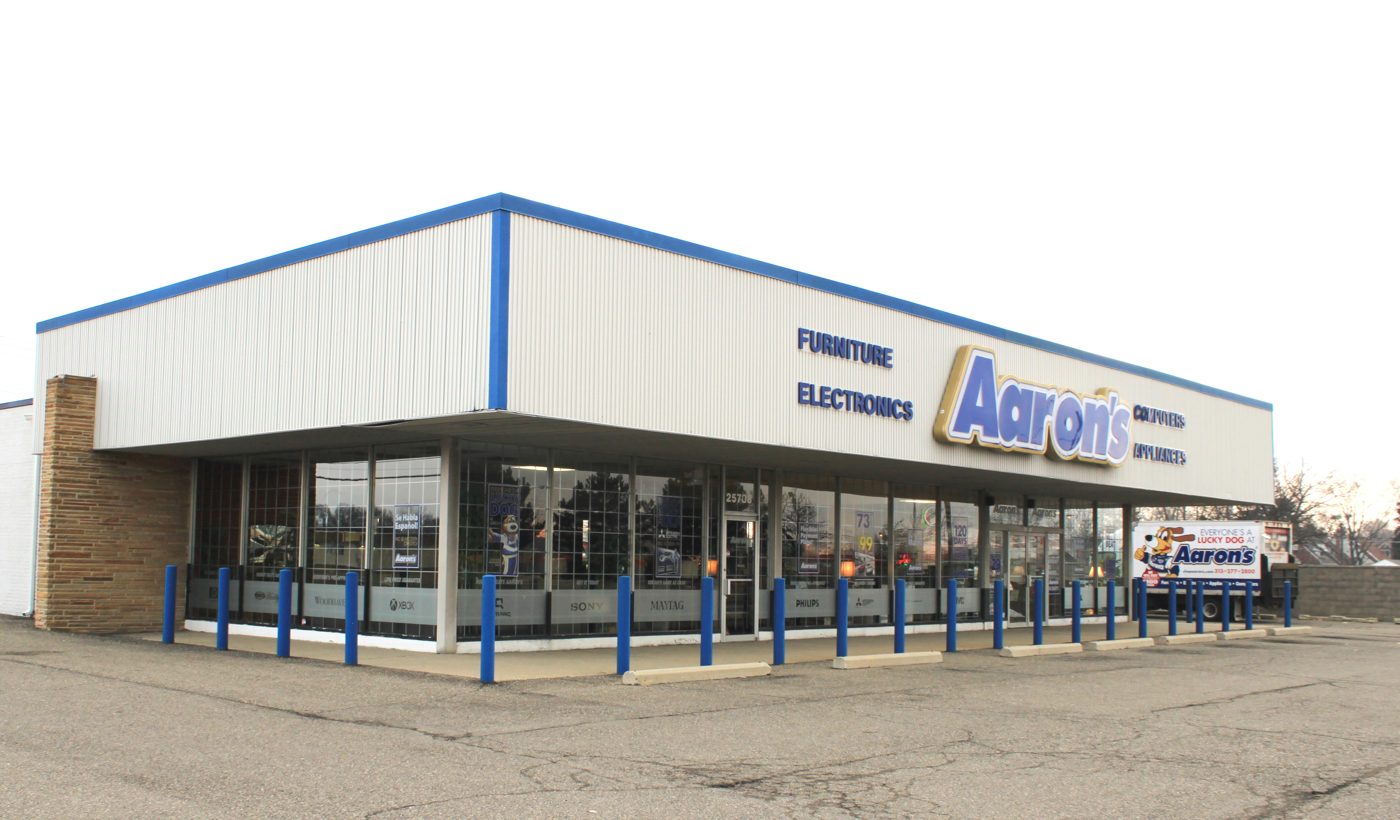
The Aaron's Company is one of the largest lease-to-own retailers in North America. It leases and sells furniture, mattresses, appliances, electronics and computers through about 1,210 company-operated and franchised stores across 47 states and Canada, plus an e-commerce site and the BrandsMart U.S.A. retail chain. Its headquarters sit at 400 Galleria Parkway in Atlanta - the same metro where Loudermilk opened his first store.
01 / THE MODELSell the payment, not the price tag
Aaron's core product is the lease-ownership agreement. A customer picks out a sofa or a refrigerator, chooses a plan - commonly 12, 18 or 24 months - and makes weekly, biweekly or monthly payments. Complete the term and the item is yours. There is also an early-purchase route: pay it off inside the "same as cash" window (generally 120 days) and you pay the cash price plus tax and applicable fees, skipping the lease premium entirely.
The part that makes the model work for its customers is what happens if life changes. If the payment stops fitting the budget, you can return the merchandise - no penalty, no lingering debt, and, Aaron's says, no impact on your credit. Delivery and setup are included. So are repairs. It is a rental that quietly turns into ownership, and it is aimed squarely at the shopper other stores wave off.
"No credit needed" is not a slogan bolted onto the business. It is the business.
That is the tension at the center of Aaron's. Roughly a hundred million American adults have thin credit files, damaged scores, or a deep distrust of revolving debt. A furniture store that only takes a credit card or a prime-rate loan simply cannot serve them. Aaron's approves on income, references and its own read of the data - and prices the risk into the lease. The trade is transparent: pay more over time, but get the appliance today and owe nothing if you walk away.
02 / THE CUSTOMERBuilt for the shopper the system skips
Aaron's customers are value-seeking, often credit-constrained households. These are people who need a working refrigerator this week, a bed for a kid's room, a laptop before the school term, or a TV for the living room - and who either can't get conventional financing or don't want it. The company built its entire operation around them: the store layout, the weekly-payment signage, the free delivery truck, the in-house repair, the return-anytime promise. Nothing about it assumes a healthy FICO score.
That focus is also why Aaron's owns so much of the experience. Most retailers hand off delivery, financing and service to third parties. Aaron's keeps them in-house because, for this customer, the couch showing up assembled and the repair being handled without a fight are the product. The lease is just the paperwork.
The expertise here is not glamorous, and that is the point. It lives in decades of decisions about which customer to approve, how to route a delivery truck, when a returned appliance can be refurbished and leased again, and how to keep roughly 9,100 employees and a franchise network pointed at the same weekly-payment promise. Aaron's has been refining that machinery since Loudermilk was routing rental chairs by hand - it is one of the few companies that has run the full lease-to-own loop, at national scale, for the better part of a century.
03 / THE SPLITThe spin-off that made two companies
For years Aaron's contained two businesses under one roof: the stores, and a fast-growing point-of-sale leasing arm called Progressive Leasing that let other retailers offer lease-to-own at checkout. In 2020 the parent separated them. Progressive became the core of a new public company, PROG Holdings, while the store network was spun off on November 30, 2020 as The Aaron's Company, Inc., trading on the NYSE under the ticker AAN.
It was an unusual move: the company spun out its own fintech and kept the physical stores - the opposite of what most operators do when a software business starts outgrowing the bricks. But it clarified what each side actually was. Progressive was a technology-and-underwriting business. Aaron's was a retail-and-service business. Splitting them let each be judged on its own terms.
Directional split of revenue sources - lease agreements do the heavy lifting, with retail and franchising alongside.
04 / THE ACQUISITIONTwo ways to sell the same television
In 2022, Aaron's completed the $230 million acquisition of BrandsMart U.S.A., a regional appliance and consumer-electronics retailer with stores in Florida and Georgia and roughly $750 million in annual revenue. On paper, a lease-to-own chain buying a cash-and-credit big-box retailer looks like a detour. In practice it was a hedge on the same shelf.
A BrandsMart customer buys a TV outright. An Aaron's customer leases the same category weekly. Same warehouses, same manufacturer relationships, two different wallets. The acquisition let Aaron's play both sides of the affordability question instead of forcing every shopper into one answer - and gave it a second revenue engine that doesn't depend on the lease.
Aaron's finances the couch and owns the store the couch sits in. That vertical stack is why it outlasted most of its category.
On the model's durability05 / THE COMPETITIONWho else says yes
Aaron's competes with Rent-A-Center and its Acima virtual-lease arm, Buddy's Home Furnishings, and Conn's HomePlus, along with a newer wave of point-of-sale lease and financing providers - Snap Finance, Katapult, and, ironically, Progressive Leasing, its own former sibling. The difference is footprint and integration. Many rivals are either pure store networks or pure software. Aaron's runs both stores and e-commerce, owns delivery and repair, and layers a franchise system and a retail chain on top. When a customer can't get approved elsewhere, breadth is the moat.
06 / THE TIMELINEFolding chairs to gaming consoles
07 / THE NEXT CHAPTERA fintech buys the furniture store
In June 2024, Aaron's agreed to be acquired by IQVentures Holdings, a fintech firm, for $10.10 per share in cash - a premium of about 34% over the prior close - valuing the company at roughly $504 million. Shareholders approved the deal in September, and it closed on October 3, 2024. The common stock stopped trading and left the NYSE. Aaron's kept its brands, its stores and its Atlanta headquarters, now operating as a private company.
The buyer is telling. A fintech wanted a national network of physical lease-to-own stores - the underwriting, the customer relationships, the repeat foot traffic. It is the same logic that has driven Aaron's for 70 years, viewed from the other end: the value isn't the sofa, it's the approval. Under CEO Douglas Lindsay, the company is now pairing that store network with a modernized, smaller "GenNext" format and a heavier online lease-approval flow built on Salesforce Commerce Cloud.
08 / THE TAKEAWAYWhat you can borrow from Aaron's
Strip away the era and the model is a short list any operator can study. Approve the customer everyone else declines, and price the risk honestly. Sell the payment, not the sticker. Make walking away free, so trust does the marketing. Own the delivery and the repair, because for this buyer that is the actual product. And know which business you're really in - Aaron's spun off its software, bought a retailer, then sold itself to a fintech, and each move was a version of the same clear-eyed question.
It won't work everywhere. The lease-to-own model draws real scrutiny over total cost, and it depends on disciplined underwriting, tight logistics and a customer base that values access over the lowest possible price. But for 70 years, in good economies and bad, enough Americans have wanted the couch today to keep the trucks rolling.