A used-car dealership has an unusual supply problem. Its future inventory is already somebody else’s car. Before it reaches the lot, a driver must trade it in, a lease must end, or another dealer must send it to auction. You can build the showroom on schedule. You cannot order three-year-old cars from a factory.
In June 2023, Sonic Automotive confronted that distinction. The Charlotte retailer suspended operations at eight EchoPark locations and 14 associated delivery and buying centers. A business designed to make buying a used car easier had run into the difficulty of buying enough suitable cars itself.
- The offer: new-car dealerships, EchoPark used cars and powersports, with financing and service attached.
- The correction: close locations and concentrate scarce inventory in key markets.
- The result: EchoPark returned to positive annual segment income in 2024, then improved in 2025.
Twenty stores, then another way to shop
Sonic began its public-company life in November 1997 with 20 stores representing 15 brands. Founder O. Bruton Smith and co-founder B. Scott Smith assembled a dealership group, rather than a car manufacturer. That distinction matters. Sonic’s expertise sits between the factory and the driveway: selecting inventory, appraising trade-ins, arranging credit, repairing vehicles and managing the many small negotiations that surround one large purchase.
Today, the company gives customers three routes. Its franchised dealerships sell new and used vehicles under manufacturers’ brands. EchoPark specializes in used cars. Sonic Powersports sells motorcycles and other recreational machines. The customer might need a family vehicle, a luxury upgrade, a repair or a Harley-Davidson. The corporate name can be less visible than the sign above the local showroom.
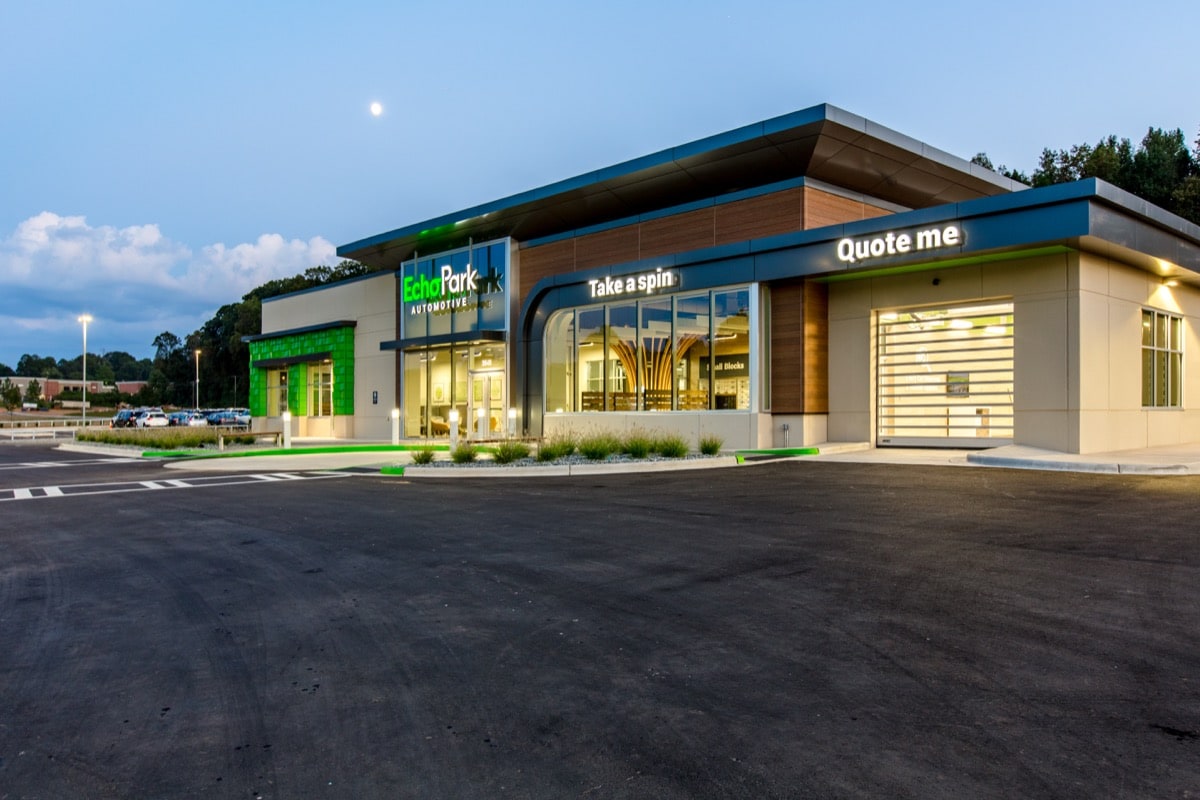
EchoPark, launched in the Denver market in 2014, made the buying process part of the product. It offers no-haggle pricing and calls its sales staff Experience Guides. Its published process includes a 190-point inspection and reconditioning. ECHO, the company explains, means Every Car, Happy Owner. It is an unusually cheerful acronym for a transaction that involves depreciation.
The promise addresses a familiar problem: shoppers arrive expecting an argument. Sonic’s own culture statement describes customers coming to the dealership “ready for a fight.” Clear pricing and a guide offer a different starting point. They do not eliminate the need to compare the vehicle, financing and optional extras.
The cars that never reached the lot
EchoPark’s 2023 trouble began upstream. Sonic pointed to reduced new-vehicle production over the preceding three years, low leasing activity and fewer lease returns. Those missing new cars would otherwise have become used cars. Wholesale prices were high and volatile. An expanding retail network had to compete for a constrained supply.
The response was specific. Stop operating selected sites. Send more available vehicles to key markets. Reduce expenses. The underlying idea was that a better-stocked remaining store could be more useful than a wider collection of thinly supplied ones.
There was a bill. Sonic recorded a $75.2 million closure-related charge in the second quarter of 2023, including asset impairments, inventory adjustments and severance. Most of it was noncash; it was not a $75.2 million check handed over to close the doors. Severance accounted for $2.2 million. Further charges followed. Closing a location stops some expenses while leaving leases, assets and people to deal with.
Sonic also closed three Northwest Motorsport locations later in 2023 and the remaining seven in January 2024. That chain, acquired with RFJ Auto Partners, belonged to the EchoPark reporting segment. The reset reached beyond the green EchoPark signs.
A smaller map, a better result
In 2023, EchoPark reported a segment loss of $132.5 million. In 2024, it reported $3.5 million in segment income. In 2025, income reached $28.1 million even as retail used-vehicle volume slipped 2%. The business had improved without needing to sell more cars that year.
Bar lengths show absolute magnitude. Orange denotes loss; navy denotes income. Segment income is not consolidated net income.
These figures support a recovery, not a controlled experiment proving closures caused every dollar of improvement. Pricing, sourcing and market conditions also matter. The practical lesson is to measure what each location can earn with inventory it can actually obtain. Counting openings will not answer that question.
The latest quarter supplies a useful complication. In the second quarter of 2026, EchoPark sold 19,601 used vehicles, up 17% from a year earlier. Reported segment income fell 38% to $7.2 million. More cars moved; less income remained. A turnaround can be real and still have uncomfortable quarters.
You cannot order three-year-old cars from a factory.
The business after the handshake
Sonic reported $15.15 billion in consolidated revenue in 2025. Its broader business offers other ways to earn. Across the group, 2025 parts, service and collision-repair revenue totaled about $2.02 billion. Finance, insurance and other net revenue contributed about $799 million. Selling a vehicle begins an ownership relationship that can bring repairs, maintenance and another purchase.
That work requires people and systems. Sonic reported adding 335 technicians in 2024. Its partnership with CDK supplies dealership-management and retail software. Participation in Amazon Autos explores another entrance to the same physical business: start online, then connect the transaction to a dealership. Neither an online listing nor an attractive showroom can replace the ability to process paperwork and support the vehicle.

David Bruton SmithChairman and CEO. The operating assignment spans luxury dealerships, used-car lots and powersports stores.
For a shopper, the useful move is straightforward. Search Sonic’s dealerships for a particular manufacturer; compare EchoPark when a used vehicle and fixed pricing suit the purchase. Check the total amount payable, the loan terms and the protection products separately. CarMax, Carvana and local dealers remain comparison points.
For another operator, the copyable idea is inventory concentration. It depends on customers still being able to reach the remaining stores and those stores having capacity. It becomes less persuasive when distance loses the customer or scarce supply remains expensive everywhere. Sonic’s experience makes an ordinary retail question surprisingly consequential: before opening another door, what will you put behind it?