Carlos García Ottati needed to sell a car. He was living in Bogotá, preparing to move to Mexico City for a new job, and the vehicle was an inconvenient piece of unfinished business. A friend eventually sold it, six months later. In Mexico, the used car he bought came with mechanical problems. Moving countries had been easier than completing two ordinary transactions.
The episode has the shape of a familiar entrepreneurial origin story: an annoyed customer decides to become a supplier. But cars give that story unusual weight. A bad purchase can swallow savings. A delayed sale can strand money precisely when its owner needs it. The smiling handshake at the end is doing an extraordinary amount of work.
García Ottati’s answer became Kavak, founded in Mexico in 2016. The business would buy used vehicles, inspect and recondition them, then sell them with financing and support. He was proposing to take responsibility for the awkward stretch between an appealing photograph and a car someone could actually depend on.
A decade into that undertaking, the interesting question is how much responsibility one company can carry. His career offers an answer with grease under its fingernails, an Oxford chapter, large funding rounds, and some chastening correspondence. Trust turns out to need a fairly extensive parts catalogue.
A childhood spent packing
García Ottati grew up in a military family in Venezuela. At twelve, he started a lawn care business. There is something pleasingly literal about that first enterprise: before he tried to tidy a fragmented market, he offered to tidy grass.
His recollections of childhood include frequent moves. In his 2020 conversation with Oso Trava, he recalled more than thirty relocations and fourteen schools. His early working life also crossed restaurants, food, and liquor. These were businesses with physical goods, daily customers, and immediate consequences when the order was wrong.
It would be tempting to make every later decision inevitable from these beginnings. That would rob the story of its choices. A child who moves often does not automatically grow up to build an international car business. What the history does establish is familiarity with starting again, and a working life that began well before venture capital entered the picture.
He later headed to Europe, describing a trip to Rome at twenty-four with no return ticket. The plan met the global financial crisis. His route into digital commerce included work at Amazon; he would return to Latin America with an interest in what marketplaces could do for businesses still operating largely offline.
Oxford, then the missing delivery truck
At Oxford’s Saïd Business School, he completed the 2010-11 MBA. A visit had helped persuade him to enrol: students in their formal academic dress made the university’s history feel like something he could join. It is a wonderfully human detail in a career usually told through balance sheets. Sometimes an important business decision begins with excellent costumes.
Consulting at McKinsey followed. Then came Linio, where he became chief marketplace officer. Here the promise of online shopping met the requirements of actually getting something to somebody’s door. Payments, fraud prevention, and delivery needed attention alongside the storefront. The attractive screen was only the visible edge of the operation.
Those years help explain the kind of founder he became. A marketplace sounds light: buyers on one side, sellers on the other, software in the middle. In practice, each transaction depends on institutions and services that may be uneven or absent. The entrepreneur can wait for them, work around them, or start building them.
For a used car, the dependencies multiply. Someone must assess its condition. Someone must make a sensible offer. Repairs need parts. The buyer may need a loan. A dispute needs an answer. A vehicle is a rather uncompromising customer experience: it cannot be made reliable by improving the checkout animation.
Three founders, one complicated purchase
His sister, Loreanne García Ottati, and Roger Laughlin joined him as Kavak’s cofounders. Loreanne has described her own entry into the automotive business as a decision to help solve a problem her brother had experienced. The founding story belongs to a team, even when the inconvenient car belonged to Carlos.
The appeal was straightforward. Sellers wanted a dependable transaction. Buyers wanted a dependable vehicle. Kavak would insert itself into the deal and handle more of the process. Taking control also meant accepting costs and risks that a simple listings website could leave with its users.
- 01 Buy
- 02 Inspect
- 03 Recondition
- 04 Sell + finance
- 05 Support
A simplified view of Kavak’s model. Each step creates an obligation for the next.
García Ottati has been candid about the founders’ starting point: they did not arrive as automotive experts. Their initial clarity concerned the experience they wanted customers to have. He described a method of setting a distant ambition, then working backwards through a detailed plan. It is a useful combination, provided reality retains the right to interrupt.
The mechanics of the business make that interruption frequent. Inventory occupies space and ties up money. Repairs delay a sale. A pricing error can linger in the yard. Financing introduces a second relationship with a customer, lasting beyond the moment the keys change hands. There is plenty for an ambitious plan to become acquainted with.
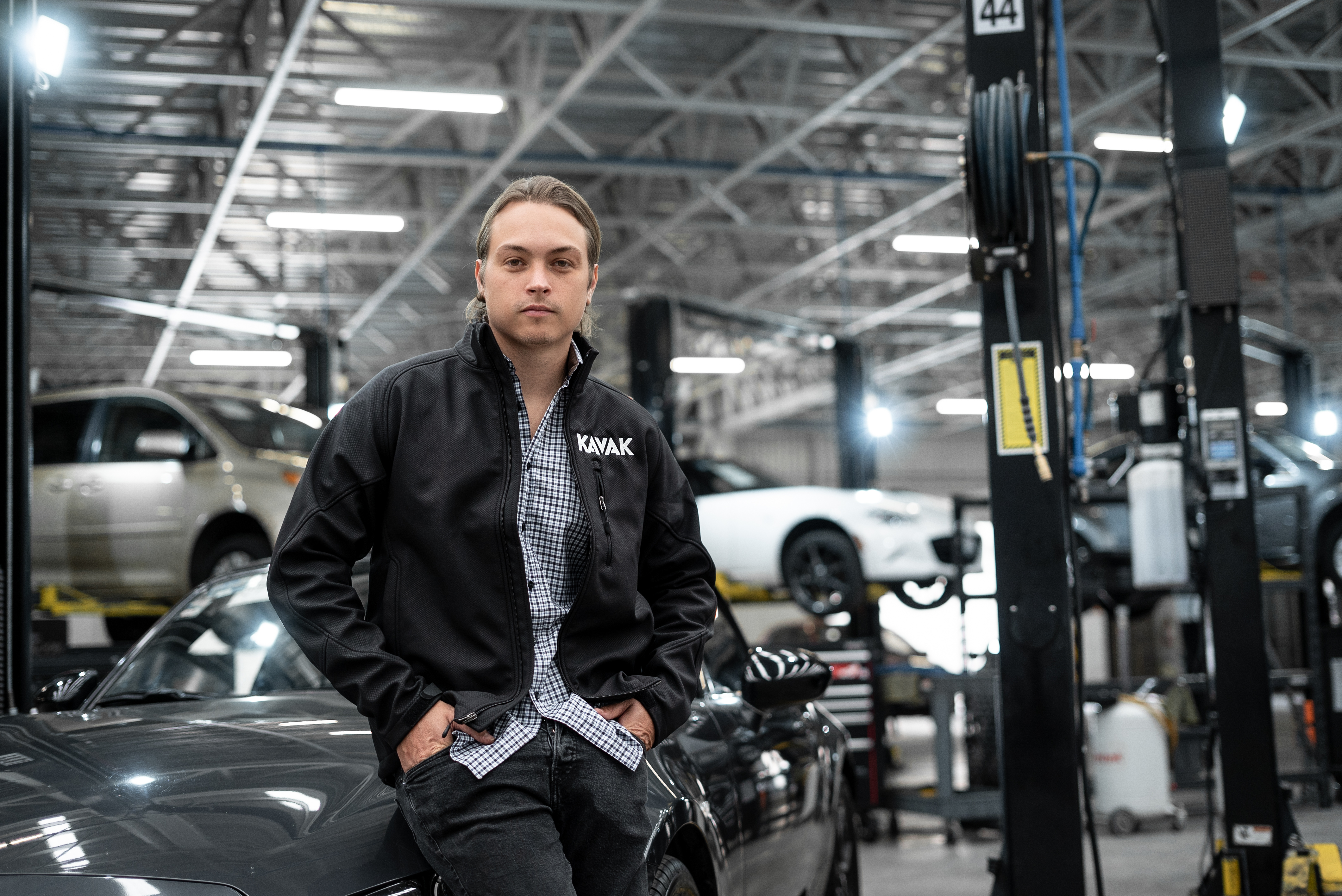
That helps explain why the most revealing picture of García Ottati is a workshop photograph. The setting contains the argument: real cars, equipment, and the space required to bring them into saleable condition. Software can coordinate this work. It still needs the work to happen.
The valuation climbs. The obligations follow.
In 2020, Kavak became Mexico’s first technology unicorn. By April 2021, its valuation had reached $4 billion. The speed was striking, and it made García Ottati a conspicuous figure in a region attracting new attention from technology investors.
A valuation gives an enterprise a number that fits in a headline. The customer’s experience resists such convenient compression. One buyer cares whether a repair has been completed; another needs a document; another wants someone to answer. Their expectations continue after the funding announcement has slipped out of the news.
By November 2022, García Ottati was telling employees that Kavak had cut spending and reduced its team. Rising rates and a difficult economic outlook had changed the conditions for growth. His message included an acknowledgement that customers found it hard to reach the company and that initial responses were inefficient.
“We now need to focus on doing fewer better things.”
Carlos García Ottati, November 2022 employee message
That sentence makes an instructive companion to the earlier ambition. Fewer things mean choosing among possibilities. Better things mean judging an operation by what it delivers. For a founder accustomed to imagining a much larger future, such a change asks for a different use of imagination.
It also puts his founding premise under scrutiny. Kavak had offered to reduce uncertainty in used-car buying. Difficulty getting an answer from Kavak would introduce uncertainty of its own. The obligation to be reachable was part of the product, as surely as inspection or financing.
A smaller number on the price tag
The correction became visible in financing, too. Kavak’s 2021 Series E had valued it at $8.7 billion. A 2025 round put the value at $2.2 billion. García Ottati described that insider round as a way to strengthen the balance sheet and support the lending business.
Reported private funding-round valuations, in US dollars. Historical snapshots of Kavak, not García Ottati’s personal wealth.
The arithmetic is severe. Yet an investor’s price for a company and a customer’s reason for buying from it remain different questions. A lower valuation does not repair a vehicle or settle a complaint. It changes the financial setting in which management must do those things.
For García Ottati, this period makes the biography more revealing. Growth had tested his capacity to expand. Retrenchment tested his capacity to allocate resources, accept constraints, and keep an existing promise working. The latter rarely produces as cheerful a photograph.
There is an ordinary discipline hidden inside that financial drama: choose which work matters, fund it, and see whether it gets done. A used-car company makes the consequences unusually tangible. The unsold stock and unanswered customer cannot be wished into a more flattering narrative.
The old robot memo gets another chance
García Ottati was already thinking about automation in 2017, when he sent his executive team a memo proposing robot hires. By 2026, Kavak’s AI effort had become central to its investment case. The proposed uses included pricing and lending workflows, inside an operation that still moves physical vehicles.
In a February 2026 discussion with Angela Strange and Gabriel Vasquez, he described a shift from tools assisting employees to agents doing work themselves. The conversation presented agents as handling 90 to 95 percent of customer interactions. That figure describes the company’s account of its implementation; it does not tell us whether every interaction ended well.
The distinction matters to his story. Automation can make a response faster, but the promise involves the result. A buyer waiting for a practical resolution measures the company in a different unit from the team measuring software adoption. García Ottati’s ambition requires those units eventually to agree.
His latest public thinking also returns to how founders interpret setbacks. In his March 2026 return to Cracks, he discussed revisiting the past while building the next stage of the company. The arc had acquired enough reversals to make that a useful subject, rather than a decorative business maxim.
The next promise is deliberately unfinished
In February 2026, Kavak announced a $300 million Series F led by Andreessen Horowitz. The company reported that December 2025 had been its first full month of consolidated global profitability. Those are meaningful developments after the cuts and repricing, with different implications: fresh capital creates room to act; an operating milestone offers evidence about what has changed.
García Ottati’s accompanying employee letter concentrated on execution. He reported almost 120,000 transactions in 2025 and faster inventory rotation, alongside work on data, pricing, and understanding customers. He also made clear that profitability needed to become consistent. One month is a beginning with a calendar attached.
His longer ambition remains access to car ownership and the opportunities a vehicle can provide. That connects the financing operation to the original troublesome transaction. A car must be attainable, the purchase must work, and the relationship must survive a problem after delivery.
García Ottati started with the desire to finish a sale and move on. He ended up building a business whose promises keep returning: with the next vehicle, the next payment, the next person needing an answer. The attractive part of his idea is still its plainness. Buying a used car ought to be an ordinary transaction. Making it ordinary has given him a very complicated career.