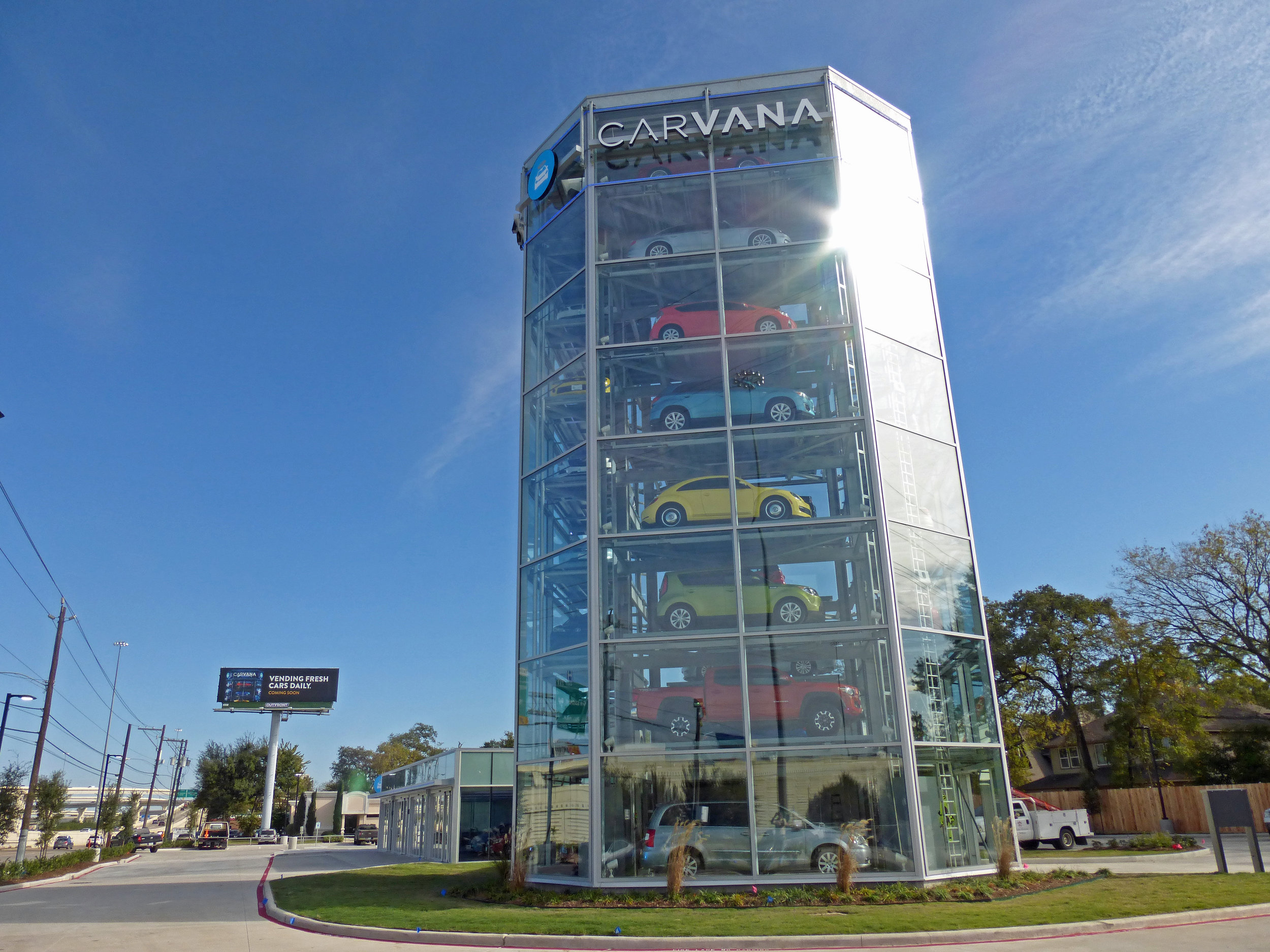
A car in a glass tower is an odd answer to an old complaint. People dislike buying cars. They dislike the bargaining, the waiting, the feeling that someone across the desk understands the transaction better than they do. Carvana gave that complaint a wonderfully literal monument: a vending machine large enough to dispense a vehicle.
But watch where the car goes before it reaches the glass. Someone has bought it, inspected it, repaired it, photographed it and transported it. Someone may have arranged its financing. The tower is the visible end of an industrial process. Understanding Carvana means following the car backward.
- The promise: choose, finance and buy a car online, without bargaining.
- The collision: a $2.2 billion acquisition met a slowing market in 2022.
- The recovery: cut costs, improve each transaction, then grow again.
01 / The lot leaves the lot
Ernie Garcia, Ben Huston and Ryan Keeton founded Carvana in 2012. Its first market was Atlanta, in January 2013. Garcia had worked at DriveTime; this was a company with roots in the actual business of selling cars. The innovation was rearranging that business around a customer sitting at a computer.
Buyers could search inventory beyond their neighborhood, examine photographs and arrange a purchase without negotiating. Today, they can also sell or trade a vehicle and arrange delivery or pickup. CarMax, local dealers and private sellers remain alternatives. Carvana’s particular proposition combines online shopping with control over much of the physical journey.
02 / The $2.2 billion collision
In May 2022, Carvana bought ADESA’s U.S. physical auction business for $2.2 billion. The purchase brought 56 locations and more than 4,000 acres. For an internet retailer, that is a revealing shopping list. Cars occupy space. Fixing and moving them require more space.
The timing was punishing. Used-car demand weakened while elevated acquisition costs left the business exposed. On the day the acquisition closed, Carvana announced roughly 2,500 job cuts. Another round followed later that year. Approximately 4,000 workers lost their jobs in 2022.
The early warning was a mismatch between the organization’s capacity and the sales it could produce. In its May announcement, the company described restoring balance between staffing and volume. An expansion strategy had run into arithmetic. Facilities and payroll still cost money when fewer customers complete a purchase.
03 / Fewer cars. Better arithmetic.
Carvana’s response was to put efficiency ahead of expansion. In 2023, retail unit sales fell 24%, to 312,847. Selling fewer cars looks peculiar on a recovery chart. Yet it accompanied reductions in inventory and spending and improvements in gross profit per unit.
Creditors supplied breathing room too. A July 2023 agreement proposed cutting outstanding debt by more than $1.2 billion and reducing required cash interest by over $430 million annually for two years. New secured notes put assets behind the agreement. Financial flexibility came with obligations.
First the retreat. Then the return.
The trade-off is worth keeping in view. A debt agreement can buy time for operational improvements; it cannot inspect a car or schedule a truck. The recovery required both financial room and a functioning service customers would continue to choose.
By 2025, retail sales reached 596,641 vehicles and revenue reached $20.322 billion. In the second quarter of 2026 alone, Carvana sold 197,325 vehicles. These are different reporting periods, but together they show the scale of the recovery. The smaller 2023 business had become a platform for renewed growth.
“We built an experience customers love”Ernie Garcia · July 2026 results
04 / The loan travels too
There is another business inside the checkout. Carvana originates vehicle loans and generally sells those receivables to financing partners or through securitizations. It also earns commissions on optional protection products. ADESA supplies wholesale auctions. A retail sale can therefore generate several kinds of revenue.
A dealer who buys a car badly cannot redesign the website to recover the difference. A transporter that travels with empty spaces still burns fuel. At Carvana’s scale, small mistakes repeated across thousands of transactions matter. Its advantage depends on making these ordinary decisions consistently, across departments that customers rarely see.
This helps explain both the attraction and the exposure. Carvana’s expertise spans vehicle pricing, credit, reconditioning and transport. A pleasing interface cannot compensate for paying too much for inventory, expensive borrowing or poor execution. The model needs working capital, reliable funding channels and enough throughput to support its network.

05 / Seven days to make it yours
For the buyer, the useful question is practical: what happens if the car feels wrong? Carvana offers a seven-day return policy. Its used cars also carry a limited warranty lasting 100 days or 4,189 miles, whichever comes first. The company describes its 150-point inspection as a snapshot of condition; mechanical problems can still emerge.
Notify Carvana before 8 p.m. EST on day seven. Driving beyond 400 miles costs $1 per additional mile on a return. Vehicle condition restrictions apply.
Shipping deserves particular attention. Carvana distinguishes the charge for moving a car into your area from a delivery charge. Shipping is nonrefundable under its stated policy, even on a return; delivery charges are refundable within the guarantee. Buyers who need to inspect before committing, negotiate a price or avoid transport costs may prefer a local transaction.
A sensible buying routine follows from those terms: compare the total price, check the delivery arrangements and use the return period deliberately. Read the vehicle history and warranty exclusions. The convenience is real, but the customer still has a job: deciding whether this particular used car fits everyday life.
06 / Back to the repair bay
In October 2026, Carvana announced plans to add reconditioning capabilities at ADESA Orlando, in Sanford, and expanded same-day delivery to eligible Jacksonville customers. Faster service still depends on local inventory and logistics. Its recruiting pages accordingly advertise work in transport, inspection, customer care and technology.
That mix of jobs also complicates the company’s cheerful recruiting voice. Carvana advertises teamwork, parental leave and tuition reimbursement. Those promises sit alongside the memory of substantial layoffs. The culture has to accommodate both a customer-facing service business and the discipline of running a physical network.
The lesson other businesses can copy is the sequence: identify what makes customers hesitate, build a concrete way around it, and measure the cost of keeping that promise. Carvana made buying feel simpler by taking on more coordination itself. Every easy checkout leaves somebody with the complicated work.