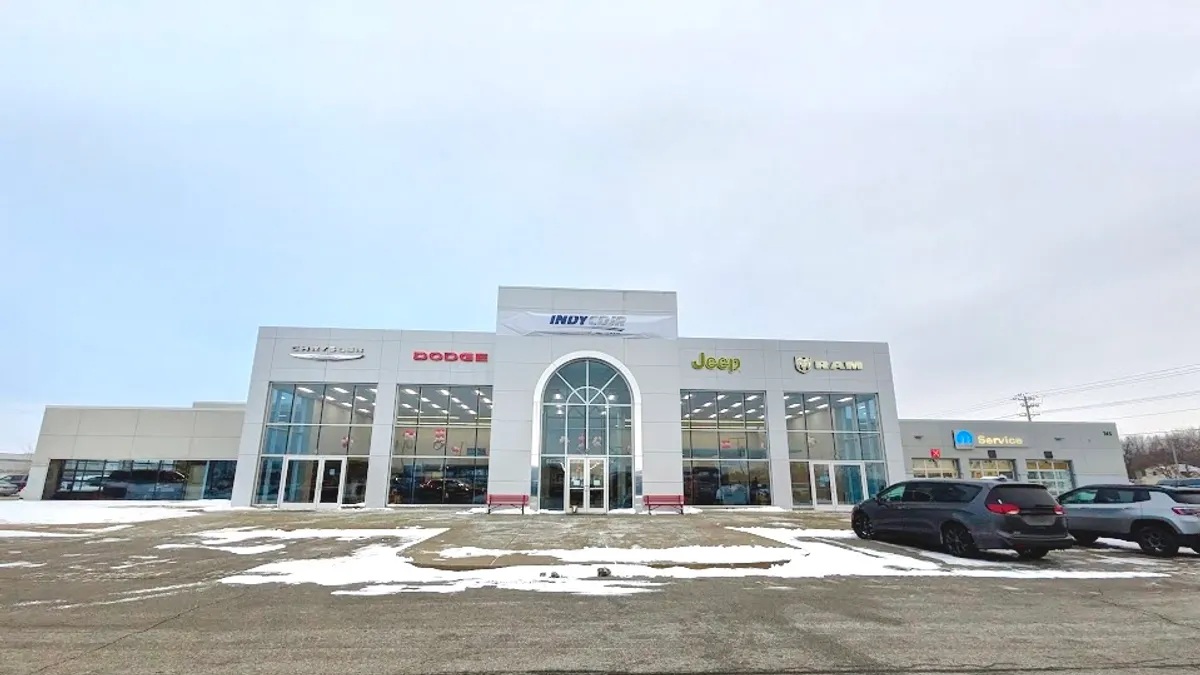
In 2017, Bill Estes had a very physical answer to the question of where car retail was going: a 41,000-square-foot building on ten acres in Brownsburg. The Chrysler Dodge Jeep Ram franchise had been in Lebanon. Chrysler wanted it closer to Indianapolis. Estes already knew Brownsburg through his Ford dealership. The new location followed the rooftops.
- A central Indiana dealership name dating to 1976, acquired by Asbury in 2019.
- Today’s group directory lists Ford in Brownsburg and Toyota in Indianapolis.
- Clicklane connects online buying with trade-ins, financing and local vehicle service.
There is something pleasingly concrete about that decision. A manufacturer had a requirement. A dealer knew a neighborhood. A corner was available. Two years after buying the franchise, Estes opened the new facility. “We’re pleased to be in the right location,” he said at the time. For a car dealer, geography was part of the product.
A showroom follows the rooftops
The business began in 1976 with Chevrolet in Indianapolis. By the time of the Brownsburg opening, the family name covered several dealerships. His son Zak was a vice president; his daughter Cali worked in events and social media. Expansion had put family members into different parts of the same enterprise.
That year also supplied a smaller, more revealing number. At a Ford Drive 4 UR School event, more than 600 drivers helped raise over $21,000 for the Brownsburg Education Foundation. Bill Estes Ford partnered with the foundation; local businesses supported the effort. Test drives became money for scholarships and classroom grants. A dealership had found a reason for people to visit beyond needing another car.
Raised at the 2017 Brownsburg education fundraiser, with more than 600 drivers.
The name stays. The owner changes.
Then the ownership changed. Asbury Automotive Group acquired the Bill Estes group in 2019. S&P Capital IQ reported an agreement value of $121 million. That figure describes the reported acquisition agreement, rather than a startup funding round. The founder’s name continued on dealerships within a publicly traded automotive retailer.
The distinction matters. A familiar sign can suggest continuity even when the organization behind it has changed. Customers encounter the local dealership; ownership sits within a larger system. Both facts belong in the picture. Calling the business family-owned today would erase the transaction that changed its structure.
Scale did not protect the stores from the pandemic. In April 2020, Asbury furloughed employees across its Indianapolis-area operations after a sharp decline in sales and service. The reported locations included five Bill Estes dealerships. Showrooms and service departments depended on demand that could disappear quickly, whatever name appeared above the door.
The portfolio kept changing. A business response on the Lebanon dealership’s BBB record dates Asbury’s divestiture there to November 2025. In February 2026, Matt Bowers bought the former Bill Estes Chrysler Dodge Jeep Ram store and renamed it Indy CDJR. The building that illustrated expansion in 2017 now illustrates a change of ownership.
The showroom moves into the browser
Today, the group’s dealership directory lists Bill Estes Ford in Brownsburg and Bill Estes Toyota in Indianapolis. Its customers include households shopping for new or used vehicles, owners booking maintenance, and businesses seeking commercial vehicles. Ford’s team directory even identifies a commercial accounts manager. Different customers arrive with different problems; the dealership assembles the vehicle, paperwork and support around them.
Clicklane moves much of that assembly online. Buyers can view pricing, obtain a trade offer, compare lenders and adjust a payment by changing the term or down payment. They can upload documents, sign online and arrange delivery, or finish at the dealership. Someone selling a car can request an offer without buying a replacement.
- 01Choose
a vehicle - 02Value
the trade - 03Set terms
and sign - 04Arrange
delivery
The practical benefit is control over the sequence. A buyer can examine financing choices before sitting at a desk. A seller can separate disposing of an old car from choosing another. The digital channel addresses the coordination problem surrounding the vehicle, while the local operation handles the car itself.
The return policy deserves equal attention. Clicklane advertises seven days or 1,000 miles, whichever comes first, for online transactions. Customers bear the expense of returning the vehicle. A trade-in may already have been sold; the terms provide for payment of its agreed allowance if it cannot be returned. The promise has boundaries a buyer can actually read.
The service bay is still the point
There is useful expertise behind that physical operation. The group advertises factory-trained technicians and diagnostic equipment, while its navigation separates service appointments, parts and recall information. A customer can shop a certified pre-owned vehicle or bring an existing car back for maintenance. Those are different moments in ownership, often years apart. Keeping them within the same dealership relationship gives the retailer more opportunities to do business, and the owner a place to return with questions.
The underlying business remains automotive retail. Revenue comes from selling vehicles, servicing them and supplying parts, alongside related ownership products. Asbury describes arranging financing through third-party lenders and selling finance and insurance products. Clicklane changes how the transaction happens. It does not turn the dealership into a software subscription company.
Against another Ford or Toyota dealer, the factory badge alone offers little distinction. Bill Estes Toyota’s own brand statement says “price is the enemy of unique.” Its proposed answer is attentive, friendly interaction. The useful test for a customer is whether the staff explain a trade valuation, a repair recommendation or a payment clearly enough to make a decision.
“Price is the enemy of unique.”
Bill Estes Toyota · The Estes Way
What another retailer can borrow
The transferable idea is to connect the handoffs. Put pricing, trade details, financing and documents within reach before the visit. Keep a physical operation capable of helping afterward. That is an editorial reading of the model, and a useful standard for evaluating it.
It works only if the handoffs hold together. Delivery needs an agreed destination; financing needs approval; a return needs transport. For shoppers, the sensible move is to compare the complete deal and confirm the current store. A name can carry fifty years of recognition. The next transaction still has to earn its place.