Douglas Campbell’s first car sale has survived as a photograph. He is sitting at a small table at Coral Springs Oldsmobile, dressed for business, with vehicles close enough to furnish the room. It is an ordinary dealership scene with an unusually long afterlife. The young salesman would eventually run a public company whose customers needed both a car and a way to pay for it.
His father had encouraged him to try selling. Getting comfortable with rejection was part of the assignment. Decades later, Campbell’s career would encompass dealerships, rental fleets, online vehicle sales and consumer financing. The common subject was the car; the questions around it kept changing.
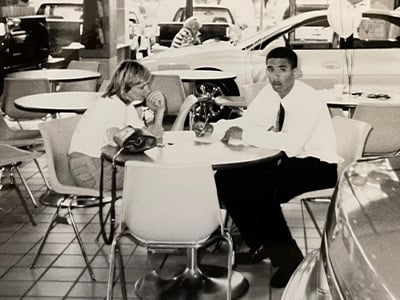
A brown Porsche, before the balance sheets
Campbell spent much of his childhood outside the United States. His father, Douglas Sr., served in the U.S. Army in Europe, principally Germany, and cars supplied a shared language. Weekends involved an auto club, cones, tires and the practical jobs that keep a race meeting moving.
One family vehicle was a dark-brown 1982 Porsche 911 Targa. Campbell remembered driving it at Hockenheim and objecting to its color. His father’s defense was economic: he had secured a good deal. An automotive education apparently includes learning that the buyer and the spectator may reach different conclusions.
The connection continued across distance. Father and son described watching Formula 1 while talking by phone. Campbell’s favorite cars became Corvettes. The larger inheritance was an interest in how people work together around a machine, and the habit of treating a setback as something to work through.

The promotion hidden in a problem
Campbell has told a less picturesque story about 2008. He received a paycheck showing zero dollars and took it to his boss. The boss said he would be paid, then asked for a plan to help the dealership business survive. Campbell developed a consolidation proposal, with advice from an investment banker to make the numbers tell the story. The owners approved it.
That episode changes the meaning of advancement. Selling well establishes one kind of usefulness. Working out how an organization can continue operating establishes another. A manager can know the showroom intimately and still have to learn how to explain the business to its owners.
Campbell later spoke about continuing to seek counsel from other chief executives. At the 2024 Automotive Remarketing Alliance Summer Roundtable, he received the organization’s Circle of Excellence Award. His advice to the room included a short assignment: “Your career is solely your responsibility.”
He had already spent years accepting broader assignments. His next moves would take him from individual dealerships into organizations where the number of vehicles, the variety of sales channels and the cost of holding inventory made each decision travel further.
Learning the business from several directions
Campbell spent 15 years at Coral Springs Auto Mall, eventually serving as executive general manager. It was an apprenticeship in several brands and in both new and used vehicles. The distinction matters. A used vehicle arrives with a history, and a retailer must decide what that history means for its next owner and its own margin.
At AutoNation, where he worked from September 2014 to March 2018, his responsibilities included Used Vehicle Director for the Eastern Region and later general manager of Honda Dulles. Those jobs placed him in both the corporate office and the field. A decision that looks tidy across a region still has to work at a particular dealership on a particular afternoon.
Avis Budget Group added another perspective. Campbell became vice president of remarketing for the Americas in 2018, then head of fleet services in 2021 and senior vice president in 2022. At a rental company, selling vehicles is part of managing the cost of the fleet. The purchase and the eventual disposal belong to the same calculation.
He led growth in direct sales to consumers and a redevelopment of a business-to-business online sales platform. Those initiatives helped reduce overall fleet costs. They also involved different kinds of buyers: the person seeking a car and the business buying inventory. Understanding both sides would be relevant when he returned to retail leadership.
The sequence of jobs is useful for understanding the decisions now on his desk. A retailer wants a vehicle that can find its next buyer. A fleet manager must consider what ownership costs before that sale. A lender must consider the payments that follow it. In Campbell’s case, those perspectives came from distinct employers and assignments. They offer a way to read his career without treating the chief executive title as an explanation in itself. The title describes his authority. The earlier jobs explain the kinds of questions he has spent years learning to ask.
- DEALERSHIPSCoral Springs Auto Mall15 years; ultimately executive general manager
- 2014-2018AutoNationRegional used vehicles and dealership management
- 2018-2022Avis Budget GroupRemarketing, then fleet services for the Americas
- 2022 / 2023America’s Car-MartPresident, then president and CEO
The customer leaves. The relationship stays.
Campbell joined America’s Car-Mart as president in October 2022, taking responsibility for operations and procurement. His introduction emphasized the enthusiasm he had encountered for employees and customers. He had studied business administration and management at the University of North Florida; by this point, he also brought a quarter-century of automotive experience.
Asked about his hopes for the company, he emphasized growth. The attraction, as he described it, was the chance to expand while preserving a culture that employees valued. It was an ambition with an operating condition attached: expansion had to carry the organization’s relationships along with it.
“To lead people, you have to lead with people.”
Douglas Campbell, on joining Car-Mart in 2022
On October 1, 2023, he succeeded Jeff Williams as chief executive and joined the board, retaining the presidency. Williams stayed through the transition as CEO emeritus. Campbell inherited a business with more than four decades of history and a model in which selling and lending were closely connected.
Car-Mart’s dealerships primarily served smaller communities in the South-Central United States. The company supplied financing for substantially all its customers. Consequently, a sale created a responsibility that continued long after the keys changed hands. The vehicle had to suit the customer; the loan had to perform; the business had to finance its own side of the arrangement.
Illustration of the business model. Sales, customer payments and company funding run on different schedules.
The unglamorous work of changing a company
His first shareholder letter as CEO, dated July 2024, described a choice with an immediate commercial cost. Car-Mart had tightened lending standards while trying to keep existing customers in their vehicles. Campbell acknowledged the effect on unit sales and defended the emphasis on underwriting.
The letter also set out work on enterprise software, customer relationship systems and a new loan origination system. These are rarely the subjects of an automotive daydream. Yet in a retailer that also lends, the ability to assess an application and manage an account can be as consequential as finding a vehicle at the right price.
By 2025, Campbell was describing risk-based pricing, a new scoring model and Pay Your Way, a payment platform deployed across the network that June. He also outlined plans for collections technology. The projects sought to make a relationship built around a local store easier to manage across a larger organization.
He recruited experienced executives, including Jamie Fischer as chief operating officer in October 2024 and Jonathan Collins as chief financial officer in May 2025. Collins arrived with international finance experience from Walmart. Campbell’s task increasingly involved building a management team able to handle the complexity of a retailer and lender together.
The ambitions were specific: improve store productivity, modernize customer payments and make better lending decisions. Their significance lies in the connection between them. A smoother sale helps little if the financing behind it cannot be sustained. A better system still needs the resources to put cars in front of customers.
When the money determines the pace
The 2026 results brought that dependence into view. Car-Mart reported fiscal-year revenue of $1.2815 billion, down 7.9%, and 48,891 retail vehicles sold, down 14.3%. The company had closed a $300 million term loan in October 2025, but obtaining additional financing remained unresolved.
Store consolidations reduced the network. Customer accounts moved to nearby dealerships or to a centralized collections team. Campbell acknowledged the effect on employees and described severance and help finding other work. His July commentary also addressed the going-concern disclosure accompanying the annual filing. The business had reached a point where its funding problem shaped its daily operating choices.
Less inventory. Fewer retail sales.
Quarter ended July 31, 2026, versus a year earlier
Inventory bars compare quarter-end balances. Sales bars compare quarterly retail unit volume. Each pair has its own baseline.
In the quarter ended July 31, 2026, retail sales fell to 2,450 vehicles and revenue to $145.8 million. Inventory stood at $35.2 million, compared with $112.5 million a year earlier. Campbell linked the contraction to limited capacity to buy vehicles and fund loans. Credit performance also weakened.
His stated first priority was resolving the capital structure, while a special committee considered financing and strategic alternatives. These figures belong to a dated quarter, rather than a prediction of what happens next. They show the pressure under which he was working and the distance between a plan for growth and the money required to execute it.
A different kind of road test
Campbell’s career offers no tidy division between the person who likes cars and the executive who studies their economics. The same working life contains a family photograph, a dealership desk, the management of rental-fleet costs and a public company’s funding negotiations. Each stage asks him to understand a different part of the transaction.
The early photograph is appealing because the scale is comprehensible: one salesman, one table, one customer. The chief executive’s work is harder to fit into a frame. It includes customers paying over time, employees adjusting to closed stores and lenders deciding what they will support. His next achievement will have to work for people who never appear in the family album.
Follow the road from here
Read and listen to Campbell in his own professional setting.