The difficult thing about a used car is that it can look perfectly innocent. The paint shines. The seats smell recently cleaned. The seller knows where it has been; the buyer is trying to guess. Between those two people sits a price, and a question: who will answer if the guess is wrong?
- Spinny buys the cars it sells, taking control of inspection and refurbishment.
- Fixed prices, test drives and conditional returns make the decision less intimidating.
- Owning the promise means paying for stock, workshops and after-sales support.
Spinny began in Delhi NCR in 2015 with that imbalance in mind. In an early first-person account, co-founder Niraj Singh described friends visiting dealer after dealer, finding a car, then still doubting its quality. His colleagues included Ramanshu Mahaur, Mohit Gupta and Ganesh Pawar. Their problem was bigger than finding available vehicles. Buyers needed to believe what they were buying.
01 / The matchmaker buys the stock
The original business was a managed marketplace. That sounds sensible: arrange the transaction, improve the information and leave the expensive metal with someone else. But a platform can make introductions without controlling what happens inside the engine. For Spinny, the gap between presenting a car and answering for it became the central problem.
In early 2017, the company adopted a full-stack model. It bought vehicles, held inventory and sold directly to consumers. The change was financial as well as philosophical. A car waiting for a buyer now tied up Spinny’s money. Refurbishment became its work. A bad purchasing decision could sit in its own parking lot.
“If you’re not owning the value chain, you cannot control the quality”
NIRAJ SINGH / AUTOCAR INDIA INTERVIEW, 2023
The financing conversation changed too. In a later podcast with Accel’s Anand Daniel, Singh discussed pursuing the full-stack model after new investors withdrew a term sheet. Better accountability required a business that some investors found less attractive. The useful lesson is specific: identify the customer promise that depends on someone else’s behaviour, then decide whether controlling it is worth the added cost.
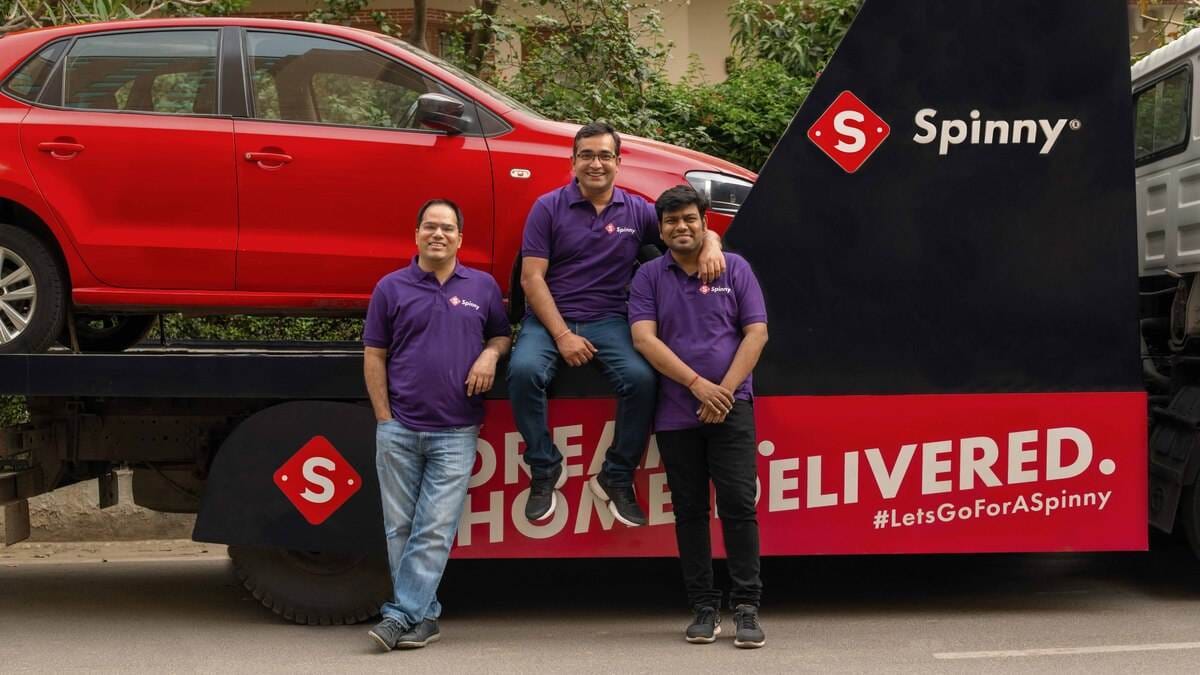
The website is the shop window. The operation runs all the way through.
02 / A first car, without the contest
Consider the buyer Spinny is trying to reassure. According to its 2024 customer report, 76% were buying their first car. The average customer was 32. Hatchbacks remained the most popular category, with the Renault Kwid, Hyundai Grand i10 and Maruti Suzuki Swift among the favourites. These are purchases made by people who may know their budget better than their way around a gearbox.
The practical journey starts online. A buyer searches available cars, compares their details and books a test drive at a hub or, where available, at home. Spinny handles documentation and delivery; financing can sit inside the same process. Sellers can request a valuation and evaluation instead of organising a succession of strangers to inspect their car.
Spinny Assured puts several promises around the transaction: a 200-point inspection, fixed pricing, a five-day money-back window and warranty coverage. The fixed price removes the little theatre of pretending to walk away. It also means a determined negotiator cannot bargain that particular car down. The advantage is a predictable process; the price still needs comparing.
Return eligibility includes a mileage ceiling and condition rules. Damage, accidents or external repair work can disqualify a car.
The warranty deserves the same attention. The Assured page distinguishes comprehensive coverage for 90 days or 3,000 kilometres from powertrain coverage for 365 days or 12,000 kilometres, whichever comes first. That distinction matters more than the comforting phrase “one-year warranty.” A buyer should examine the report, drive the car and understand the exclusions before paying.
Car finance solves a different obstacle: the gap between an affordable monthly payment and the cash needed today. Spinny’s loan page offers eligibility checks and an EMI calculator through finance partners. Approval and interest depend on the borrower. The useful comparison is the total repayment plus fees, alongside the vehicle price, rather than the monthly number alone.
03 / The bill behind the reassurance
Economically, Spinny is a retailer. It must buy a vehicle at a price that leaves room for restoration, logistics, carrying costs and support after resale. Its expertise lives in evaluation and pricing, but also in the unglamorous choreography of workshops, documents and deliveries. Software helps coordinate the work; someone still has to inspect the brakes.
Its FY25 results show the tension. Operating revenue reached ₹4,657 crore, while the reported net loss was approximately ₹424 crore. Revenue grew and losses narrowed, but the machinery had not yet produced a net profit. More sales help only if the purchase price, restoration bill and time spent waiting for a buyer leave enough room.
CARS24, CarDekho, CarTrade, local dealers and direct sellers offer alternatives with different combinations of inventory, information and service. Spinny’s case rests on accepting responsibility across the transaction. That is attractive to a buyer who values convenience. It is harder to justify for someone who wants maximum bargaining freedom, has a trusted mechanic and can manage the paperwork independently.
04 / The next unknown is in the battery
Expansion brings new versions of the original problem. In August 2026, Spinny’s partnerships with Nissan and Tesla covered exchanges, while its JSW MG Motor India programme included battery-health assessment for pre-owned EVs. An electric car asks the buyer another question: what condition is the expensive component they cannot see?
In September 2026, operator Valuedrive Technologies confidentially filed draft IPO papers with SEBI. A filing is a step toward a possible listing, with the offering still subject to the process ahead. Spinny’s next test follows its first one: whether making the buyer more comfortable can pay for everything the seller has agreed to carry.