Asked what he would take to a deserted island, Niraj Singh hesitated, then chose his car. “I would take my car!” he said. It is a splendidly impractical packing decision. The island would presumably need roads, fuel and somewhere worth driving to. But the answer says something useful about the founder of Spinny: he regards a car as personal space, a small territory you can close a door around.
That attachment makes his business more intelligible. A used car is an old possession for its seller and a new chapter for its buyer. The same hatchback can represent an upgrade on one side of the transaction and a first taste of independence on the other. Singh has built his career around the space between those two descriptions.
His company buys, prepares and sells pre-owned cars in India. Its central decision was to own inventory and accept the work that came with it. Before there was a confidential IPO filing or a roster of institutional investors, Singh had to decide whether a promise about quality was worth making expensive. The answer took him into parking lots, refurbishment and personal financial risk.
The dictionary beside the textbook
Singh grew up in Daltonganj, Jharkhand. His route into engineering included studying with a Hindi-to-English dictionary alongside his textbooks. The detail deserves more attention than the familiar shorthand of “IIT graduate.” A textbook already asks a student to learn something difficult. A dictionary beside it adds a second task: establish what the sentence means before tackling what it explains.
He first entered IIT Roorkee in 2002 to study architecture. A year later, he took the entrance examination again, secretly, to change courses. He moved to IIT Delhi and studied electrical engineering from 2003 to 2007. Leaving an IIT place to pursue another course was an early instance of choosing a different route after already securing a respectable one.
There is no need to turn that choice into a prophecy. He was a student changing direction. Still, it is an unusually concrete beginning for a founder whose later career would involve rebuilding a business after it had started operating. Twice, the credential or the existing structure proved less persuasive than the question of whether he wanted to continue inside it.
Two companies before the car keys
Entrepreneurship began for Singh in the period after college, before the Indian startup vocabulary had become everyday conversation. In a later interview, he recalled not knowing what venture capital was when he began. Family, friends and well-wishers pushed back against choosing a business over a job. The objection had ordinary logic behind it: a degree offered a route to stability, while a company offered no such assurance.
His first venture was Locus Education. His second, TechMonkey, worked in internet media, including local-language content. Both closed. By the time he was considering Spinny, he had spent years working without a durable business to show for them. His account of that period includes uncertainty about what to do next, alongside a refusal to abandon entrepreneurship.
He also became an investor. As a founding partner of Outbox Ventures, he backed early businesses; Spinny’s own account names Tripoto, Shaadisaga and JustRide among his investments. An August 2015 report described him supporting startups founded by fellow IIT alumni. He occupied both sides of the table: asking what made another founder’s idea credible while searching for an idea he could carry himself.
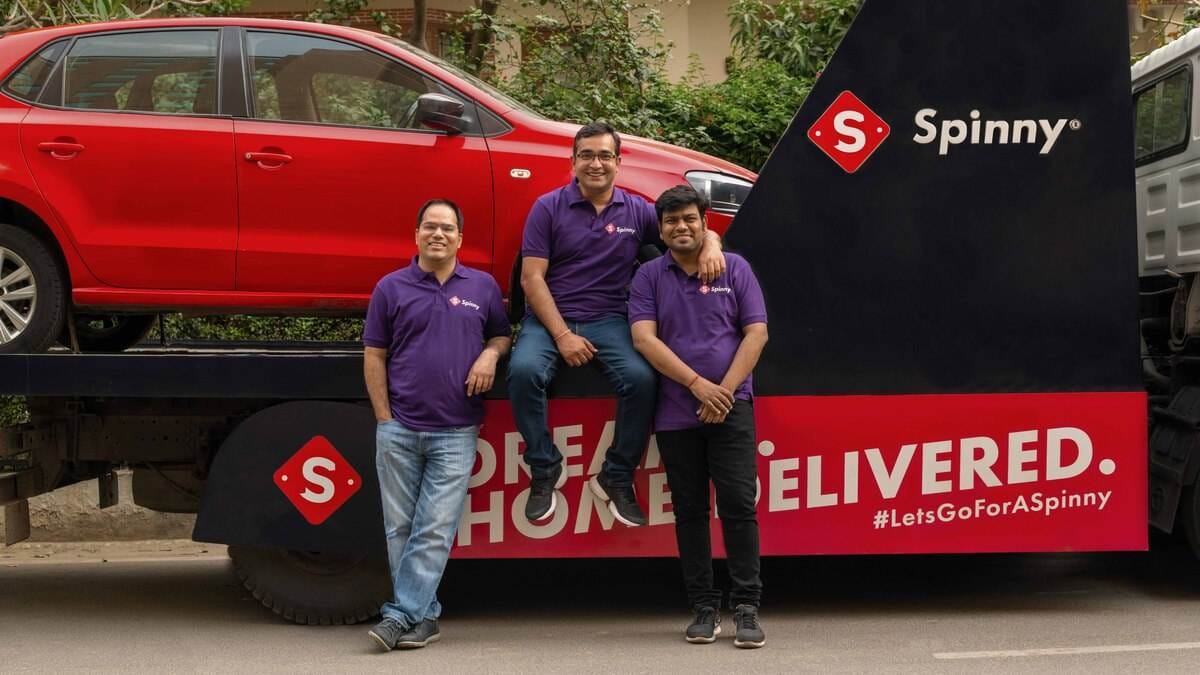
Founding and investing have different comforts. An investor can spread attention across several possibilities. A founder eventually has to pick a problem and remain answerable to it. In 2015, Singh chose used cars, joining Ramanshu Mahaur and Mohit Gupta to start Spinny. Mahaur brought a technology background and experience at Adobe. Gupta came from Flipkart and took on operations. This was a business that would need both.
Ten spaces, one uncomfortable answer
The market already had companies, dealers and websites. Finding a listing was only one part of buying a car. Understanding its condition, believing the price and deciding who would answer for it were separate problems. Spinny’s early account of its purpose focused on unequal information, uncertain quality and the inconvenience of the transaction. Those are awkward problems to fix through a prettier screen.
The first business model left Spinny without sufficient control over the cars at the centre of its promise. Singh and his team tested another approach in a corner of a parking lot, using ten car slots. The small pilot gave them evidence for changing the business. They moved to an inventory-owning model, rebuilding the operation around vehicles they could actually control.
The switch cost them a signed investment term sheet. Singh funded the change by mortgaging his house. A test involving ten parking spaces had led to a decision reaching well beyond the parking lot. This is the part of the story that makes the later funding announcements feel less abstract: before investors priced the company, its founder had put a personal asset behind its method.
The attraction of the experiment was its scale. Ten slots were enough to ask whether direct responsibility changed the experience. They were too few to disguise a weak answer behind an impressive total. For anyone accustomed to measuring a young business by how quickly it grows, the episode offers a different question: what, exactly, is getting better as it grows?
A price tag without a performance
Singh’s view of the buyer is emotional, but his chosen response is operational. Spinny’s advertised approach has included a 200-point inspection, fixed pricing and a five-day money-back guarantee. Warranty benefits now vary by vehicle category. These are concrete terms a customer can examine, rather than an invitation to take a salesperson’s confidence on faith.
Fixed pricing removes one of car buying’s stranger examinations. Bargaining rewards a customer for knowing how much doubt to express, when to walk away and which price to disbelieve. Someone buying a first car may have none of those skills. A declared price lets that person spend more attention on the vehicle. It also requires the seller to stand behind the valuation before the conversation begins.
The inspection and return offer address different stages of uncertainty. A report helps before a purchase. A limited return window gives a buyer a way to reconsider afterwards, within the applicable terms. Neither abolishes the possibility of a problem. Together, they show how Singh has tried to translate the broad word “trust” into a sequence of decisions and obligations.
In 2024, he explained why owning cars mattered: it gave Spinny control over quality and accountability. The company reported that 73 percent of its demand in calendar 2023 came from first-time car buyers. That is a revealing customer mix. The person entering this market may be learning the language of finance, paperwork and inspection all at once. An experience that assumes expertise is asking the beginner to subsidise everyone else’s convenience.
- AcquireEvaluate the seller’s car
- PrepareInspect and refurbish
- RetailOffer a fixed price
- SupportApply return and warranty terms
The customer who has not sold yet
A car retailer needs a willing seller as well as an enthusiastic buyer. Singh has described supply as a particular challenge: sellers compare prospective purchasers because they want to maximise what they receive. Buyers, meanwhile, are trying to find the right car, with quality and accountability attached. The two sides are asking different questions about the same object.
His response connects price with speed and convenience. Spinny’s selling process starts with vehicle details and a valuation range, followed by inspection and a final offer. The attraction for a seller is being able to complete a complicated transaction with fewer moving parts. For the retailer, every promise on the buying side begins here, with deciding which cars to acquire.
This is why the business cannot live entirely on a phone. In his automotive interviews, Singh has discussed large retail spaces and end-to-end services under one roof. The online inventory gets someone interested; the actual car must survive a visit, a test drive and the questions that come with them. A digital business still has to make room for the customer who wants to open the bonnet.
Cars, cricket and the work after the advert
Spinny eventually attracted investors including ADQ and Tiger Global. Its $283 million round in 2021 valued it at about $1.8 billion. Sachin Tendulkar also became an investor. Cricket gave the brand a connection to a recognisable public figure; the business still had to earn recognition in a considerably less glamorous setting, when someone came back with a question after delivery.
In a 2022 interview about marketing, Singh placed word of mouth and continuing customer relationships alongside advertising. He described reducing advertising’s share of the budget and increasing integration of the product so that the experience did not break between steps. The aim makes commercial sense: an introduction purchased through an advert becomes more valuable if the customer later supplies an introduction of their own.
He extended the same thinking into luxury vehicles through Spinny Max. In 2023, he discussed buyers reaching premium brands through pre-owned cars and the need for skilled evaluation. A more expensive badge increases the consequences of a poor inspection. His argument for accessible luxury therefore depended on refurbishment, warranty support and clear information as much as on the purchase price.
For Singh, aspiration runs across price brackets. The first hatchback and the pre-owned luxury car serve different budgets, but each can be a purchase someone has imagined for years. His public conversations repeatedly return to respecting that feeling. The practical test is whether the company can maintain its standards when the emotional occasion has passed and the car is simply being used.
“I would take my car!”Niraj Singh, on packing for a deserted island, 2023
A new audience for the promise
In February 2026, Spinny closed a reported $160 million to $170 million financing led by Fidelity and Accel Leaders Fund. The transaction included $90 million in primary capital, with the balance involving existing shares. Separately, the competition regulator approved Fidelity Funds’ proposed acquisition of approximately 6.63 percent of Valuedrive Technologies, the Spinny group company.
By September, Valuedrive had confidentially filed draft papers for an Indian IPO. It was another change in the audience to whom Singh’s company would have to explain itself. A business that once had to persuade investors to back an inventory-owning model was moving towards scrutiny by public-market investors. The filing marked a step in that process; the everyday work of buying and selling cars continued underneath it.
Singh’s story has plenty of large numbers, but its memorable objects are modest: a dictionary, a second exam paper, ten parking spaces, a house pledged to keep a decision alive. They make a career built around responsibility easier to grasp than a valuation does. Each belongs to a moment when the next step required more than an appealing explanation.
Then there is the car he wanted to take to the deserted island. It is a funny answer because it is so personal, and a useful one because it brings him back into view. Behind the systems and financing sits someone who understands why a vehicle can matter beyond its resale value. Spinny’s continuing task is to make that understanding hold up when the customer turns the key.